
Lieferung heute & morgen

Qualitätsgarantie

Willkommens-Angebote freischalten: KOSTENLOSE Lieferung | Bis zu 80 % RABATT | Kostenlose 30-Tage-JoyPlus-Testphase
App herunterladen
Unclear accident details or a scratch on your parked car—situations like these are frustrating for any driver. A modern car camera can provide clarity by objectively documenting traffic events. Models with 4K resolution, in particular, promise highly detailed recordings. But what really matters when choosing one?
This article serves as your guide. We'll outline objective criteria for selecting a 4K dashcam and present a selection of models with different strengths to help you make an informed decision.
The market for car cameras is vast. To find the right device for your needs, you should take a closer look at a few key technical specifications and features.
Resolution is a key indicator of quality. A 4K resolution (3840 x 2160 pixels) offers four times the pixel density of Full HD, allowing you to clearly identify important details like license plates or road signs, even from a distance.
The built-in image sensor is just as important. High-quality sensors, such as the Sony STARVIS, are known for their excellent light sensitivity. This is the technical foundation for a good car night vision camera. A quality sensor ensures low-noise, clear recordings even at dusk or in poor weather conditions.
Modern dashcams often come equipped with useful extra features that enhance your vehicle's protection:
The use of dashcams is subject to legal regulations. Permanent, indiscriminate recording of public spaces is generally not permitted due to data protection laws (like GDPR). Modern dashcams solve this issue with loop recording: the camera records in short intervals and automatically overwrites the oldest files. Only when the G-sensor detects an incident (e.g., sudden braking or an impact) is the relevant video sequence saved as a write-protected file, making it available as potential evidence.
Here is a selection of models that stand out for their technical specifications and feature sets.
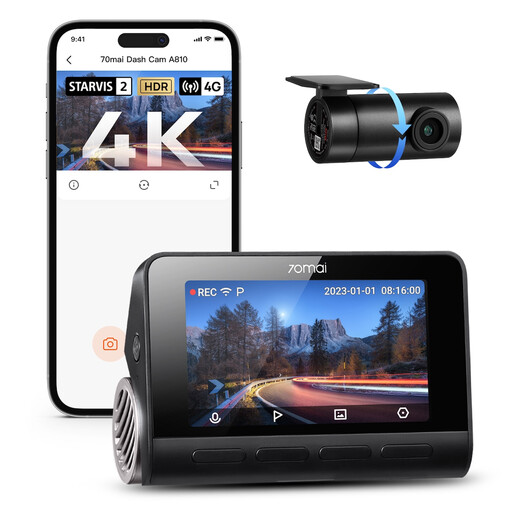
Why it stands out The 70mai A810-2 is a comprehensive front and rear system focused on high image quality. The Sony STARVIS 2 sensor in the front camera delivers true 4K recordings. According to the manufacturer, its MaiColor Vivid+ Solution optimises image processing for enhanced colour and detail accuracy. The combination of front and rear cameras with HDR (High Dynamic Range) technology ensures balanced exposure day and night.
Benefits
Who is it for? For drivers seeking a complete front and rear surveillance system with exceptional image quality and smart features like AI parking surveillance and GPS tracking.
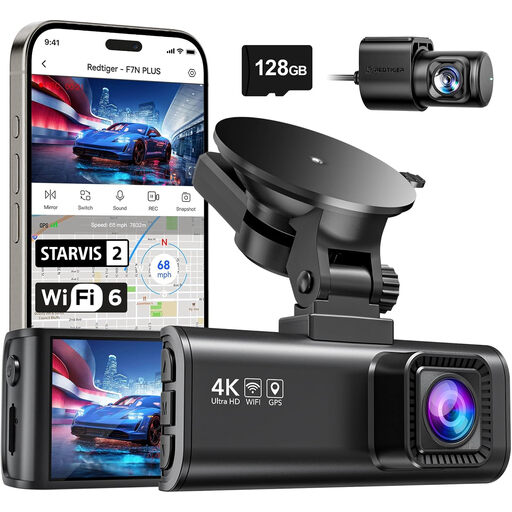
Why it stands out The REDTIGER F7NP also combines a 4K front camera with a 1080P rear camera. A key technical feature is its integrated 5.8 GHz Wi-Fi, which, according to the manufacturer, enables significantly faster data transfers to your smartphone than standard 2.4 GHz Wi-Fi. Instead of a battery, it uses a supercapacitor, which offers greater heat resistance and a longer lifespan.
Benefits
Who is it for? For tech-savvy users who value a fast, stable connection to their smartphone and prefer robust, durable hardware for use in various climates.
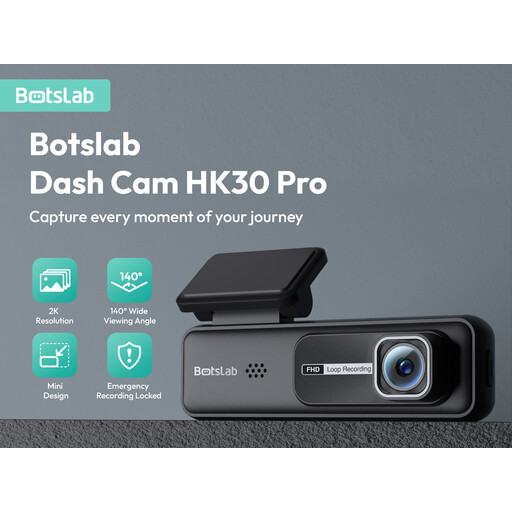
Why it stands out This model offers 2K resolution (Quad HD), delivering image quality that is significantly better than standard Full HD and provides excellent detail for most situations. Its main advantage is its minimalist and compact design, allowing it to be placed discreetly on the windscreen. Despite its small form factor, it includes essential features like night vision and G-sensor-triggered emergency recording.
Benefits
Who is it for? For drivers looking for a discreet, easy-to-use car camera with image quality superior to Full HD, without needing the full feature set and price of a 4K dual-camera system.
If the models featured here don't perfectly match what you're looking for, or if you're specifically searching for a wide-angle camera with different specifications, you can find more alternatives in our collection.
Explore our entire selection of cameras here.
1. Are dashcams legal? Yes, their use is generally permitted as long as data protection regulations are followed. The camera should record in loop mode and only save footage permanently on an event-triggered basis (e.g., in an accident). Continuous surveillance of public space is not allowed.
2. What does loop recording mean on a car camera? With loop recording, the camera continuously records in short segments (e.g., 1, 3, or 5 minutes). Once the memory card is full, the oldest recording file is automatically overwritten. This ensures seamless recording without needing to manually clear the memory card. Emergency recordings triggered by the G-sensor are exempt from being overwritten.
3. Does a dashcam with parking mode require special installation? Yes, for reliable 24-hour parking surveillance, a hardwire kit is typically required. This kit connects directly to the vehicle's fuse box to supply power to the camera even when the ignition is off. Such kits usually include a battery monitor to prevent the car battery from being completely drained.