A 4K dash cam offers a resolution of 3840 x 2160 pixels. This fourfold increase in detail compared to conventional Full HD (1080p) is a crucial factor for the usability of video recordings in traffic. Details such as license plates, road signs, or the behaviour of other road users can be captured more precisely from a greater distance and even in challenging light conditions. Modern systems combine this high resolution with specialised image sensors, GPS modules, and intelligent surveillance features to provide comprehensive documentation of your drive and your parked vehicle.
Buyer's Guide: What to Look for in a 4K Car Camera
The selection of a suitable car camera should be based on an analysis of its technical specifications. The following parameters are crucial for the device's performance and reliability.
Resolution and Image Sensor: The Foundation of Image Quality
The "4K" label alone is not enough. It is important to look for a high-quality image sensor that can natively process the high resolution.
- Image Sensor: Sensors like the Sony STARVIS and its successor, STARVIS 2, are renowned for their high light sensitivity. Their back-illuminated (BSI) structure allows them to capture more photons, resulting in lower-noise and clearer recordings at night or during twilight.
- HDR/WDR Technology: High Dynamic Range (HDR) or Wide Dynamic Range (WDR) are features that balance strong contrasts. They prevent bright areas (e.g., headlights) from being overexposed and dark areas (e.g., shadows) from being underexposed, ensuring that details remain visible throughout the entire scene.
Recording Channels: Which Setup Do You Need?
The number of cameras (channels) determines the area under surveillance.
- 1-Channel: A single front-facing camera that records the traffic ahead of the vehicle. This is the basic configuration.
- 2-Channel (Front and Rear Dash Cam): A system consisting of a front and a rear camera. This configuration is a popular choice as it also documents events behind the vehicle, such as rear-end collisions.
- 3-Channel Dash Cam: This system includes a front, a rear, and an interior camera. It offers the most comprehensive surveillance and is particularly relevant for professional drivers, ride-sharing services, or for complete documentation of the vehicle's surroundings.
Key Features for Practical Use
Modern dash cams offer a range of features that enhance their everyday usability.
- Dash Cam with GPS: An integrated GPS module continuously records the exact position, speed, and driving route. This data is synchronised with the video and can serve as objective evidence when reconstructing an event.
- Dash Cam with Wi-Fi: A Wi-Fi interface enables a wireless connection between the camera and a smartphone. Through a companion app, users can access live footage, review and download recordings, and adjust settings without having to remove the memory card. Models with Wi-Fi 6 offer faster transfer speeds.
- Dash Cam with Parking Surveillance: This feature protects the vehicle while the driver is away. There are several modes:
- Collision Detection: The G-sensor activates recording when an impact (e.g., a parking bump) is detected.
- Motion Detection: The camera starts recording as soon as motion is detected in the sensor's field of view.
- Time-Lapse: The camera records continuously at a low frame rate (e.g., 1 frame per second) to save storage space while still ensuring seamless monitoring. A separate hardwire kit for connecting to the vehicle's fuse box is typically required to use this feature.
Storage Technology and Reliability
- Loop Recording: By default, dash cams record in a loop. When the memory card is full, the oldest files are automatically overwritten.
- G-Sensor: An accelerometer detects abrupt manoeuvres or collisions and locks the current video file. These protected recordings are exempted from the loop recording and will not be overwritten.
- Supercapacitor: Instead of lithium-ion batteries, many high-end dash cams use supercapacitors. These are significantly more resistant to extreme temperatures (e.g., -20°C to +70°C) that can occur inside a car parked in the sun. This increases the device's operational safety and lifespan.
Our 2026 Selection
Based on the technical criteria above, here are some models that stand out for their specifications.
AZDOME M550 MAX 4K Dashcam
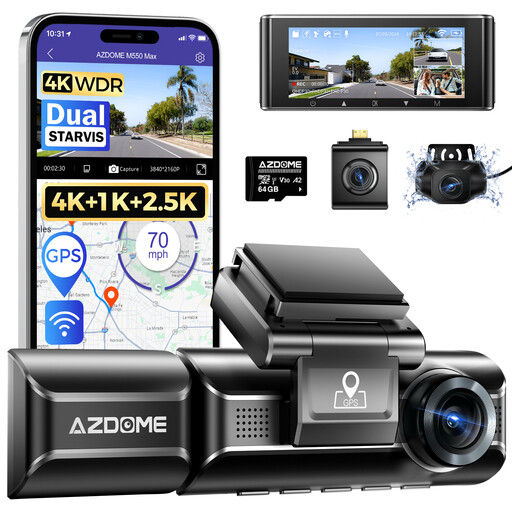
- Why we recommend this product: The AZDOME M550 MAX is a 3-channel dash cam that provides comprehensive surveillance of the front (4K), interior (2.5K), and rear (1080p). The use of two STARVIS sensors ensures excellent image quality, even in low-light conditions.
- Pros:
- 3-channel recording for a 360-degree view
- Front camera with 4K resolution
- Dual STARVIS sensors and WDR technology for enhanced night vision
- Integrated Wi-Fi and GPS
- 24-hour parking surveillance (requires a separate hardwire kit)
- 64 GB SD card included
- Who it's for: Drivers who need seamless documentation of the front, rear, and interior, such as for family vehicles, ride-sharing services, or for maximum security.
70mai 4K Dash Cam Front and Rear A810-2
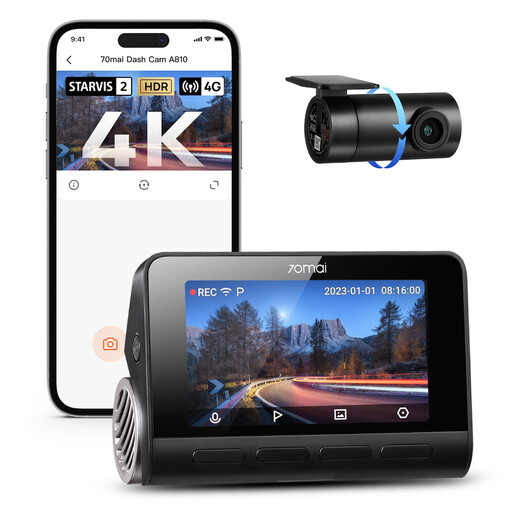
- Why we recommend this product: The 70mai A810-2 features the advanced Sony STARVIS 2 IMX678 sensor and dual-HDR technology. This delivers exceptionally high image sharpness and an extended dynamic range, which is particularly advantageous for night driving. According to the manufacturer, the model was rated "Good" by German tech magazines such as Autobild.de and Computerbild.de.
- Pros:
- True 4K resolution with Sony STARVIS 2 sensor
- Dual-channel recording with HDR for both front and rear
- AI-powered motion detection for parking surveillance
- Integrated GPS and ADAS (Advanced Driver-Assistance System)
- Expandable with optional 4G connectivity for remote access (separate kit required)
- Who it's for: Tech-savvy users who prioritise the highest image quality by day and night and appreciate advanced features like AI surveillance and optional cloud connectivity.
AZDOME GS63H Pro Dashcam Front Rear 4K
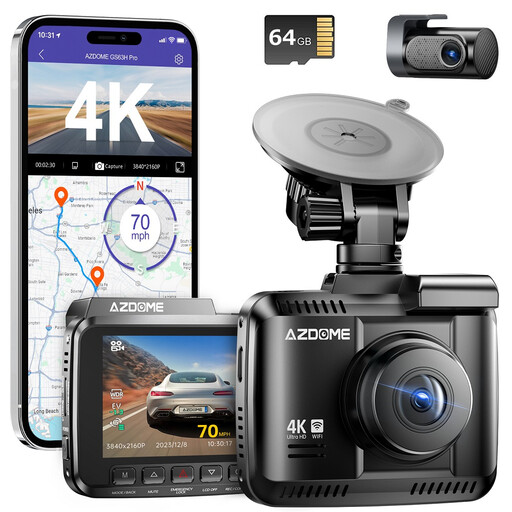
- Why we recommend this product: The AZDOME GS63H Pro offers a solid combination of a 4K front camera and a 1080p rear camera. A standout feature is its Wi-Fi 6 integration, which enables faster wireless data transfer to a smartphone compared to older standards.
- Pros:
- Front and rear dash cam with 4K resolution for the front
- Integrated Wi-Fi 6 connectivity for fast transfers
- STARVIS sensor and WDR for good low-light performance
- Built-in GPS module
- 64 GB SD card included
- Who it's for: Drivers looking for a reliable 2-channel solution with 4K resolution and exceptionally fast data transfer via Wi-Fi for convenient operation.
More Options in Camera Systems
If the models presented do not precisely meet your requirements, or if you are looking for specialised solutions, our main Camera System category offers a wider selection of vehicle cameras and accessories.
Frequently Asked Questions (FAQ)
1. Is the use of a dash cam legally permitted in Germany? Yes, recording for private purposes to document an accident is generally permitted. However, their use is subject to the provisions of the General Data Protection Regulation (GDPR). Permanent, indiscriminate recording of public spaces is not allowed. Dash cams solve this technically through loop recording, where old footage is continuously overwritten. Only in the event of an incident (e.g., triggered by the G-sensor) is a short clip saved permanently. Publishing recordings where people or license plates are identifiable is not permitted without their consent.
2. What is the technical advantage of a STARVIS sensor? STARVIS is a Sony technology for CMOS image sensors, characterised by its very high light sensitivity. Through a back-illuminated structure, the sensor can capture more light, which leads to significantly brighter and lower-noise images in poor light conditions. STARVIS 2 is a further development that enhances the dynamic range and image quality even more, which is particularly beneficial for night driving.
3. Does a dash cam with parking surveillance require special installation? Yes. The standard power supply for a car camera is the cigarette lighter socket, which in most vehicles only provides power when the ignition is on. To operate a dash cam with parking surveillance even when the engine is off, a permanent power source is necessary. A so-called hardwire kit is connected directly to the vehicle's fuse box. It not only ensures the power supply but also typically includes a battery voltage monitor that shuts off the camera before the vehicle's battery voltage drops to a critical level.
Written by: Joybuy Product Recommendation Officer

