
Lieferung heute & morgen

Qualitätsgarantie

Willkommens-Angebote freischalten: KOSTENLOSE Lieferung | Bis zu 80 % RABATT | Kostenlose 30-Tage-JoyPlus-Testphase
App herunterladen
A 4K dashcam front and rear can record your journeys, parking manoeuvres and potential accident sequences. However, resolution alone isn’t the deciding factor. With a car camera, you also need to consider the front and rear camera sensor, power supply, memory card and a practical mounting solution.
Many buyers first look for terms like “Ultra HD”, “night vision” or “24-hour parking surveillance”. These details only become useful when the technical specifications match your vehicle and usage profile.
With many dual dashcams, the front camera records in 4K while the rear camera is limited to 1080P. This isn’t necessarily a problem, but you should be aware of it before you buy. If you frequently drive on motorways or need highly detailed rear footage, check the resolution of both cameras separately.
The frame rate also affects how moving scenes are captured. Recording at 60 frames per second can make motion appear smoother in the appropriate mode, but it requires more storage space.
A 24-hour parking surveillance feature doesn’t work with just the standard 12-volt socket on many models. For continuous monitoring, you’ll often need a separately available hardwire kit. This connects the dashcam to the fuse box and, depending on the model, can offer voltage monitoring.
Before buying, you should clarify:
4K videos generate large amounts of data. A microSD card rated U3 or UHS-I U3 is required for many devices. Not every standard memory card is suitable for continuous writing. Additionally, loop recording overwrites older files once the storage is full. Event files should therefore be automatically locked or backed up promptly.
A supercapacitor can offer better temperature tolerance than a battery on models designed for it. However, this doesn’t replace proper installation: the camera must not obstruct the driver’s view or interfere with airbag deployment zones.
For a 4K dashcam front and rear, the following details are particularly important:
A night vision dashcam shouldn’t just be promoted with a marketing term. Check whether details about the sensor, aperture, HDR/WDR and infrared illumination are provided.
A dashcam with GPS can record speed, time and location data alongside the footage. This makes it easier to organise video files later, but it doesn’t replace a legal review of how the data is used.
A dashcam with Wi-Fi allows you to transfer clips to a smartphone without removing the memory card. 5 GHz Wi-Fi can speed up the transfer of large 4K files on compatible devices. For this to work, your smartphone, app and camera must all be compatible.
Voice control is handy when you want to take a photo or lock a file while driving. However, it shouldn’t be seen as a substitute for safe and attentive operation.
A classic front and rear camera is usually attached to the windscreen and rear window. A mirror dashcam, on the other hand, uses the existing rear-view mirror as a mounting point and often features an integrated display. Before installation, check the cable length, field of view and vehicle size.
In the UK, dashcam footage should be used sparingly and for specific purposes. Continuous, indiscriminate recording of public traffic can raise data protection concerns. Event-based recordings, short storage periods and avoiding the publication of identifiable people or number plates can reduce potential risks. For specific questions, individual legal advice is recommended.
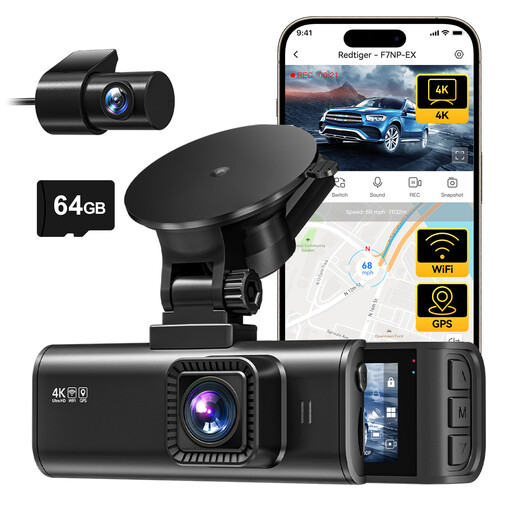
Why this product fits the profile: The combination of 4K front recording, rear camera, GPS, 5.8 GHz Wi-Fi and an included 64 GB card covers the key features for commuters and everyday driving.
The memory card is included according to the product description. This saves you an immediate additional purchase; however, you should still check the storage and parking mode requirements.
4K front, GPS, 5.8 GHz Wi-Fi and WDR night vision as per product specifications.
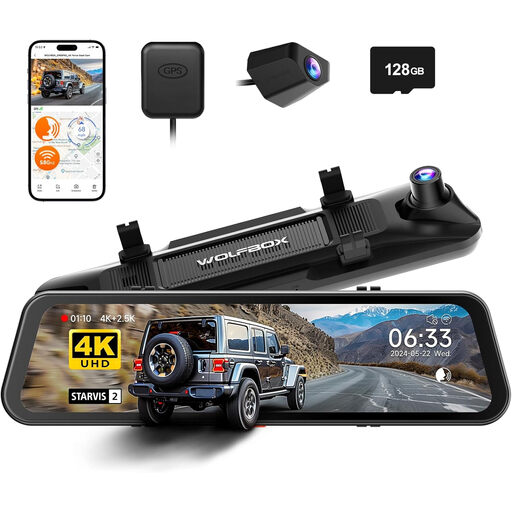
Why this product fits the profile: The mirror dashcam is ideal for vehicle owners who want to combine front and rear cameras with a large rear-view mirror display.
The resolution of the two cameras is listed separately: 4K front and 2.5K rear. This makes it easier to assess rear performance than with a generic 4K claim.
12-inch mirror display, Sony STARVIS IMX678 as per product specifications, GPS, G-sensor and 128 GB card.
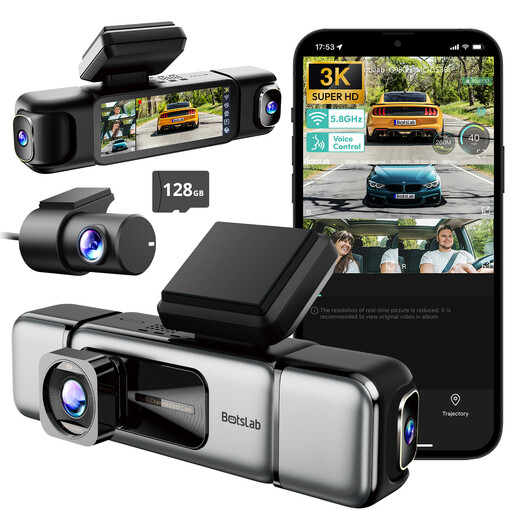
Why this product fits the profile: Taxi, rideshare and high-mileage drivers can benefit from four recording channels for front, rear and sides, provided the additional installation effort suits your vehicle.
The 24-hour parking modes are specifically described as time-lapse, sentry and impact detection. According to the product specifications, a hardwire kit is required for this function.
3K front camera, four channels, 5.8 GHz Wi-Fi, voice control, GPS and 128 GB card as per product specifications.
We’ve put together a full, regularly updated list of products that fully meet these strict selection criteria and the safety regulations in force in the EU.
Dashcam footage isn’t banned outright. However, continuous, indiscriminate recording of public traffic can raise data protection issues. Event-based recordings, short storage periods and private use without publication are generally the more cautious approach. Your specific situation may require legal advice.
The front camera is usually mounted behind or near the rear-view mirror, without obstructing your view. The rear camera is attached to the rear window or the back of the vehicle. The cable should be routed along the trim and must not be placed near airbags. Test the viewing angle and cable length before final installation.
In addition to the purchase price, you may need to budget for a suitable U3 memory card, a hardwire kit for parking mode and possibly professional installation. Wi-Fi or GPS models typically don’t require an ongoing subscription. An optional 4G or cloud function, on the other hand, may incur additional fees.