
Lieferung heute & morgen

Qualitätsgarantie

Willkommens-Angebote freischalten: KOSTENLOSE Lieferung | Bis zu 80 % RABATT | Kostenlose 30-Tage-JoyPlus-Testphase
App herunterladen
A 4K dashcam front and rear can document your journeys, help with parking bumps, and automatically save important footage. However, the technical specifications vary significantly: high resolution alone doesn't guarantee clearly readable number plates at night or a straightforward installation.
For commuters, frequent drivers, families, new drivers, and taxi or ride-sharing drivers, several factors are crucial. Three marketing pitfalls in particular often lead to poor purchases:
With a dual dashcam, 4K usually refers to a front recording of up to 3840 × 2160 pixels. The rear camera, on the other hand, can work with 1080p, 2K or a higher resolution. For accident footage, it's not just the pixel count that matters, but also:
A dashcam with night vision should be evaluated in poor light conditions, reflections and changing lighting. Terms like "Super Night Vision" are brand names and should be cross-referenced with the specific sensor, aperture and HDR data.
4K video files require more storage than Full HD recordings. What's practically relevant:
A memory card should be formatted in the dashcam before first use. For models without an included card, such as the REDTIGER F7N-N or F7NT-N, this needs to be budgeted for separately.
A car camera with GPS can record speed, time and position data in footage or the associated app. Whether this data may be used in individual cases depends on the specific circumstances and legal assessment.
A dashcam with Wi-Fi usually transfers videos directly to your smartphone without having to remove the camera. 5 GHz Wi-Fi can offer higher transfer speeds than 2.4 GHz on compatible devices. The range depends on the vehicle, smartphone and surroundings.
With a dashcam with parking surveillance, particular attention should be paid to the power supply. A hardwire kit may be required and should be professionally connected. The function can also put a strain on the vehicle battery; models with voltage monitoring or IPS management are therefore practically relevant.
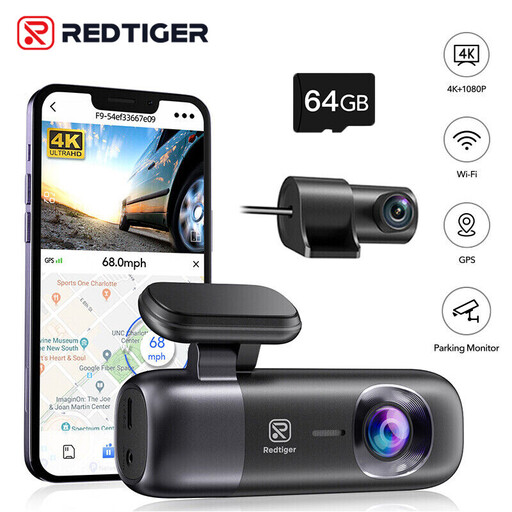
Why this product suits the profile: This model combines 4K front recording and 1080p rear recording with GPS, Wi-Fi, night vision and an included 64 GB card. This covers the essential basic functions.
The memory card is mentioned in the scope of delivery. At the same time, it remains transparent that the rear camera works at 1080p and not 4K.
4K front, 1080p rear, GPS, Wi-Fi, loop recording and 64 GB storage.
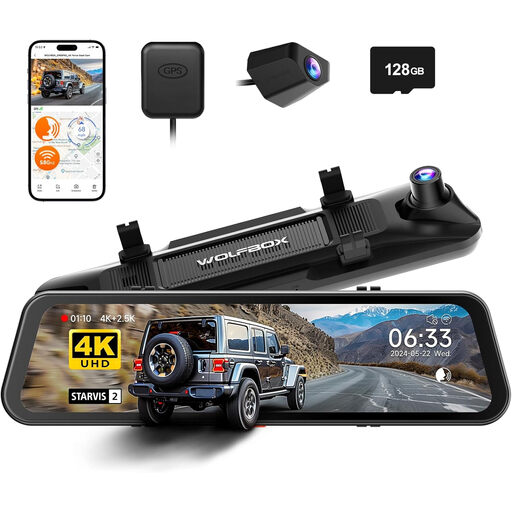
Why this product suits the profile: This mirror camera uses an 8 MP STARVIS IMX678 sensor at the front, records in 4K at the front and 2.5K at the rear, and features GPS, voice control and 5.8 GHz Wi-Fi.
The rear camera resolution is specifically stated as 2.5K. Additionally, a 128 GB card is mentioned, so the storage requirements of 4K recordings can be better planned for.
4K front, 2.5K rear, 128 GB card, GPS, 5.8 GHz Wi-Fi and voice control.
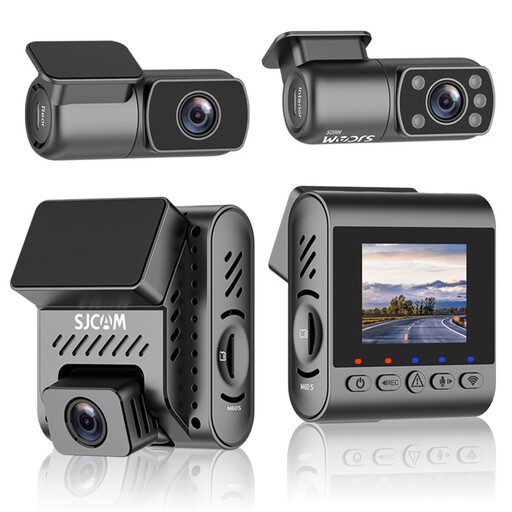
Why this product suits the profile: This 3-channel dashcam records in 4K at the front, 2K at the rear and 1080p inside the cabin. This is suitable, for example, for family vehicles, taxi and ride-sharing drivers.
The three recording channels are clearly separated. Additionally, a 64 GB card is included; support up to 256 GB allows for more storage if needed.
Front, rear and interior camera, WDR, G-sensor, Wi-Fi, parking surveillance and H.265 support.
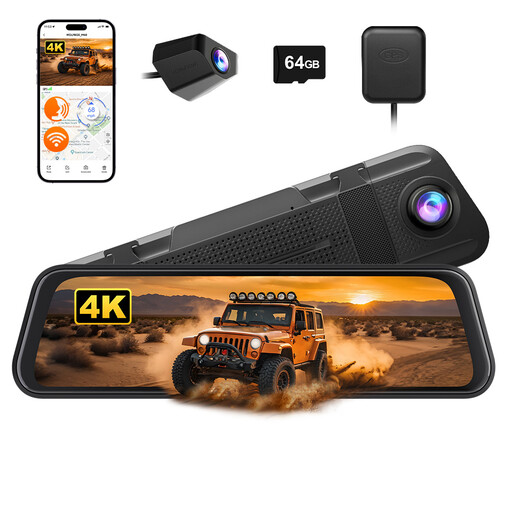
Why this product suits the profile: This 10-inch mirror camera replaces the view of your existing rearview mirror with a touchscreen display and combines 4K front recording with 1080p at the rear.
The resolution of both cameras and the installation requirements are specified. The 64 GB card is included in the scope of delivery.
10-inch touchscreen display, 4K front, 1080p rear, ADAS, BSD, voice control, Wi-Fi, GPS and 64 GB card.
We have compiled a complete, regularly updated list of products that fully meet these strict selection criteria and the safety regulations applicable in the EU.
A dashcam should not continuously and indiscriminately record all traffic activity. For use on the road, data protection, the specific purpose of recording and short, event-based storage must be taken into account, among other things. Recordings should not automatically be considered admissible evidence in every case. Before use, users should check the operating instructions, local regulations and the manufacturer's data protection information.
The camera must not obstruct the view or the deployment zone of airbags. The rear camera should be installed so that cables are safely routed. Settings must not be operated while driving.
The front camera is usually attached to the windscreen and powered via the 12-volt socket. The rear camera cable is routed along the interior trim to the back. For permanent parking surveillance, a suitable hardwire kit is often required. If in doubt, installation should be carried out by a qualified professional.
The lifespan depends on operating hours, temperatures, memory card, power supply and build quality. Models with a supercapacitor are designed for high temperature ranges, but do not replace regular checks. The memory card should be checked for errors and replaced if problems occur. Regular firmware updates can improve compatibility.
In addition to the purchase price, costs can arise for a U3 microSD card, a hardwire kit or optional 4G accessories. Wi-Fi usually incurs no ongoing charges, as the connection is made directly with your smartphone. With cloud or mobile data services, however, additional tariffs may apply.