
Lieferung heute & morgen

Qualitätsgarantie

Willkommens-Angebote freischalten: KOSTENLOSE Lieferung | Bis zu 80 % RABATT | Kostenlose 30-Tage-JoyPlus-Testphase
App herunterladen
A 4K dashcam front and rear can record journeys, parking events and traffic situations from two perspectives. For commuters, frequent drivers and owners of cars, SUVs, vans or lorries, a front and rear car camera is therefore an appealing option. However, the high resolution alone does not determine whether a system will work effectively in everyday use.
With many dual dashcams, the front camera records in 4K while the rear camera only supports 1080P or 2K. This is technically common, but you should check it clearly before buying. If you expect a genuine 4K rear camera, you could otherwise be disappointed.
A dashcam parking surveillance feature often requires a separate hardwire kit to connect to the fuse box. Without this power supply, the camera will typically only operate while driving. Additionally, voltage monitoring should be present to avoid unnecessarily draining your vehicle's battery.
4K recording generates larger files than Full HD recording. So check whether a microSD card is included, what maximum capacity is supported, and whether a card of U3/UHS-I class is recommended. Cable length, mounting type and the required connection for your vehicle should also be part of your comparison.
With a 4K car dashcam, 4K normally means a front recording of up to 3840 × 2160 pixels. A higher frame rate can provide smoother footage in moving scenes. The rear camera often works at 1080P; this is sufficient for an additional perspective, but does not match the detail level of the front camera.
A Sony STARVIS dashcam sensor can, according to product specifications, form the technical basis for recordings in difficult lighting conditions, depending on the model. However, the lens, aperture, HDR or WDR, compression and the actual camera position also remain decisive. Terms like "Super Night Vision" should therefore not be equated with guaranteed readability of every number plate.
A dashcam with GPS can record speed, coordinates and route in the video data. This information is practical when sorting through footage later. When using it on the road, you should consider data protection aspects and not share recordings publicly as a matter of course.
A dashcam with Wi-Fi usually transfers files directly to a smartphone. 5 GHz Wi-Fi can speed up the transfer of large 4K files on compatible devices. However, the range is limited; Wi-Fi does not replace a mobile internet connection. Features like 4G remote access may require an additional module and a data plan, depending on the model.
The front camera must not unnecessarily restrict your field of view. Cables should not run near airbag zones. For the rear camera, check whether the cable routing through the tailgate, headliner or side trim is suitable for your vehicle.
In the UK, the use of dashcam footage is legally situation-dependent. Continuous, indiscriminate recording and publication can raise data protection concerns. Loop recording, event locking via the G-sensor and short file lengths are therefore more practical in everyday use than uninterrupted archiving. A dashcam also does not replace safe driving or looking around when manoeuvring.
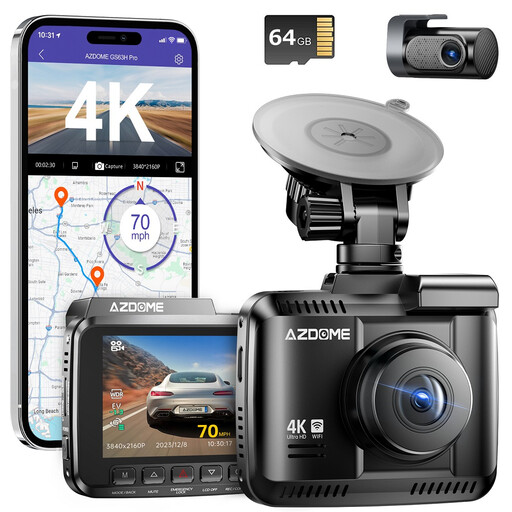
Why this product suits the profile: This model combines 4K front recording with a 1080P rear camera, GPS and Wi-Fi. A 64 GB SD card is reportedly included.
Resolution, rear camera and package contents are clearly listed separately. The separate JYX05 hardwire kit is required for parking surveillance.
4K front, 1080P rear, integrated GPS, Wi-Fi 6 and loop recording.
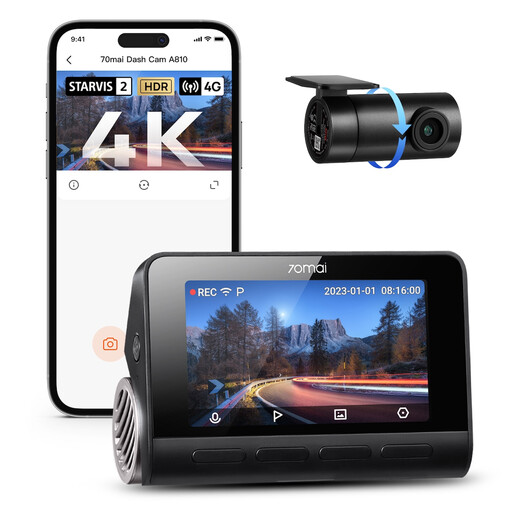
Why this product suits the profile: The front camera reportedly uses a Sony STARVIS 2 IMX678 sensor. It also features HDR, GPS, voice control and optional 4G connectivity.
The specifications distinguish between integrated features and additional requirements: the UP04 hardwire kit is needed separately for parking mode.
4K front, 1080P rear, HDR, GPS and support for up to 256 GB microSD.

Why this product suits the profile: The three-channel solution is aimed at users who need an additional perspective alongside the front and rear views. It is particularly interesting for larger vehicles or frequent journeys.
The third camera is explicitly listed as a separate channel. This reduces the risk of merely assuming an additional interior or rear perspective.
4K front camera, 2.5K rear camera, additional 1080P channel, 256 GB card and GPS.
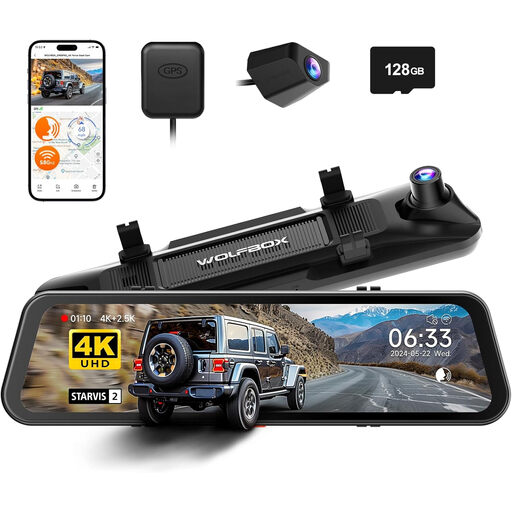
Why this product suits the profile: The rearview mirror format with a 12-inch display combines front and rear cameras with a large viewing area. The included 128 GB card reduces the need for additional accessories.
The resolution of both cameras is specifically stated: 4K front and 2.5K rear. This means the rear camera is not merely described as a simple reversing aid.
Sony STARVIS IMX678 front, 2.5K rear, 5.8 GHz Wi-Fi, voice control, GPS and G-sensor.
We have compiled a complete, regularly updated list of products that fully meet these strict selection criteria and the safety regulations in force in the EU.
For 4K recordings, a microSD card with U3 classification and sufficient capacity is recommended. Check the maximum card capacity of your specific model. Loop recording automatically overwrites older, unlocked files.
The front camera is usually attached to the windscreen. The rear camera sits on the rear window, at the back of the vehicle or, with certain systems, on the bumper. The connecting cable must be routed neatly and away from airbag zones. For larger vehicles, the cable length should be checked before purchase.
In addition to the purchase price, a memory card and a hardwire kit may be required. For models with 4G functionality, module and mobile data costs may also apply. If you do not need parking surveillance, you can operate the camera via the 12-volt socket only while driving.