
Lieferung heute & morgen

Qualitätsgarantie

Willkommens-Angebote freischalten: KOSTENLOSE Lieferung | Bis zu 80 % RABATT | Kostenlose 30-Tage-JoyPlus-Testphase
App herunterladen
A 4K front and rear dash cam can document journeys, parking incidents and accidents from two perspectives. However, resolution alone does not determine whether a dash cam is genuinely useful in everyday driving. Other key factors include image quality in challenging lighting conditions, the storage of important clips and practical installation in your vehicle.
For many products, “4K” only means that the front camera records in this resolution. The rear camera often records in 2K or Full HD. This is not necessarily a problem, but you should check the specifications carefully before buying. If you specifically want a dash cam with a high-resolution rear camera, compare the details for both channels.
With many models, a 24-hour parking mode does not work solely through the supplied cigarette lighter adapter. Monitoring while the ignition is switched off often requires a separately available hardwire kit. You should also consider battery protection to prevent unnecessary strain on the vehicle battery.
4K videos require significantly more storage space than lower-resolution recordings. Some models come with a memory card, while others require one to be purchased separately. Check the manufacturer’s required U3 or UHS-3 classification and the maximum supported capacity.
A dash cam with Wi-Fi or an app can transfer files wirelessly to your smartphone. This is convenient, but it does not replace a suitable memory card. For long journeys and frequent parking-mode use, a high-endurance microSD card designed for continuous writing is a sensible choice, provided it is compatible with the model in question.
A front camera with 3840 × 2160 pixels provides more image detail than a 2K recording in suitable lighting conditions. However, when assessing a dash cam with night vision, you should also consider the sensor, lens, HDR or WDR and image processing.
So check the following:
A wider viewing angle captures more of the road, but can create greater distortion around the edges of the image. Camera specifications should therefore always be considered together.
Loop recording overwrites older, unprotected files once the storage is full. This enables continuous recording. The G-sensor detects sudden movements or impacts and can automatically lock the relevant file. On many devices, you can also save an important clip manually.
After installation, check that:
Depending on the model, a GPS dash cam can save speed, time, route and coordinates in the video data. This information can make it easier to identify the circumstances of a recording later. A dash cam with an app and Wi-Fi usually allows you to preview, download and manage video files.
Voice control can reduce the need to operate the camera while driving, but it should never be seen as a substitute for concentrating on the road. Features such as ADAS, lane-departure warnings and collision warnings are driver-assistance functions and may produce false alerts. They do not replace the driver’s attention or compliance with traffic regulations.
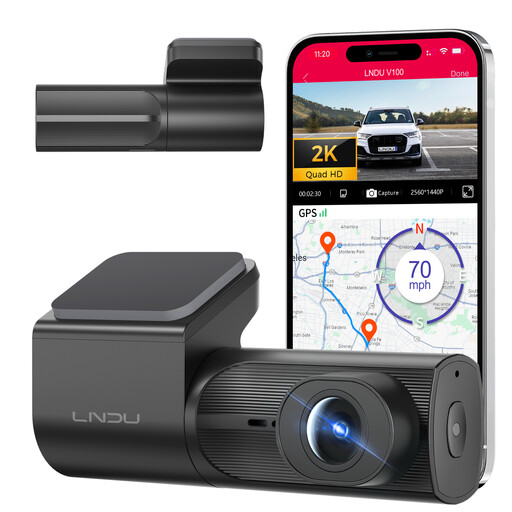
Why this product suits this profile: This compact front-camera model is aimed at drivers who need Wi-Fi, app control and parking monitoring, but do not require a rear camera.
The product details explicitly state 2K resolution, loop recording, a G-sensor and a separately required hardwire kit for 24-hour parking mode.
2K front recording, integrated Wi-Fi, LNDU app, night vision and G-sensor.
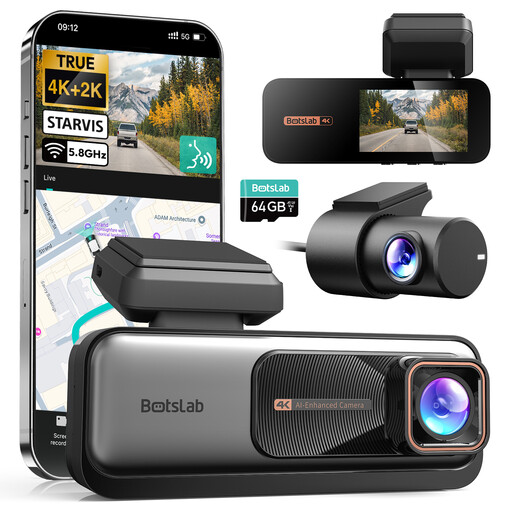
Why this product suits this profile: Ideal for commuters and high-mileage drivers looking for front and rear recording, GPS, Wi-Fi and additional driver-assistance features in one system.
The listed specifications clearly distinguish between the front and rear cameras: 4K at the front, 2K at the rear, plus a required hardwire kit available separately for parking mode.
4K front camera, 2K rear camera, 170° and 150° viewing angles respectively, GPS, 5.8 GHz Wi-Fi and loop recording.
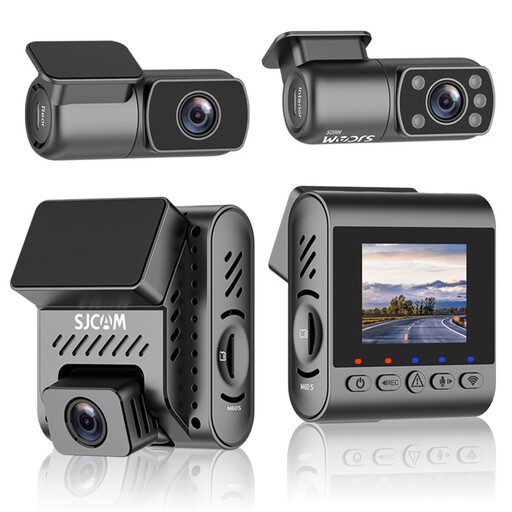
Why this product suits this profile: Taxi and private-hire drivers, as well as families, benefit from three separate channels for recording the front, rear and interior.
The three recording channels reduce the risk of documenting only the area in front of the vehicle. The specifications also mention WDR, a G-sensor and separate infrared lighting for the interior.
4K front, 2K rear, 1080P interior, WDR, H.265, Wi-Fi and support for microSD cards up to 256 GB.
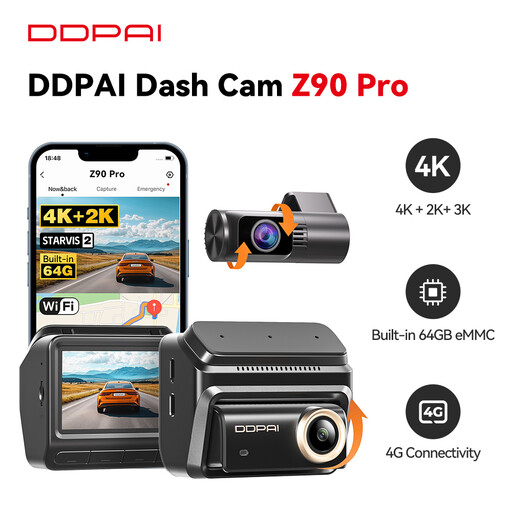
Why this product suits this profile: This model is a compelling option for users who want high front resolution, additional storage and the option to add an interior camera at a later date.
The product information specifies 4K at the front, 2K at the rear, integrated 64 GB eMMC storage and a separately required hardwire kit for parking monitoring.
4K+2K HDR recording, 5 GHz Wi-Fi, GPS, voice control, ADAS and support for an optional interior camera.
A dash cam should be mounted so that it does not unnecessarily restrict your field of vision or obstruct safety-critical areas such as airbags. Avoid operating it while driving.
When using recordings, you must respect data protection and personal rights. Publishing or sharing video footage continuously and without a specific reason can cause problems. Save relevant sequences selectively and check the specific reason before sharing any footage. A dash cam is not a substitute for legal advice.
We have put together a complete, regularly updated list of products that fully meet these strict selection criteria and the safety regulations applicable in the EU.
Using one may be permitted if recordings are processed in compliance with data protection rules and for a specific purpose. Permanently publishing or routinely sharing video footage is not automatically permitted. The camera must also be securely mounted and must not obstruct your view.
Monitoring while the ignition is switched off often requires a suitable hardwire kit. This is connected to the vehicle’s electrical system and should include low-voltage protection. Installation should be carried out professionally and be suitable for the vehicle model.
Its lifespan depends on factors including heat, cold, writing load, memory card and power supply. Models with a supercapacitor are designed for specific temperature ranges, while actual durability depends on the manufacturer’s specifications and operating conditions. A compatible high-endurance memory card and regular function checks can help support reliable operation.