
Lieferung heute & morgen

Qualitätsgarantie

Willkommens-Angebote freischalten: KOSTENLOSE Lieferung | Bis zu 80 % RABATT | Kostenlose 30-Tage-JoyPlus-Testphase
App herunterladen
Investing in a dash cam is a wise decision for enhancing your safety on the road. Models with 4K resolution for both front and rear cameras, in particular, promise highly detailed recordings that can serve as crucial evidence in the event of an accident. However, the market is crowded and filled with technical promises that aren't always kept. As your Joybuy Product Recommendation Officer, I'm here to help you identify the critical features and steer clear of common purchasing traps.
Many products advertise impressive specifications, but these often conceal costly shortcomings. Pay close attention to these three points to avoid a poor investment.
To avoid the problems mentioned above, you should carefully examine three technical aspects before making a purchase. These are the key determinants of your dash cam's reliability and image quality.
Resolution alone says little about image quality, especially in the dark. The built-in image sensor is the decisive factor. Models with sensors like the Sony STARVIS are specifically optimized for low-light conditions. They can deliver clear, low-noise images even at night. Combined with a large aperture (e.g., F/1.8), which allows more light to reach the sensor, the performance of the night vision car camera is significantly improved.
A 4K front and rear dash cam (2-channel system) is the standard for comprehensive documentation of traffic events. For professional drivers or families, a 3-channel dash cam that also records the vehicle's interior can be a valuable addition. Also, look for a wide viewing angle (140° or more is recommended) to capture events on the sides of the vehicle without significant distortion at the edges of the image.
Modern dash cams offer much more than just video recording.
Based on the criteria above, we have identified several models that are well-suited for different needs and budgets.
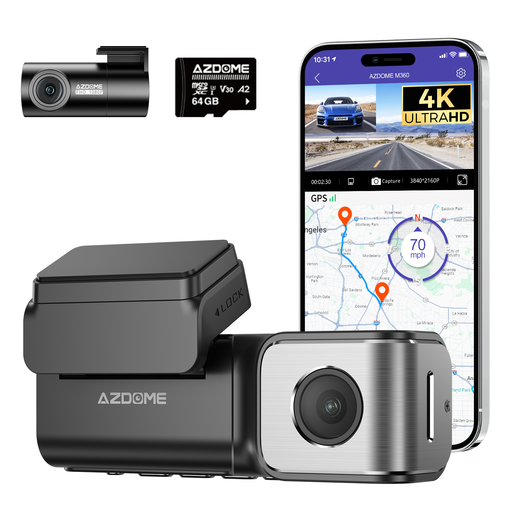
Why This Fits Their Persona: This model offers a solid feature set with a true 4K front camera and a Full HD rear camera. It's a great choice for drivers looking for a reliable dual-channel solution with modern features like GPS and Wi-Fi without a large budget.
The front camera delivers native 4K footage, thus avoiding the "Fake 4K" trap. The product description transparently states that a separate hardwire kit (AZDOME JYX05) is required for the 24-hour parking mode.
Integrated GPS for route tracking and fast 5-GHz Wi-Fi for convenient data transfer via the app.

Why This Fits Their Persona: For drivers who prioritize the highest image quality and technological innovation. This model combines two high-quality Sony STARVIS sensors with HDR functionality for both front and rear, ensuring excellent dynamic range in all lighting conditions.
The D?save 2.0 dual-storage technology (32GB internal eMMC memory plus a microSD slot) safeguards recordings even if the memory card fails, directly addressing the problem of data loss.
A combination of a Sony STARVIS 2 sensor (front) and a STARVIS sensor (rear) with Dual-HDR for superior image quality. The option to record at 60 frames per second ensures smooth videos at high speeds.
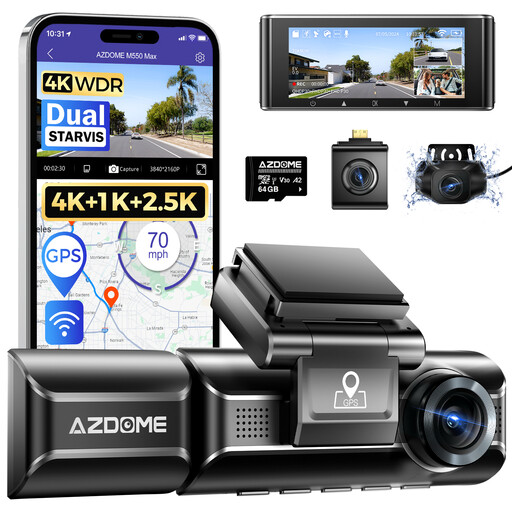
Why This Fits Their Persona: As a 3-channel system, this dash cam simultaneously records the road ahead (4K), behind (1080P), and the vehicle's interior (2.5K). This provides complete surveillance and is ideal for taxi drivers, ride-sharing services, or families who want maximum security.
This model integrates three cameras into one system, avoiding the need to install and manage multiple separate devices. The use of two Sony STARVIS sensors ensures high-quality recording for the front and interior cameras.
Complete 360-degree surveillance through three cameras. The interior camera is equipped with infrared LEDs for clear night vision inside the vehicle.
We have compiled a complete, up-to-date list of products that fully meet these strict selection criteria and local safety regulations.
Yes, the use of a dash cam is generally permitted in many countries, including Germany, and recordings may be admissible as evidence in court. However, usage must comply with data protection laws like the General Data Protection Regulation (GDPR). This means that permanent, indiscriminate recording of public spaces is not allowed. Most modern dash cams solve this with loop recording, where old data is continuously overwritten, and footage is only permanently saved when an event is detected (e.g., by the G-sensor).
Parking mode monitors your vehicle when the ignition is off. It is typically activated by impacts (via the G-sensor) or motion detection. To prevent draining the car battery, a special hardwire kit is required. This connects directly to the vehicle's fuse box and includes a battery monitor that cuts power to the dash cam if the car battery's voltage drops below a critical level.
For 4K recording, a microSD card with a speed class of U3 (UHS Speed Class 3) and a video speed class of V30 or higher is necessary. Even more important, however, is choosing a "High Endurance" card. These are specifically designed for the high write-intensive load of surveillance cameras and dash cams, offering significantly longer lifespan and greater reliability than conventional memory cards.