
Lieferung heute & morgen

Qualitätsgarantie

Willkommens-Angebote freischalten: KOSTENLOSE Lieferung | Bis zu 80 % RABATT | Kostenlose 30-Tage-JoyPlus-Testphase
App herunterladen
Choosing a suitable car camera can be overwhelming. Many manufacturers advertise impressive specifications, but not all of them live up to their claims. As your Joybuy Product Recommendation Officer, I'll help you understand the essential features and avoid common pitfalls, so you can make an informed decision for your safety.
A common issue is the advertised 4K resolution. Some models only achieve this through software interpolation, which means a lower-resolution image is artificially upscaled. The result is often blurry footage where important details like license plates are unreadable in low light or from a distance.
Another pitfall is an unreliable parking mode. Effective parking surveillance for your car is a key purchasing factor for many. However, it's often not mentioned that this feature requires a constant power supply via a separate hardwire kit. Without this kit, the parking mode is useless or, in the worst-case scenario, drains the vehicle's battery.
Finally, vague terms like "Super Night Vision" are used as a lure. Without specifying the image sensor used, such a statement means very little. High-quality dash cam night vision depends directly on the quality of the sensor. Models that don't provide precise details on this often deliver only noisy, unusable footage in the dark.
To avoid a bad purchase, you should focus on a few crucial technical parameters. These are the primary determinants of your car camera's reliability and image quality.
Resolution alone isn't everything. A native 4K sensor, like the Sony STARVIS 2, is the foundation for detailed and clear recordings, day and night. These sensors are designed to capture a high level of detail and reduce image noise even in minimal light. Look for the combination of a true 4K resolution (3840x2160 pixels) and a specified, high-quality image sensor. This is the only way to ensure your dash cam provides usable evidence in critical situations.
The choice of channels depends on your individual security needs.
A functional dash cam with parking mode also records when the engine is off. This typically requires a hardwire kit for connection to the vehicle's fuse box. This kit ensures a continuous power supply and includes a battery monitor that prevents the car battery from being drained.
Modern features like a dash cam with GPS and Wi-Fi significantly enhance convenience. GPS records the route, speed, and exact location, providing important contextual data in the event of an accident. Wi-Fi allows you to access, view, download, and manage settings for your recordings directly on your smartphone via an app, without having to remove the memory card.
Instead of presenting an overwhelming list, we have selected models tailored to specific requirements and user profiles.
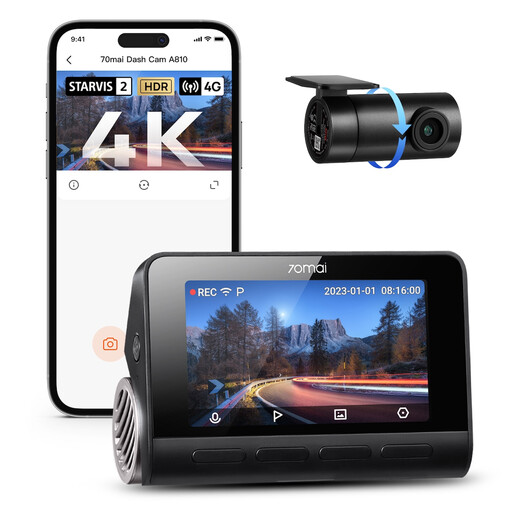
Why it's a match: Ideal for drivers who commute daily and need reliable documentation of traffic events from the front and rear. The high image quality, day and night, ensures peace of mind on the way to work and back.
This model uses a specified Sony STARVIS 2 IMX678 sensor. This ensures true 4K HDR recordings and strong night vision performance that goes beyond vague marketing promises.
The dual-channel recording with HDR for both front and rear cameras ensures that details are captured clearly even in difficult lighting conditions, such as backlighting or in tunnels.
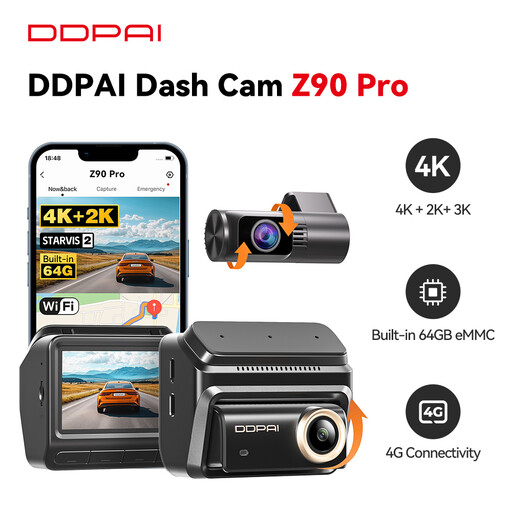
Why it's a match: For users seeking seamless, all-around protection with the latest technology. The system is modularly expandable to 3 channels and offers optional 4G connectivity for remote access.
The D?save 2.0 technology, with integrated 64GB eMMC storage and an additional SD card slot, prevents data loss in case of a memory card failure, providing a dual backup for important recordings.
The combination of a Sony STARVIS 2 IMX678 sensor for the 4K front camera and the optional 4G connection enables real-time remote monitoring of the vehicle via the app.
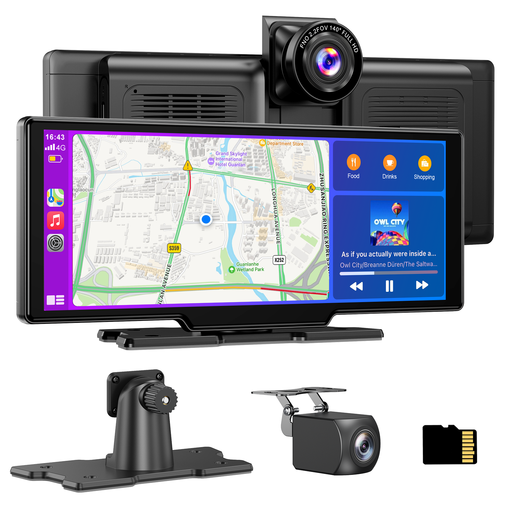
Why it's a match: Perfect for drivers of older vehicles who want a modern infotainment solution with an integrated dash cam, without the need for a complex and expensive installation.
This device combines two functions in one, solving the problem of having to install and wire multiple separate devices. It is powered simply via the cigarette lighter socket.
A 2-in-1 solution: A full-featured 4K dash cam set (front and rear) is integrated directly into a large 10.26-inch display with wireless Apple CarPlay and Android Auto.
We have compiled a complete, up-to-date list of products that fully meet these strict selection criteria and local regulations.
Yes, operating a dash cam is generally permitted in Germany. However, the requirements of the General Data Protection Regulation (GDPR) must be observed. Permanent, non-event-based recording of public space is not allowed. Modern dash cams solve this problem with a loop recording function, where old footage is continuously overwritten. Only in the event of an incident (e.g., triggered by the G-sensor) is a short clip saved permanently. This event-based storage for evidence in an accident is generally considered permissible. However, publishing the recordings on the internet is prohibited.
Parking mode allows for the surveillance of your vehicle when the ignition is off. To use this function, the dash cam needs a constant power supply. This is achieved with a hardwire kit, which is connected directly to the vehicle's fuse box. Such kits have an integrated voltage monitor that cuts off power to the dash cam before the car battery reaches a critical level, ensuring the engine can be started at any time.
A supercapacitor is significantly more heat-resistant and durable compared to a conventional lithium-ion battery. This is a major advantage, as a car's interior can reach very high temperatures in the summer, which are damaging to batteries. A supercapacitor stores just enough energy to safely save the last recording after a sudden power loss (e.g., in an accident) and shut down the device properly. It is not designed for extended operation without an external power source but offers greater operational safety and reliability.