
Lieferung heute & morgen

Qualitätsgarantie

Willkommens-Angebote freischalten: KOSTENLOSE Lieferung | Bis zu 80 % RABATT | Kostenlose 30-Tage-JoyPlus-Testphase
App herunterladen
Investing in a dash cam is a smart move for securing yourself on the road. A 4K front and rear dash cam, in particular, promises high-resolution video footage that can serve as crucial evidence in the event of an accident or parking damage. However, the market is flooded with devices making grandiose marketing claims that often fall short in practice. Many drivers invest in a system only to discover later that the recordings are unusable or that essential features are missing.
This guide, created by the Joybuy Product Recommendation Officer, reveals the most common pitfalls and highlights the technical features you should actually focus on to make an informed decision.
Before we dive into recommended features, it's important to understand the typical issues that can lead to a poor purchase:
To avoid the problems mentioned above, you should focus on a few crucial technical specifications. These determine the reliability and image quality of your car camera.
True 4K resolution (3840 x 2160 pixels) is only achieved with a correspondingly powerful image sensor. Look for models that use renowned sensors. A current industry standard is the Sony STARVIS 2 image sensor. It is specifically optimised for low-light conditions and delivers sharp, detailed images not only during the day but also at night. Combined with technologies like HDR (High Dynamic Range), which balances strong contrasts between bright and dark areas of the image, you get excellent dash cam night vision.
A dash cam with parking surveillance also protects your vehicle while it's parked. There are two common methods for this:
For both modes, a constant power supply is necessary. To avoid draining the car battery, a hardwire kit with a low-voltage protection feature is essential. This is connected directly to the vehicle's fuse box and cuts off the power supply before the car battery's voltage drops to a critical level.
Modern dash cams offer much more than just video recording. A dash cam with app control via Wi-Fi allows you to download recordings directly to your smartphone and conveniently adjust settings without removing the SD card. A dash cam with GPS is also an important feature. The GPS module continuously records your location and speed. This data is embedded in the video and can prove the exact location and circumstances of an incident.
Based on the criteria above, we have identified a few models that represent a well-considered choice for different requirements and user groups.
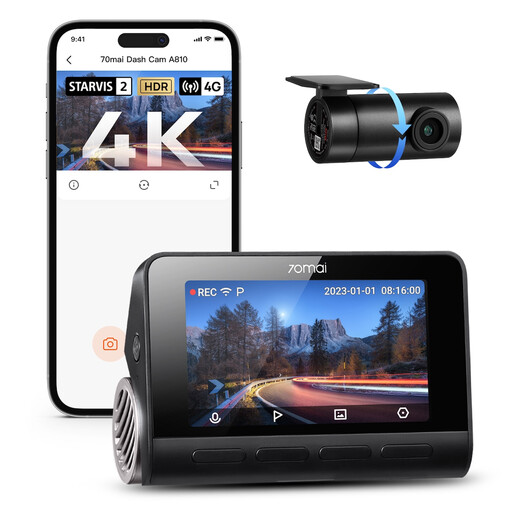
Why It's a Match: This model is aimed at users who value cutting-edge technology. The Sony STARVIS 2 sensor, AI-powered motion detection, and the option for 4G connectivity for remote access provide the highest level of security and technical sophistication.
The 70mai A810 uses a genuine Sony sensor for native 4K recording and outstanding dash cam night vision. The product information transparently indicates the hardwire kit needed for parking surveillance, thus avoiding hidden costs.
True 4K resolution with Sony STARVIS 2 sensor. AI-powered motion detection for parking surveillance. Integrated GPS and ADAS driver-assistance system.
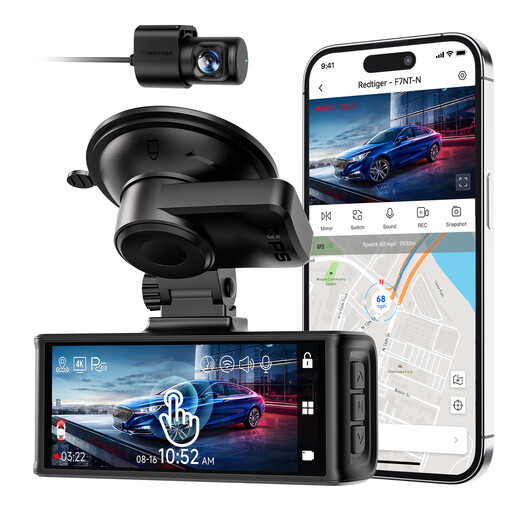
Why It's a Match: This user appreciates straightforward operation. The large touchscreen and voice control allow for simple use without navigating complex menus. A solid 4K system for daily use.
The model offers true 4K resolution. The product information clearly states that the SD card is not included and requires a U3 speed class. This prevents the purchase of an incompatible card and the associated malfunctions.
Intuitive operation via a 3.18-inch touchscreen and voice control. Integrated GPS and fast 5.8 GHz Wi-Fi for swift app control and data transfer.
We have compiled a complete, up-to-date list of products that fully meet these strict selection criteria and German safety regulations.
1. Is a dash cam legal in Germany? Yes, using a dash cam is generally permitted in Germany. The recordings can be used to document an accident. However, compliance with data protection laws (GDPR/DSGVO) is crucial. Permanent, indiscriminate recording of public space is not allowed. Therefore, all common models work with loop recording, where old footage is automatically overwritten. Recordings are only saved when an event is detected (e.g., by the G-sensor). The video material should only be shared with the police or insurance companies in the specific case of a claim.
2. Which SD card do I need for a 4K dash cam? For a 4K car camera, a high-quality memory card is essential. Due to the large file sizes and constant overwriting in loop mode, you need a "High Endurance" microSD card. Look for the speed class U3 (UHS Speed Class 3) or V30 (Video Speed Class 30). A capacity of 64 GB to 256 GB is recommended to achieve a good balance between recording time and cost.
3. How exactly does parking surveillance on a dash cam work? Parking surveillance is activated as soon as you turn off your vehicle's engine. The camera switches to a low-power monitoring mode. If a jolt (e.g., a bump) or motion in front of the lens is detected, the camera starts a protected emergency recording. This feature requires a permanent power supply via a hardwire kit, which is connected directly to the car's fuse box and includes low-voltage protection for the car battery.