Checking texture by a window
If you’re checking fine seams in distracting daylight, you’ll want to tell reflections apart from flaws in the texture file.


Start by choosing a 4K monitor that’s verified as anti-glare, then check reflections at your actual workstation: a brightness figure alone won’t guarantee a reflection-free view. If you also need to assess colours and tonal values reliably, uniformity and a suitable calibration and profiling workflow become more important. Size and connections should suit your desk and computer.
If you’re checking fine seams in distracting daylight, you’ll want to tell reflections apart from flaws in the texture file.
If you’re assessing colour and tonal transitions as well as seams for a colour-managed output process, the right settings and a well-planned colour management workflow matter.
If you’re connecting a laptop, your monitor should offer both a clear 4K workspace and the connections your computer needs.
First, check how reflections affect you at your actual workstation. Then weigh up detail, your colour workflow and the connections your computer needs.
| Buying criterion | What to check | Who should prioritise it? |
|---|---|---|
| Reflections by a window | Check the anti-glare finish, typical rather than peak HDR brightness, screen position and possible ways to block the light. | If I work next to a bright window, I don’t want to mistake a reflection for a faulty seam. Around 36% of consumers are likely to make reducing reflections their top priority. |
| Seam detail and workspace | Check the specific model’s native 4K resolution, screen size, desk space and readable scaling. | If I want to assess fine seams, I need a detailed preview that’s practical to use on my desk. Around 29% of consumers are likely to make checking seam detail their top priority. |
| Colour and brightness uniformity | Check the target colour space, uniformity features, and calibration and profiling options for your workflow. | If I’m assessing colours and tonal values reliably, the display needs to work with my colour management setup. Around 21% of consumers are likely to make a colour-critical workflow their top priority. |
| Connections and positioning | Check the video connections you need, laptop power delivery and stand adjustments on the specific model. | If I’m connecting a laptop or need to adjust the screen position, the connections and setup should suit my workstation. Around 14% of consumers are likely to make connecting their computer their top priority. |
Typical brightness and peak HDR brightness are different operating specifications. Even an anti-glare screen won’t guarantee that distracting reflections won’t appear at your window-side workstation.
Compare typical brightness with the screen finish, and check the view where you plan to set up the monitor.
A stated colour gamut doesn’t replace settings for your output target, or calibration and profiling. The International Color Consortium describes calibration and profiling as complementary steps towards consistent display colours.
Decide on your target colour space and colour management workflow before treating a percentage in the spec sheet as the deciding factor.
According to EIZO, the optional CH2710 for the CS2740 reduces direct light from above and the sides. That doesn’t mean it will eliminate reflections from a window directly in front of you.
Check that the hood is compatible and consider the direction of incoming light at your workstation.
The ProArt PA279CRV is a 27-inch 4K model for detail-focused and colour-focused work.
The RD320UA and PD2732U are designed for different workflows; specifications for one model don’t automatically apply to the other.
The ColorEdge CS2740 is designed for workflows where 4K detail and hardware calibration both matter.
The UltraSharp U2725QE is a 27-inch 4K option if a laptop hub and an adjustable workstation matter to you.
Here you’ll find Joybuy 4K monitor options in different sizes and with different features. Check each model separately to see whether its screen finish is suitable for your particular bright-window workstation.
 No image available
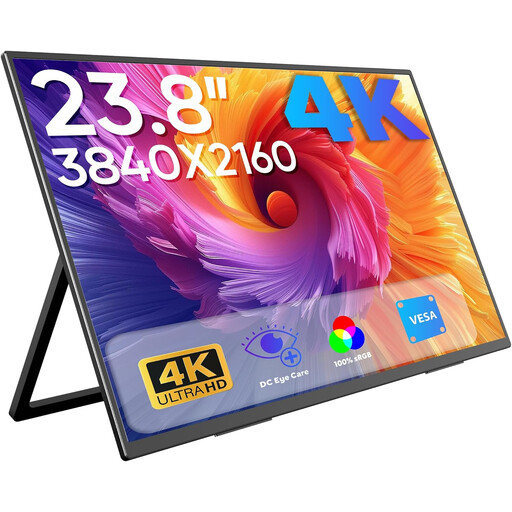
The stated UHD resolution provides a starting point for checking fine seams. The portable 23.8-inch format may suit you if a compact workspace works for your setup.
3840 × 2160 UHD, 60 Hz, 100% sRGB; integrated stand, USB-C and Mini-HDMI, two built-in speakers.
 No image available
The 32-inch model may suit you if you have room for a larger workspace; check reflections at your intended setup before deciding.
VA display, 3000R curvature, 3840 × 2160 UHD, HDR10 and 100% sRGB.
 No image available
The 27-inch model may suit you if you’re looking for a 4K workspace with a height-adjustable stand and USB-C; check the screen finish separately for your window-side setup.
3840 × 2160 IPS, 120 Hz, HDR500, USB-C with 90 W Power Delivery, HDMI and DP ports, height-adjustable.
 No image available
This 4K model is an option for detailed previews; if you’ll be working by a bright window, check whether its particular screen finish is suitable.
Fast IPS, 4K at 160 Hz or FHD at 320 Hz, HDR1400, Type-C with 65 W, KVM, plus tilt, swivel and height adjustment.
 No image available
This 32-inch model may suit you if you’re planning a larger 4K workspace; check reflections where you intend to position it by the window.
3840 × 2160, OLED, 240 Hz, 0.03 ms GtG, DisplayHDR 400, DisplayPort 2.1, HDMI 2.1, plus USB-C with 90 W and USB hub.
No. Typical brightness and peak HDR brightness are different manufacturer specifications. For everyday work, compare typical brightness, check the screen finish and assess reflections where you plan to set up the monitor.
First, check whether changing the screen position or blocking light from the window reduces distracting reflections. An optional compatible hood is available for the EIZO CS2740 to block light from above and the sides; you’ll need to assess its effect on reflections from your window separately.
If you rely on accurate colour matching, the International Color Consortium recommends checking calibration regularly and creating a new profile when needed. Calibration and profiling serve different purposes; a wide colour gamut doesn’t replace them.
A hood may be useful if it’s compatible with your specific model and light coming from the sides or above is a problem. EIZO offers the CH2710 as an optional accessory for the CS2740. According to EIZO, it reduces direct light from above and the sides, but may not prevent reflections from a window directly in front of you.
The European Commission includes computer monitors in its energy labelling requirements for electronic displays; certain specialist displays are exempt or subject to different requirements. Germany’s ASR A6, issued by the Federal Institute for Occupational Safety and Health, applies to screen-based work within its defined scope of workplaces and home-based workstations. It doesn’t apply universally to every home desk.