Detail-focused retouchers
When checking scratches, edges and subtle tonal transitions in an old portrait, you need a clear view with enough room for both the image and your tools.


When retouching an old portrait, choose a monitor with native 4K resolution and a scaling setting that keeps image details and tools easy to read. For colour decisions, you’ll also need a suitable colour mode and a profile for the specific device. Adobe explains that the monitor profile, ambient light and printing process all work together. So, if you want to assess a print, you’ll also need a suitable print workflow and, where appropriate, a wider colour gamut. If you’re using a laptop, also consider reflections, desk space and connections.
When checking scratches, edges and subtle tonal transitions in an old portrait, you need a clear view with enough room for both the image and your tools.
To assess a print, your monitor profile, ambient light and printing process need to work together. Adobe describes these as part of consistent colour management.
If your workspace is limited or used for different purposes, make sure the desk space, lighting conditions, video connections and charging ports work with your laptop.
Decide whether fine detail, a future print, digital output or your home-working setup matters most to you.
| Priority | What to check when buying | Who is this important for? |
|---|---|---|
| Fine image details | Native 3840 × 2160 pixels, screen size and a scaling setting that works for you. | If I want to assess damage and tonal transitions carefully, I need enough room for the image and tools. Around 36% of consumers put checking details first. |
| Colour control for prints | Adobe RGB coverage, supported calibration and a profile for the intended printing process. | If I want to assess the restored portrait as a print, I need to consider the monitor, lighting and print profile together. Around 29% of consumers prioritise colour control for print. |
| Digital colour display | A documented sRGB mode and the ability to profile the specific device. | If I’ll mainly be showing the portrait on screen, I want to assess the colours in a mode I can control. Around 21% of consumers prioritise digital colour display. |
| Home-working setup | Desk space, adjustability, reflections, and your laptop’s video output and charging requirements. | If my workspace is limited or I use the monitor with a laptop, the size, lighting and connections all need to work together. Around 14% of consumers put their home-working setup first. |
Even with documented Adobe RGB coverage, the monitor profile, lighting and printing process all affect the result. A colour gamut figure alone can’t predict how a particular print will look.
First decide whether you want to assess a print, then plan your colour workflow around it. This may involve a measuring device, calibration and suitable print profiles.
4K resolution doesn’t prove that a monitor offers the same photo and print features as a model designed for that purpose.
Compare the full model number, colour modes and calibration options rather than relying on resolution alone or a product’s place in a selection.
The monitor’s stated charging output needs to match your laptop’s video and charging requirements.
Check the video output, cable and charging power needed for your specific laptop against its specifications. Depending on how you connect it, you may need a separate power supply.
The ProArt PA279CRV is a documented 27-inch 4K option for digital output and a mix of digital and print-related work.
The PhotoVue SW272U is a documented 4K option for photography, while the Creative Pro PD2732U is another 4K option for creative work.
The ColorEdge CS2740 is a 26.9-inch 4K monitor focused on photo retouching and controlled colour display.
The UltraSharp U2725QE is a documented 27-inch 4K option for a home-working setup with plenty of connections.
The following Joybuy products are 4K monitors for retouching at home. They differ in screen size, stated colour gamut and laptop connections, among other features.
 No image available
If you’re considering both native 4K resolution and stated Adobe RGB coverage for portrait retouching, these specifications can help you assess this model.
3840 × 2160 pixels; 100% Adobe RGB; 1,152 dimming zones; height-adjustable, tilt, swivel and pivot stand.
 No image available
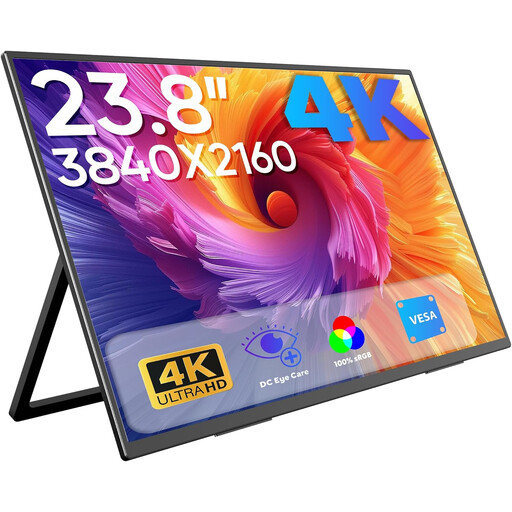
If you retouch on a laptop and want a portable second screen, compare this model’s size and connections with your workspace.
3840 × 2160 pixels; 60 Hz; 100% sRGB according to the product description; built-in stand; USB-C and Mini HDMI inputs.
 No image available
If you want a 27-inch 4K display for retouching, with USB-C for video and charging, check that its charging output meets your laptop’s requirements.
3840 × 2160 pixels; 120 Hz; 100% sRGB and 99% Adobe RGB according to the product specifications; HDR500; USB-C with 90 W Power Delivery; height-adjustable stand.
 No image available
If you’re considering a larger 4K display with stated Adobe RGB coverage for photo editing, make sure the 32-inch screen will fit your desk.
3840 × 2160 pixels; 240 Hz; 98% Adobe RGB according to the product description; USB-C with 98 W Power Delivery; height-adjustable stand.
 No image available
If you’re looking for a 27-inch monitor with native 4K resolution and USB-C for video and charging, check that its stated charging output meets your laptop’s requirements.
3840 × 2160 pixels; 4K 160Hz/FHD 320Hz; 1,152 dimming zones; USB-C with 65 W; height-adjustable stand.
No, resolution alone isn’t enough. Adobe describes monitor profiling, consistent lighting where possible and the printing workflow as factors that work together. What you see on screen also depends on the monitor and viewing conditions.
Check that the image and tools are easy to read at your chosen scaling setting, and avoid direct sunlight or lighting that changes significantly at the screen. For colour-critical decisions, Adobe recommends calibrating and profiling your monitor. You may need to recalibrate it after changing its settings.
No. For consumer purchases in Germany, the seller is generally liable for two years for defects that were already present when the goods were handed over. A manufacturer’s guarantee is an additional voluntary offer with its own terms and conditions, as explained by the Verbraucherzentrale (German consumer advice centre).
The EU energy label, with ratings from A to G, applies to electronic displays covered by the rules. The European Commission points consumers to the EPREL database for further model information. According to guidance from Germany’s Federal Environment Ministry, you shouldn’t put an old monitor in household waste. Take it to an authorised collection or return point instead. The return options offered by retailers depend on the relevant conditions.