If you want to assess print colours, choose a monitor and calibrated workflow suited to your output profile: 4K resolution and a wide colour gamut are no substitute for soft proofing. If you have limited access to power sockets, USB-C or Thunderbolt can do away with your laptop’s separate power adapter only if the port, video signal and charging power are all compatible with your laptop. For a straightforward layout preview, a less specialised 4K monitor may be enough.
Who is a 4K monitor for photobook double-page spreads suitable for?
Photobook designers who need to approve print output
If you want to assess colours for a specific photobook printing process, you need more than a suitable monitor: you also need the right output profile and a soft-proofing workflow. EIZO explains that the printing process, paper and ink can all affect the result compared with what you see on screen.
Laptop users with limited access to power sockets
If you want to send the video signal and power your laptop through a single connection, your computer’s port, the connection standard and the monitor’s charging power all need to be compatible. Manufacturers’ Power Delivery specifications vary by model.
Designers working on long runs of double-page spreads
If you mainly need to keep the page layout, image details and tools in view, compare resolution, screen size and how the monitor will fit into your workspace. A clear layout view alone doesn’t tell you how reliably you’ll be able to assess print colours.
What should you look for when buying a monitor for photobook previews and laptop power?
First decide what matters most to you: print-colour previews, powering your laptop or having a clear, spacious area for your layout.
| Priority |
What to check before you buy |
Who is it most relevant to? |
| Assessing print colours |
Check the colour gamut and calibration method of the specific model. EIZO points out that the printing process and paper affect the result; also check that the output profile and soft-proofing software are compatible. |
If I need to assess colours for a specific photobook print, I need a suitable output profile and soft-proofing workflow. Around 33% of consumers put print-colour previews first. |
| Powering a laptop through the monitor |
Compare the video output supported by the laptop’s port, the connection standard, cable and required charging power with the monitor’s specifications. |
If there are only a few power sockets at my workspace, I want to send the video signal and power my laptop through a single connection if possible. Around 27% of consumers prioritise powering their laptop. |
| Viewing double-page spreads clearly |
Compare the native resolution, screen size, stand dimensions and preferred system scaling with your workspace. |
When I’m checking long double-page spreads, I want to see the layout, images and tools clearly at a scaling level that suits me. Around 20% of consumers prioritise the layout view. |
| Calibration needs and choosing the right device |
Check what calibration and software your workflow requires, and which product specifications apply to the specific display. |
If I want to assess the extra effort involved in calibration and ongoing use before buying, I need information that’s relevant to my workflow and device. Around 20% of consumers focus on the overall effort involved. |
Which assumptions should you avoid?
-
Assuming 4K and a wide colour gamut are all you need for accurate print soft proofing
The final printed result also depends on the printing process, paper and ink. EIZO also points out that limitations such as a narrow colour gamut or uneven panel performance can’t simply be fixed through calibration.
First, choose your photobook provider and its output profile. Then check whether the monitor, calibration and software support a suitable soft-proofing workflow.
-
Assuming every USB-C port saves you a power socket
The connection needs to support both the required video signal and enough charging power for your laptop to do away with its separate power adapter.
Compare the technical specifications for your laptop’s port and its charging requirements with the specific monitor port and cable you plan to use.
-
Treating a review listing as proof that a monitor is suitable for print workflows
CHIP included the BenQ RD320UA in a selection of monitors for image editing. BenQ positions this model as a programming monitor and states that it covers 98% DCI-P3; these specifications don’t prove that it’s suitable for an equivalent Adobe RGB print workflow.
Check the intended use and colour-gamut specifications of the specific model, along with the output profile you need. Don’t assume that a place in a review means it’s suitable for soft-proofing your photobook.
Which brands are worth considering for this use?
ASUS
The ProArt PA279CRV is a 27-inch 4K model for workspaces where colour gamut and powering a laptop over USB-C matter.
- ASUS specifies 99% Adobe RGB coverage and 96 W USB-C Power Delivery for the PA279CRV.
- ASUS notes that specifications may vary by region. These figures are no substitute for checking compatibility with your laptop or choosing the right print profile.
BenQ
The SW272U and PD2732U are designed for photography, print and design workflows, while the RD320UA is positioned as a programming monitor.
- BenQ specifies 27 inches, 4K, 99% Adobe RGB coverage and 90 W charging power for both the SW272U and PD2732U. The SW272U also offers hardware calibration.
- According to BenQ, the RD320UA offers a 31.5-inch 4K display and 98% DCI-P3 coverage. These specifications don’t prove that it’s suitable for an equivalent Adobe RGB print workflow.
EIZO
The ColorEdge CG2700X is worth considering for regular, colour-critical photography and print work if self-calibration is part of your workflow.
- EIZO specifies 4K resolution, over 99% Adobe RGB coverage and an integrated calibration sensor for the CG2700X.
- Check separately whether its charging power is enough for your laptop. A calibration sensor is no substitute for the right print profile.
Dell
The UltraSharp U2725QE is a 27-inch 4K Thunderbolt hub monitor for workspaces where connectivity matters.
- Dell describes this model as offering 4K, IPS Black and hub features.
- Check the charging power available through the specific port you’ll use against your laptop’s requirements. Hub specifications alone don’t make it suitable as a print reference display.
LG
The UltraFine 27UP850K-W is a 27-inch 4K option for layout and general image previews.
- LG specifies USB-C and typical DCI-P3 coverage of 95%.
- These specifications don’t tell you whether the monitor provides enough charging power for your laptop, whether it covers Adobe RGB or whether it’s suitable for soft-proofing a particular photobook.
Joybuy products for layout and image-detail previews
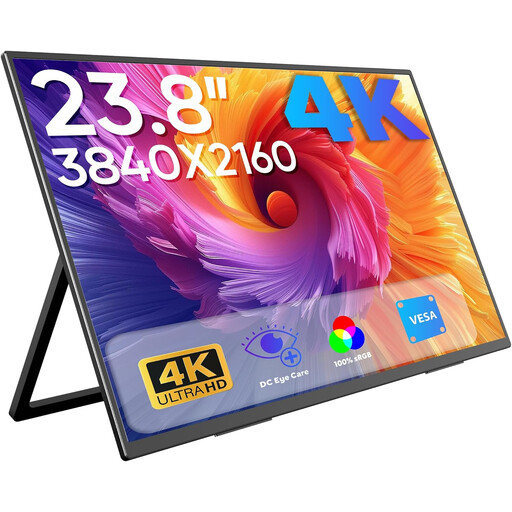
This selection includes a portable 4K monitor for previewing layouts and image details on a laptop.
 No image available
Portable 23.8-inch 4K monitor, 60 Hz
Described as a portable second screen for checking page layouts and image details on a laptop.
The product title specifies a 23.8-inch display, 3840 × 2160 pixels, 60 Hz, 100% sRGB and USB-C and Mini HDMI inputs.
A USB-C input alone doesn’t prove that the monitor can charge your laptop. Check the video connection for this specific model and the charging power your computer requires.
View at Joybuy
Frequently asked questions
Is a 4K monitor all I need to make my photobook look like the preview?
No. For a more accurate print preview, you need a suitable calibrated monitor, software that supports soft proofing and a profile for the specific combination of printing process and paper. EIZO notes that the result can vary depending on the print material and ink.
Can I always leave my laptop’s power adapter at home if I use USB-C?
Only if your laptop, connection and monitor support both the required video signal and enough charging power. BenQ specifies DisplayPort Alt Mode and 90 W Power Delivery for the SW272U; according to the manufacturer, the PD2732U offers Thunderbolt 4 and 90 W.
Do I need to calibrate a monitor regularly?
If you need to make colour-critical decisions, plan for a suitable calibration and profiling process. EIZO notes that calibration can’t compensate for a colour gamut that’s too narrow or uneven panel performance.
Which colour-gamut specification matters for photobook printing?
The right colour-gamut specification depends on your print workflow and is no substitute for an output profile. Check the photobook provider’s profile and whether the specific monitor and software you use support soft proofing.
Do energy label rules apply to monitors too?
EU energy labelling rules generally cover monitors too. However, the official EUR-Lex summary lists exceptions and different requirements for certain professional displays, so check how the specific model is classified and review its product information.
What are my rights when buying online in Germany if I change my mind or there’s a fault?
For an online purchase by a consumer, there is generally a 14-day right to cancel from the date the goods are received. The Verbraucherzentrale distinguishes this right from statutory rights relating to faulty goods and a voluntary manufacturer’s warranty. If you’re buying for business use, check separately whether consumer protections apply.


