Checking texture and UV seams
If you switch between the UV view and the 3D preview, you’ll want to be able to assess small breaks and transitions at the size you normally work at.


For checking texture seams, a monitor with native 4K resolution of 3840 × 2160 pixels is a sensible starting point. The key is to be able to assess the UV view and 3D preview at the size you normally work at. If you also need to make definitive colour decisions, the colour space, profiling and calibration process should suit your intended output. Adobe identifies monitor calibration and profiling as the first step in colour management. At a laptop workstation, you’ll also need to consider display compatibility, sufficient charging power and a screen position that works for you.
If you switch between the UV view and the 3D preview, you’ll want to be able to assess small breaks and transitions at the size you normally work at.
If colour matters alongside seams and your work is intended for a specific output, you’ll need a consistent approach to colour mode, profile and calibration.
If you use the monitor with a laptop when working from home, display compatibility, charging power and screen position all need to suit your workstation.
First, check that native 4K resolution and screen size suit the way you actually work. Then decide whether colour management or specific laptop connections are genuinely necessary for your workflow.
| What matters | What to look for | Who will find this especially important? |
|---|---|---|
| Seeing fine seams | Native resolution of 3840 × 2160 pixels; check that tools and surfaces remain clear at your chosen scaling setting. | If I want to assess breaks in both the UV view and the 3D model, detail at the size I normally work at matters. Around 36% of consumers put seam and detail inspection first. |
| Checking colours | Match the colour space mode to your intended output; include profiling and calibration in your workflow. | If I’m approving colours for a specific output, I want to tailor the colour space and calibration to suit it. Around 29% of consumers prioritise reliable colour control. |
| Laptop and workstation | Check that display compatibility and charging power match your laptop; consider the stand and desk space available. | If I use the monitor with a laptop, I want the connection and screen position to suit my desk. Around 21% of consumers prioritise a laptop-friendly workstation. |
| Keeping track of ongoing costs | Check what software and measurement devices are included; only budget for features that are genuinely part of your workflow. | If I want to avoid extra purchases for a feature I rarely use, I check its requirements and what’s included beforehand. Around 14% of consumers pay particular attention to keeping total and ongoing costs manageable. |
The UV view and model view show different aspects of a texture. For definitive colour decisions, you also need to consider the display profile and calibration status.
Check your usual UV and 3D workflow. Decide on the intended output before approving colours.
Manufacturers quote different colour spaces, and some figures are explicitly described as typical. A percentage showing colour space coverage alone doesn’t tell you how accurate a specific device is.
Compare figures for the same colour space and choose a mode that suits your intended output. Distinguish manufacturer claims from measured results.
LG says the 27UP850K-W can be calibrated using LG Calibration Studio and notes that the software isn’t included.
Check the exact model to find out what software and other requirements you’ll need for your intended calibration process.
Display compatibility and charging power depend on the features supported by your laptop and monitor, and the amount of power your laptop needs.
Check display compatibility and the charging power you need against the specifications for your laptop and the specific monitor model.
The ColorEdge CG2700X is a specialist 27-inch 4K option for workflows that involve regular colour calibration.
The DesignVue PD2725U is a 27-inch 4K design monitor with colour modes, uniformity technology and Thunderbolt 3.
The ProArt PA279CRV is a 27-inch 4K option with several colour modes and USB-C for a compatible laptop.
The 27UP850K-W is a 27-inch 4K IPS monitor with USB-C, an adjustable stand and support for hardware calibration.
The models below include both desktop and portable 4K monitors for viewing texture details. Compare the screen size and connections with your workstation and computer.
 No image available
Native 4K resolution may be useful for viewing texture details; check how it looks at your usual working size.
32 inches; OLED+; 4K UHD (3840 × 2160); 240 Hz at 4K and 480 Hz at FHD according to the product name.
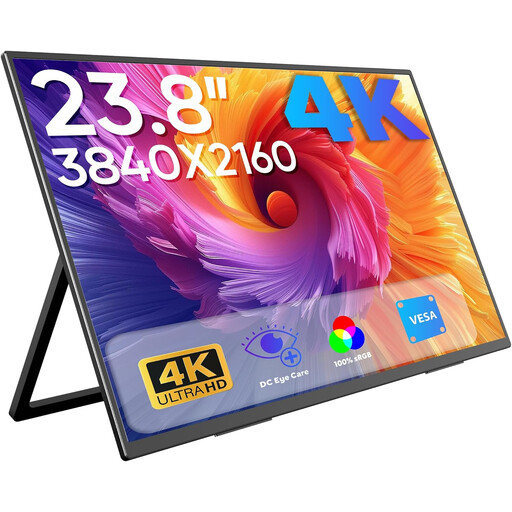 No image available
The portable design may suit a laptop workstation; check that the connections are compatible with your computer.
23.8 inches; 4K UHD (3840 × 2160); 60 Hz; built-in stand; USB-C and Mini HDMI inputs.
 No image available
Native 4K resolution is useful for viewing details; also check whether the stand lets you position the screen as you want.
27 inches; 4K UHD; IPS; 60 Hz; HDR Ready.
 No image available
Native 4K resolution is one factor to consider for viewing details; also take the adjustment options at your workstation into account.
27 inches; 4K UHD; IPS; tilt-adjustable stand.
 No image available
Native 4K resolution is a good consideration for viewing details; check that the USB-C connection and stand suit your laptop workstation.
27 inches; 4K UHD (3840 × 2160); IPS; 120 Hz; USB-C with 90 W Power Delivery; height-adjustable stand.
Compare the seam in both the UV view and the 3D model. Adobe describes a 2D view of UV islands in Substance 3D Painter, so a high monitor resolution alone can’t confirm that a texture is flawless.
There’s no general requirement to calibrate a monitor just to spot visible transitions. If you need to assess colours definitively, Adobe recommends calibrating and profiling the monitor, and ensuring that lighting conditions remain stable.
Only if your laptop and monitor support the display connection you need and the power output is suitable for your laptop. BenQ lists 65 W via Thunderbolt 3 for the PD2725U, while ASUS lists 96 W USB-C Power Delivery for the PA279CRV. These figures don’t guarantee compatibility with every laptop.
Check the energy label for the specific monitor and distinguish voluntary manufacturer warranties from your rights against the seller. The European Commission confirms that computer monitors are covered by energy labelling. EU information also states that goods bought from a trader come with a legal guarantee of at least two years.
For a standard distance purchase by a consumer, there is generally a 14-day withdrawal period from the date of delivery. Exceptions apply, and you should also check the rules on return costs. EU consumer information explains this period for distance purchases.