
Lieferung heute & morgen

Qualitätsgarantie

Willkommens-Angebote freischalten: KOSTENLOSE Lieferung | Bis zu 80 % RABATT | Kostenlose 30-Tage-JoyPlus-Testphase
App herunterladen
A 4K rear-view mirror dash cam combines a digital rear-view mirror with front and rear cameras. It can be a practical choice for commuters, families, taxi and delivery drivers, and owners of commercial vehicles. However, models vary considerably in resolution, storage, installation and extra features.
If you focus only on the “4K” specification, it’s easy to overlook important details. A high front-camera resolution, for example, says little about the rear camera’s quality, how easy the device is to use at night or how reliable the memory card is.
When buying a front and rear 4K dash cam, check whether both cameras really record in 4K. On many devices, the 4K specification applies only to the front camera. The rear camera may use a lower resolution, such as 2.5K or Full HD. That isn’t necessarily a drawback, but it’s worth knowing before you buy.
The image sensor, field of view, WDR processing and night recording also affect the picture. A dash cam with night vision can be useful in challenging light conditions, but it’s no substitute for adapting your driving or keeping the camera lens clean.
GPS, a G-sensor, voice control and parking monitoring are different features:
You should also consider the legal requirements before buying. In Germany, in particular, you need to take data protection, the reason for recording and an appropriate retention period into account. Publishing or sharing recordings continuously, without a specific reason, can cause problems.
A 128 GB memory card offers more capacity than a 32 GB card, but actual recording time depends on resolution, frame rate and the number of cameras. For loop recording, use a card designed for continuous video recording and check it regularly for errors.
The mounting system matters too. The rear-view mirror screen shouldn’t unnecessarily restrict your view. Route cables so they don’t interfere with airbags, pedals or the vehicle’s controls. For commercial vehicles, also check that the digital rear-view mirror’s size is compatible with the existing mirror assembly.
Check the resolution and field of view of both cameras. A combination of a 4K front camera and a 2.5K rear camera can be sufficient for many everyday situations. If you often reverse or need to monitor a long trailer or vehicle body, pay particular attention to the rear camera’s position and cable.
A rear-view mirror camera with GPS is useful if you want route and speed data saved alongside the video file. Check the data for personal information before sharing it.
A 12-inch smart rear-view mirror displays the camera image across a large area and can be used as a digital rear-view mirror. A smaller 10-inch screen may take up less space, depending on the vehicle. Touchscreen controls, voice control and physical buttons all offer different user experiences.
A dash cam with voice control can be useful if you want to save a recording or change the view while driving. Before you buy, check which voice commands are supported and whether the feature is available in your preferred language.
5.8 GHz Wi-Fi can speed up the transfer of video files to a smartphone, as long as your device and the app are compatible. Wi-Fi doesn’t replace an internet connection and isn’t automatically the same as a cloud service.
For parking monitoring, the power supply, shut-off behaviour and any battery protection are key considerations. A G-sensor can detect impacts, but sensitivity and trigger thresholds vary by model.
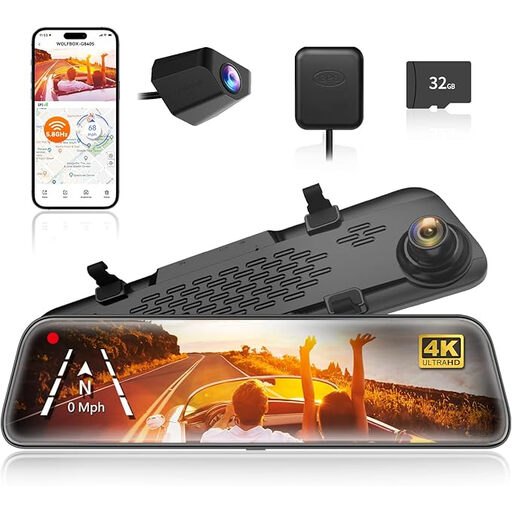
Why it suits this type of buyer: This model combines a 12-inch rear-view mirror with front and rear cameras, 5.8 GHz Wi-Fi, GPS and a supplied 32 GB card.
The specifications explicitly mention the rear camera, night recording and parking assistance, rather than focusing only on front-camera resolution.
12-inch display, 4K front recording, GPS, 5.8 GHz Wi-Fi and 32 GB memory card.
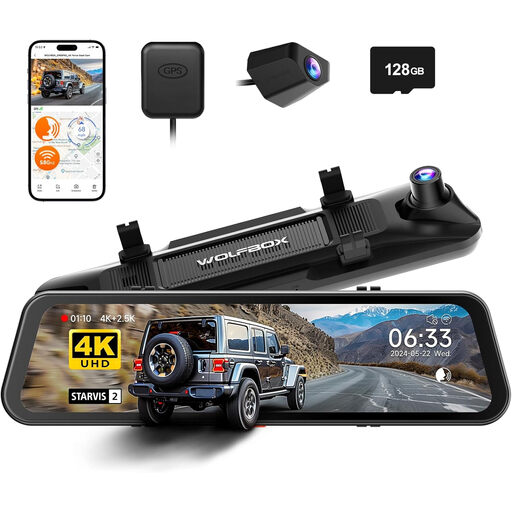
Why it suits this type of buyer: The combination of 4K front recording, 2.5K rear recording, an 8 MP STARVIS IMX678 sensor and a 128 GB card will appeal to those who like to compare technical specifications in detail.
The front and rear resolutions are listed separately, making it easier to compare the specifications with other models realistically.
128 GB card included, 5.8 GHz Wi-Fi, voice control, GPS, G-sensor and loop recording.
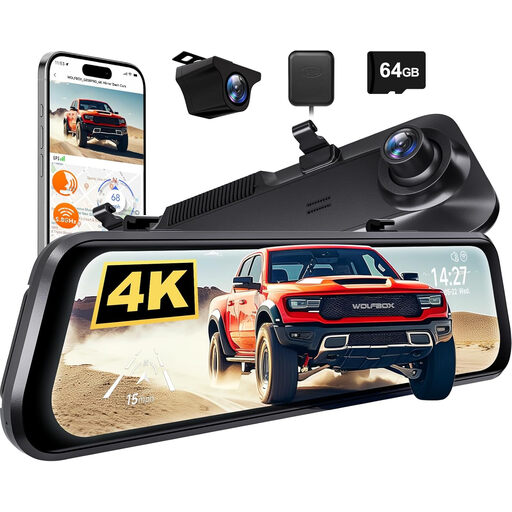
Why it suits this type of buyer: For frequent drivers, taxi drivers and delivery drivers, ADAS and BSD alerts, voice control and GPS can provide useful additional guidance.
The driver assistance features are presented as additional alerts, not as guaranteed obstacle or blind-spot detection.
12-inch mirror, ADAS and BSD, 5.8 GHz Wi-Fi, voice control, GPS, G-sensor and 64 GB card.
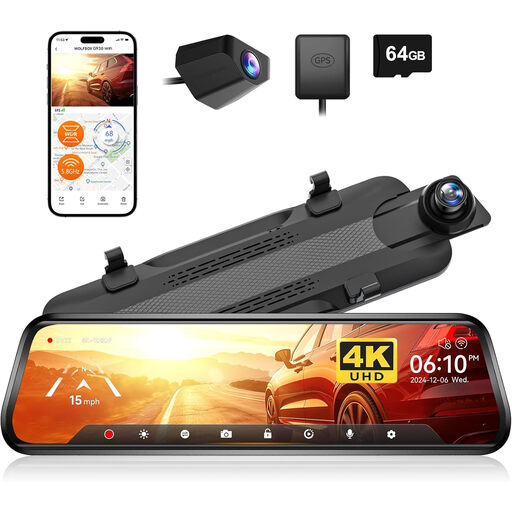
Why it suits this type of buyer: The 10-inch format may appeal to drivers who want a digital rear-view mirror with front and rear recording, but would prefer not to use a 12-inch screen.
The specifications list WDR, parking monitoring and reversing assistance separately, making it easier to distinguish recording from parking support.
10-inch touchscreen, 4K front and rear recording, WDR, GPS, 5.8 GHz Wi-Fi, parking monitor and 64 GB card.
We’ve put together a complete, regularly updated list of products that meet these strict selection criteria and fully comply with the safety regulations in force in the EU.
Many models fit over or attach to the existing rear-view mirror. The front camera needs a clear view through the windscreen. The rear camera is usually fitted at the back of the vehicle and connected to the display. Before securing everything in place, check the camera angles, cable routing and reversing view.
It depends on the storage capacity, resolution, frame rate and number of active cameras. A 128 GB memory card typically stores more footage than a 32 GB card. When loop recording is enabled, older, unprotected files are overwritten. The G-sensor can save event files separately.
In addition to the purchase price, you may need to budget for a suitable memory card, a replacement card and, if necessary, professional installation. For parking monitoring, check whether you need a compatible hardwiring kit or battery protection. The specific equipment and your vehicle’s compatibility will determine the actual cost.