
Lieferung heute & morgen

Qualitätsgarantie

Willkommens-Angebote freischalten: KOSTENLOSE Lieferung | Bis zu 80 % RABATT | Kostenlose 30-Tage-JoyPlus-Testphase
App herunterladen
The search for the right remote-controlled car can quickly become overwhelming. The market is flooded with models promising incredible speeds and indestructible toughness. But too often, these promises turn out to be empty marketing claims, leading to disappointment and an empty wallet. Before you make a decision, it's crucial to understand the common pitfalls that cost buyers money.
A solid understanding of the core features will help you avoid these problems and find a model that is worth its price.
To identify a high-performance and durable model, you should closely examine three technical aspects. These are the primary factors that determine off-road capability and driving enjoyment.
The drivetrain system is the heart of any off-road vehicle. Here, 4WD (four-wheel drive) is the crucial component for challenging terrain. Unlike a 2WD (two-wheel drive) system, which only transfers power to two wheels, a four-wheel drive RC car distributes the engine's power to all four wheels. The result is significantly better traction on loose surfaces like sand, gravel, or damp earth. Combined with a high-torque motor, such as a brushed motor, this allows for impressive climbing abilities and stable control even at high speeds. Such a setup is ideal for a fast RC car that needs to perform not just on asphalt, but in the wild as well.
The robustness of an off-road RC car depends entirely on its chassis. Models with an aluminum alloy chassis plate and metal-reinforced parts in the shock absorber and transmission systems offer significantly higher resistance to impacts and torsion. These vehicles can withstand hard landings and collisions without serious damage.
Another key feature is being a waterproof RC buggy. Caution is advised here: "waterproof" usually means the electronics are protected against splashes and driving through shallow puddles. It is not an invitation to fully submerge the vehicle. Nevertheless, this feature allows for use in the rain or on muddy tracks, ensuring year-round driving fun.
Battery performance determines how long the fun lasts. Pay attention to the capacity, indicated in milliampere-hours (mAh). A 7.4V 1500mAh lithium-ion battery provides a solid foundation for extended drives. An uncomplicated charging process, ideally via an included USB cable, is just as important.
The remote control is your interface to the vehicle. A 2.4GHz pistol-grip remote is the standard for hobby-grade models. It ensures an interference-free connection, even when multiple vehicles are running at the same time. More professional transmitters also offer settings for speed, steering, and other parameters, making them adaptable for both an RC car for beginners and advanced drivers.
Based on the quality features mentioned, we have put together recommendations tailored to different users.
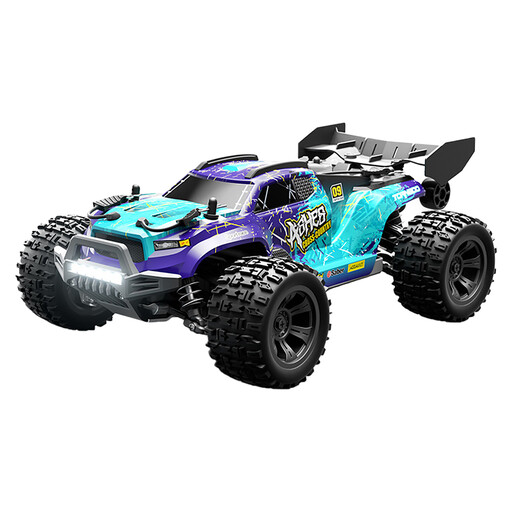
Why this model is a great fit: This model is designed as a "Ready-to-Run" set and includes everything needed to get started immediately. The professional remote control allows you to throttle the speed, which prevents beginners from being overwhelmed and enables a gradual learning process.
The complete accessory package avoids the trap of hidden follow-up costs. Unlike pure toy cars, its performance is based on a solid 4WD system, not on empty speed promises.
The all-inclusive package, with a battery, charging cable, and tools, makes getting started effortless. The 2.4GHz remote ensures interference-free and precise control.
Why this model is a great fit: As a birthday gift for boys or for other occasions, this set is ideal. It comes in an attractive gift box and includes everything needed for an immediate start, maximizing the joy of unboxing.
The robust construction with an aluminum chassis prevents the typical disappointment that occurs when a cheap toy car breaks after a short time. This model is built for durability and offers lasting play value.
The "all-in-one" concept makes it a straightforward and high-quality gift. No prior technical knowledge is required to operate the vehicle.
Why this model is a great fit: For drivers looking for an RC car for adults that offers true off-road performance. The 4WD system, large high-grip tires, and splash-proof electronics allow for use on sand, grass, mud, and even in light rain.
Instead of relying on a single, high-speed claim, this model delivers balanced performance. The reinforced aluminum chassis withstands the stresses of off-road driving where cheap plastic models would fail.
The combination of a powerful motor, 4WD system, and robust build enables versatile maneuvers like drifts and jumps. The bright LED headlights also allow for driving at dusk.
We have compiled a complete, up-to-date list of products that fully meet these strict selection criteria and safety regulations.
The battery life depends on the capacity (in mAh) and your driving style. A 1500mAh battery typically allows for a runtime of 15 to 25 minutes. Continuous driving at top speed or in difficult terrain will shorten the runtime, while moderate driving will extend it. Many enthusiasts purchase a second battery to double the driving time without a long charging break.
The term "waterproof" in RC vehicles usually refers to protection against splashes (e.g., rain or puddles). The electronic components, such as the speed controller and receiver, are sealed to prevent short circuits. However, the vehicle should not be fully submerged in water. After driving through water or mud, thorough cleaning and drying are important to prevent corrosion.
The main difference lies in quality, performance, and repairability. Toy-grade RC cars are mostly made of simple plastic, have low performance, and often cannot be repaired if they break. Hobby-grade RC cars, like the model featured here, use higher-quality materials (e.g., metal parts), offer significantly higher performance, and have a modular design. This means that almost every part—from the motor to the suspension—can be individually replaced or upgraded, ensuring a much longer lifespan.