
Lieferung heute & morgen

Qualitätsgarantie

Willkommens-Angebote freischalten: KOSTENLOSE Lieferung | Bis zu 80 % RABATT | Kostenlose 30-Tage-JoyPlus-Testphase
App herunterladen
A convertible tricycle promises to be a faithful companion for your child, from their first birthday to their preschool years. However, the market is saturated with models whose promises don't hold up in practice. As a Joybuy Product Recommendation Officer, I'll help you identify the crucial features and make a choice that will pay off for years to come.
Many parents invest in a 5-in-1 model only to find it sitting unused in a corner after just a few months. This is often due to three common problems that are overlooked during the purchasing decision.
To avoid these pitfalls, you should focus your attention on three core technical parameters. These determine whether a toddler tricycle is a worthwhile long-term investment.
The foundation for safety and durability is the frame. Models made from high-carbon steel or aluminium offer significantly greater stability and load capacity than all-plastic designs. Look for a wide rear axle, which increases stability against tipping, especially as your child begins to steer and ride independently. A solid frame ensures the tricycle remains stable even after several years of intensive use.
A true tricycle and balance bike in one is distinguished by a well-designed and user-friendly conversion mechanism. Check if the most important components can be easily adjusted:
The type of wheels directly impacts ride comfort and safety. Rubber or PU (polyurethane) wheels are the superior choice over hard plastic. They offer more grip on various surfaces, roll more quietly, and absorb small bumps. For the child's safety, especially when used as a tricycle for 1-year-olds, a reliable harness system is essential. A 2-point harness (lap belt) is the minimum; a 5-point harness provides even more support and security.
Based on these objective criteria, we have identified products that offer a well-thought-out solution for everyday family life.
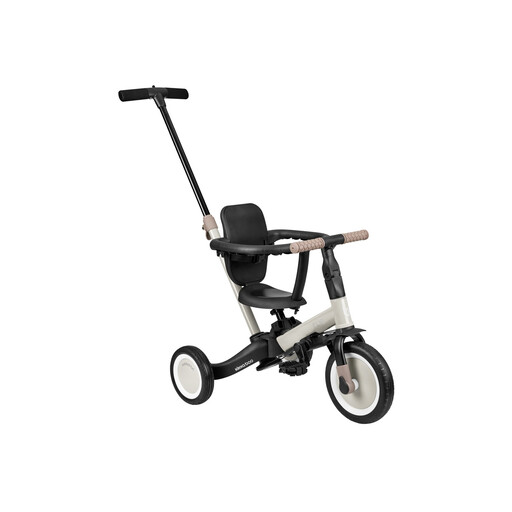
Why It's a Great Fit: This Kikka Boo tricycle is designed for families seeking a single, durable solution for the 1-to-5-year age range. It covers every stage of development—from being safely pushed by parents and learning to pedal, to riding independently as a balance bike or bicycle. This saves not only money but also storage space.
The frame, made of high-carbon steel, counteracts the problem of poor durability. The clearly defined 5-in-1 modes and adjustable components address the concern of a complicated conversion. The 2-point harness system and the combination of rubber and PU wheels provide a solid safety foundation.
Versatility: Five usage modes (push mode, tricycle, tricycle without pedals, balance bike, bicycle) support motor skill development over several years.
Control & Comfort: The 3-level adjustable push handle and height-adjustable seat ensure ergonomics for both parent and child.
We have compiled a complete, up-to-date list of products that fully meet these strict selection criteria and high safety standards.
Most models are designed for children from around 12 months old. In the first phase, the vehicle is used as a tricycle with a push handle, where parents have full control over steering and speed. The child is secured by a harness and often a safety bar. As the child grows and shows interest, they can gradually learn to pedal and steer on their own.
The complexity of the conversion is a critical factor and varies greatly between manufacturers. Look for product descriptions that highlight "tool-free" or "easy" conversion with click-in mechanisms. Models that require a full toolbox for every transformation are often impractical for daily use.
For a versatile, adjustable tricycle, wheels made of rubber or polyurethane (PU) are the clear winner. They provide better traction on various surfaces like parquet, tile, asphalt, or pavements. They also ensure a quieter, smoother ride and absorb minor impacts, which increases comfort for the child. Hard plastic wheels are often loud, slippery, and wear out more quickly.