
Lieferung heute & morgen

Qualitätsgarantie

Willkommens-Angebote freischalten: KOSTENLOSE Lieferung | Bis zu 80 % RABATT | Kostenlose 30-Tage-JoyPlus-Testphase
App herunterladen
A 5-in-1 kids’ tricycle is designed to cover several stages of development: initially being pushed by an adult, followed later by independent pedalling or riding without pedals. For parents and grandparents, this sounds like a practical long-term solution. In practice, however, its usefulness depends greatly on whether the child’s age, height, safety features and conversion system are compatible.
As Joybuy Product Recommendation Officers, we therefore focus our selection on clear product features rather than marketing claims. This helps you avoid common unsuitable purchases and compare models for everyday use in the UK more effectively.
A 5-in-1 model may be used, for example, as a push-along vehicle, classic tricycle, pedal-free tricycle, balance bike and later as a children’s bicycle. What matters is how easily you can switch between the individual configurations. If the pedals, footrest or safety bar can only be removed using awkwardly positioned screws, the versatile design may end up going unused in everyday life.
Before buying, check:
A folding kids’ tricycle can be practical for the boot of your car, the shed or holidays. However, the folded dimensions should be clearly stated in the product specifications; a compact design alone does not automatically mean that the model can be folded completely.
An adjustable parent push bar makes it easier for adults to steer and guide the tricycle. However, it will not stop a child from sliding forwards when braking or leaning out of the seat. Look for a safety harness, a sturdy seat and a secure push-bar locking mechanism.
For younger children, a foldable footrest and removable safety bar are also important. Before every ride, check the locks, screws, wheels and harness. Manufacturers’ warnings also frequently specify that the tricycle must be used under direct supervision, that a helmet should be worn and that it is not suitable for roads, stairs or steep slopes.
The description “tricycle for children from 1 to 5 years” is only a general guideline. Height, inside leg measurement and motor skills vary considerably. An adjustable seat is useful if your child can reach the pedals or the ground safely. The seat height should not leave their legs permanently bent, nor should it prevent them from maintaining stable contact with the pedals.
You should also check the maximum user weight. The product information provided for the Kikka Boo 5in1 Flip states a maximum user weight of 25 kg. This limit must not be disregarded simply because of the age recommendation.
A steel frame, described as being made from high-carbon steel for the Kikka Boo 5in1 Flip, can provide a solid basis for the construction. However, the entire system matters when making your decision: the frame joints, axles, locking mechanisms and attachment of the parent handle must all be robustly made.
Rubber or PU wheels can be comfortable indoors and on paved paths. The Kikka Boo model is listed with a rubber front wheel and polyurethane rear wheels. This tells you something about the materials and potential noise levels, but it does not replace checking the intended riding surface. Performance on wet leaves, coarse gravel or uneven paths may differ from that on a level pavement.
A growing-with-your-child tricycle should offer several adjustment options:
The Kikka Boo 5in1 Flip is listed with a push bar offering three positions. This can accommodate the posture of different accompanying adults. A rotating seat is also specified for some versions; before buying, check whether this feature applies specifically to the version you have chosen.
The CE mark is a legally required conformity marking for certain product groups, but it is not an independent quality assessment. You should therefore read the information about the manufacturer, importer, age range, user weight and warnings. For a children’s vehicle, use on public roads should be expressly prohibited or clearly regulated.
A model advertised as a children’s bicycle from 1 year is not automatically suitable for independent use on public roads. With toddlers, supervised use in push mode should be the priority. A 2-in-1 balance bike and tricycle is often aimed at a narrower stage of development than a 5-in-1 model, so it may be the better choice if you do not need as many conversion options.
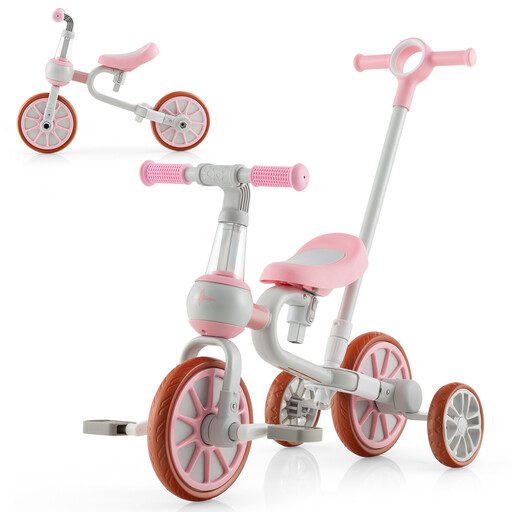
Why this product suits this profile: This version is aimed at families looking for a simpler multi-purpose vehicle with an adjustable parent push bar for children aged approximately 2 to 4.
The 4-in-1 design reduces the number of conversion options, which can make it more straightforward than a more extensive 5-in-1 system.
Adjustable parent push bar and several usage stages, according to the product name.
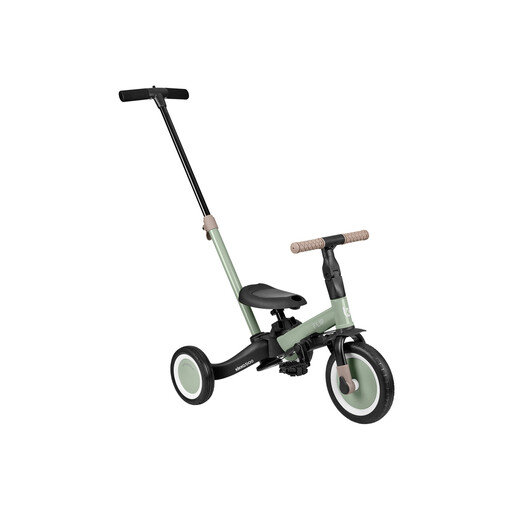
Why this product suits this profile: Suitable for families looking for five clearly defined usage modes, a safety harness and adjustment options for longer-term use.
The product information specifies a 2-point harness system, a height-adjustable seat and a parent handle with three adjustment positions.
Listed for ages 1 to 5, with a high-carbon steel frame, dimensions of 70 × 45 × 65–91 cm and a net weight of 5.6 kg.
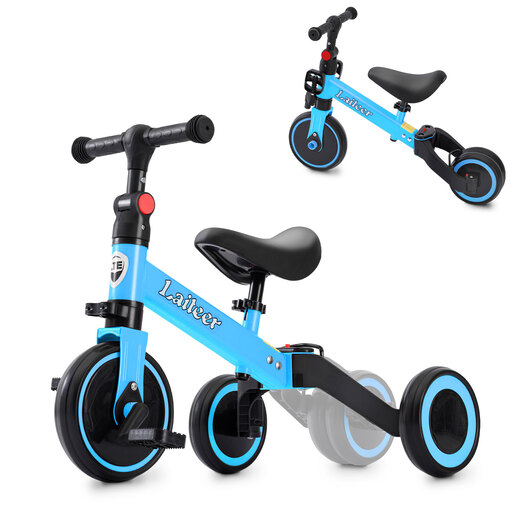
Why this product suits this profile: A suitable option for families specifically looking for a 2-in-1 balance bike and tricycle for balance training and flexible use.
The simplified 2-in-1 design focuses on two functions and avoids unnecessary components for riding modes that are not needed.
Adjustable seat, removable pedals and folding design, according to the product name.
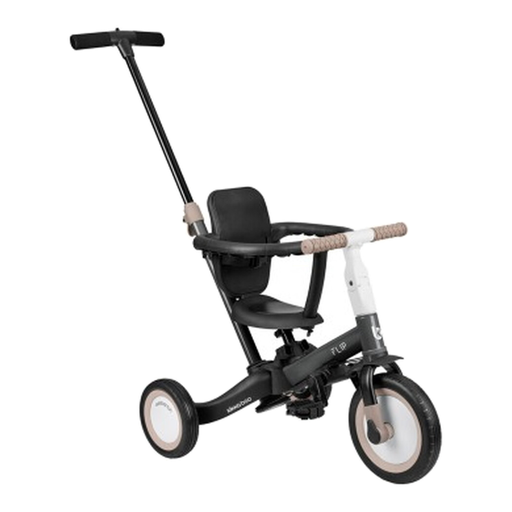
Why this product suits this profile: The black version is aimed at buyers who prefer the features of the Kikka Boo tricycle without a bold colour scheme.
The stated checks are specific and easy to verify: 2-point harness, height-adjustable seat, three-position push bar and specified weight limit.
Five usage modes, rubber and PU wheels, and a net weight of 5.6 kg, according to the product information.
We have put together a complete, regularly updated list of products that fully meet these strict selection criteria and the safety regulations applicable in the EU.
This depends on the specific model and the intended usage mode. According to the product information, some 5-in-1 tricycles are suitable from 1 year, initially in push mode with a safety harness and footrest. Other models are only suitable from the age of 2. In addition to the stated age range, height, user weight and a secure seating position are all important factors.
Some models are listed as suitable for children aged 1 to 5. The actual period of use depends on whether your child remains within the weight limit and can reach the seat and pedals safely. Check the screws, wheels, harness and locking mechanisms regularly. Worn or damaged parts should be replaced before the tricycle is used again.
Under normal use, there are usually no ongoing energy costs. However, you may need to budget for replacement parts, tyres, screws or a suitable children’s helmet. A transport bag may also be useful for a folding model. Before buying, it is worth checking whether the manufacturer provides spare parts and care instructions.