People who cook with dried fruit regularly
You use the same fruit in several dishes and expect to get through a 500 g pack.


For student meals you cook regularly, a 500 g pack makes sense if the fruit suits your recipes and you’ll use it all. Sultanas, dates and prunes aren’t interchangeable, so check the ingredients and storage instructions for the specific product too.
A larger pack is best suited to recipes you make regularly or a specific type of fruit you’re looking for.
You use the same fruit in several dishes and expect to get through a 500 g pack.
You need a particular fruit for your recipes and check what else is in the specific product before buying.
You’re specifically looking for mango, dates, fruit mixes or freeze-dried fruit because the flavour or processing matters for how you plan to use it.
Start by choosing the type of fruit you need for your dishes. Then decide whether you can use and store the pack size appropriately.
| What to consider | What to check before buying | Who it matters to |
|---|---|---|
| Pack size | Does a 500 g pack suit how often you use it and the storage instructions? | If I often use the same fruit for breakfast or dinner, I want to be able to use the whole pack. This need to stock up is the main consideration for around 39% of consumers. |
| Type of fruit | Choose a single fruit or a mix to suit the recipe you have planned. | I need a particular fruit for my dishes and don’t want to replace it with just any mix. Getting the right fruit for a recipe is the top priority for around 23% of consumers. |
| Ingredients and portions | Read the ingredients list and nutritional information for the specific product, and plan how much you’ll use. | If extra ingredients or the amount per portion matters to me, I take a closer look at the pack before buying. This is the top priority for around 23% of consumers. |
| Availability and storage | Check the pack size available where you shop, as well as the storage instructions. | I want to find a suitable pack locally and store it properly once opened. This practical consideration comes first for around 15% of consumers. |
Mango, fruit mixes and freeze-dried fruit differ from sultanas or prunes in both fruit type and processing. They won’t necessarily work as substitutes in every dish you have planned.
Before buying, think about the dishes you’ll use that particular fruit and its processing in.
Ingredients vary by product. REWE’s ja! Prunes, for example, contain water and potassium sorbate as well as dried plums.
Check the ingredients list if you want to be aware of any additional ingredients.
According to the consumer advice centre, temperature and humidity affect how long food keeps. REWE recommends storing its ja! Prunes in a dry place, away from heat.
Follow the instructions on your pack and seal it carefully after opening.
An opened pack takes up suitable storage space for longer if you only use the fruit occasionally.
The ranges below offer different types of fruit and pack sizes. The specific product matters more than the brand name alone.
Seeberger offers dates, sultanas and prunes in 500 g packs, as well as other types of fruit and formats.
REWE sells ja! Prunes in a 500 g pack.
The EDEKA24 range includes various dried fruits, such as raisins, dates and figs.
ALDI SÜD sells FARMER NATURALS sultanas and prunes in 500 g packs.
Lidl includes Alesto in its range of nuts, dried fruit and snacks.
These 500 g packs include sultanas, prunes and two different date products. Start by choosing the fruit for the dishes you have planned, then check the ingredients and storage instructions on the pack.
 Image unavailable
A good choice for dishes where you regularly use dates. The product name states that the dates are pitted; check the storage instructions on the pack.
 Image unavailable
For recipes where you specifically want to use red dates. Before preparing them, check whether they’re pitted if that matters for your dish.
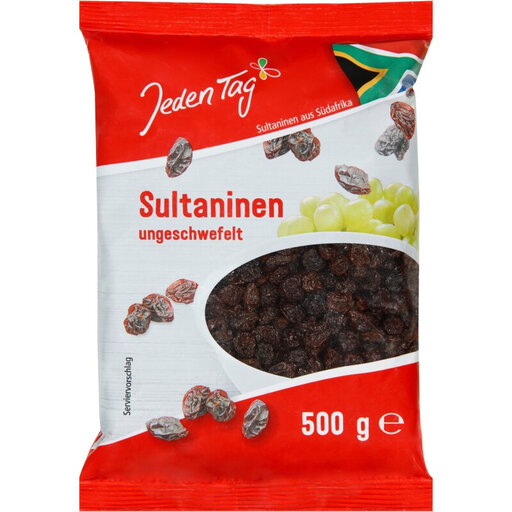 Image unavailable
A pack for recipes you make regularly with sultanas, such as baking or breakfast dishes. Seal it after opening, following the instructions on the pack.
 Image unavailable
For dishes you make regularly with prunes. The ingredients list includes potassium sorbate; despite the ‘pitted’ description, the product information says that fragments of stones may be present.
A 500 g pack is a good fit if you use that fruit regularly and can store it properly. Plan specific recipes rather than choosing based on pack weight alone.
The German Nutrition Society (DGE) gives 25 g of dried fruit as one portion and notes that it contains more calories than fresh fruit. Pack weight shouldn’t be mistaken for a portion size.
It depends on the specific product. For example, according to REWE, the ingredients list for ja! Prunes includes water and potassium sorbate as well as dried plums.
Follow the instructions on the pack and seal it carefully after opening. REWE recommends storing ja! Prunes in a dry place, away from heat; the consumer advice centre notes that temperature and humidity affect how long food keeps in general.