
Lieferung heute & morgen

Qualitätsgarantie

Willkommens-Angebote freischalten: KOSTENLOSE Lieferung | Bis zu 80 % RABATT | Kostenlose 30-Tage-JoyPlus-Testphase
App herunterladen
A portable power station with a capacity of around 500 watt-hours (Wh) is a flexible solution for on-the-go power. Whether for camping, as storage for a balcony solar system, or as a quiet emergency power supply during an outage, its applications are diverse. Choosing the right device depends on specific technical parameters. This guide breaks down the crucial criteria and presents a selection of models based on their specifications.
Your choice of model should be based on an analysis of technical data tailored to your specific use case.
Capacity, measured in watt-hours (Wh), defines the amount of energy stored. For example, a 500Wh power station can power a 50-watt device for about 10 hours (500Wh / 50W = 10h), accounting for efficiency losses. The power output, measured in watts (W), determines which devices can be run simultaneously. A continuous output of 500W is sufficient for most mobile devices like laptops, cameras, small coolers, or lamps.
Modern power stations increasingly rely on LiFePO4 (Lithium Iron Phosphate) batteries. Compared to conventional lithium-ion (NCM/NCA) batteries, LiFePO4 cells offer a significantly longer cycle life. This means they can be fully charged and discharged many more times before their capacity noticeably degrades. It's common to see ratings of over 3,000 cycles while retaining 80% of their original capacity. Furthermore, they are considered more thermally stable and thus safer to operate.
A wide selection of ports ensures high functionality. Standard ports should include:
A power station's flexibility is also reflected in its charging options. Common methods include:
An integrated UPS (Uninterruptible Power Supply) function is a key feature for use as an emergency power source. During a power outage, the power station switches to battery power within milliseconds, ensuring the continuous operation of connected devices. An Eco Mode helps conserve energy by automatically shutting down the power station when it's not in use.
The following models were selected based on their technical specifications and feature sets in the 500Wh category.
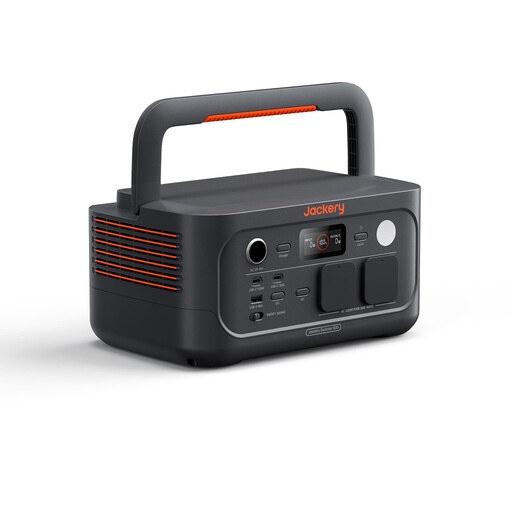
Why We Recommend This Product: The Jackery Explorer 500 V2 combines a 512Wh capacity with a solid 500W continuous output. A standout feature is its ChargeShield 2.0 technology, which, according to the manufacturer, enables a full recharge in approximately 1.3 hours while keeping the charging noise level as low as 36 dB. The device uses a long-lasting LiFePO4 battery rated for up to 6,000 cycles while retaining 70% capacity. Weighing 5.7 kg and featuring an integrated carrying handle, it is designed for portability.
Pros:
Who It's For: Users looking for a well-rounded balance of durability, fast charging, and portability for camping, travel, or home backup.

Why We Recommend This Product: The Anker 535 Power Station focuses on ruggedness and longevity. It is equipped with a LiFePO4 battery rated for 3,000 charge cycles. Its unibody design is built to ensure high resistance to drops and impacts during outdoor use. With a 512Wh capacity and 500W output, it powers a wide range of devices through its seven ports. According to Anker, it recharges to 80% in under 2.5 hours using the included AC adapter.
Pros:
Who It's For: Outdoor enthusiasts and mobile professionals who need an exceptionally durable and long-lasting device for use in demanding conditions.
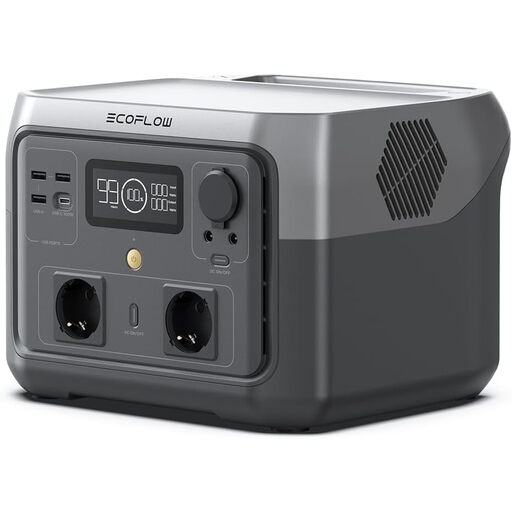
Why We Recommend This Product: The EcoFlow RIVER 2 Max stands out with its X-Stream fast-charging technology, which the manufacturer claims can achieve a full recharge from a wall outlet in just one hour. Despite its 512Wh capacity and 500W continuous output, the device can temporarily power appliances up to 1000W thanks to its X-Boost mode. The LiFePO4 battery is rated for over 3,000 cycles. At 6 kg, it is also highly portable and offers a wide array of ports, including app control via Wi-Fi and Bluetooth.
Pros:
Who It's For: Users who prioritise minimal charging times and the ability to temporarily run more powerful devices, for example, when using a power station for camping or in professional settings.
The models featured here cover common use cases in the 500Wh range. If these specifications don't perfectly match your needs, a broader spectrum of devices with different capacities, power ratings, or form factors is available. You can find a more comprehensive overview in our main category for solar portable power stations.
1. What can you run with a 500Wh power station? A power station with a 500Wh capacity can typically run a laptop (approx. 50W) for 8-10 hours, power an LED lamp (10W) for about 45 hours, or recharge a smartphone (approx. 10Wh battery) around 40-50 times. It is also suitable for operating small coolers, cameras, drones, or medical devices like CPAP machines overnight.
2. How long does a LiFePO4 battery last in a power station? A LiFePO4 battery is designed for exceptional longevity. Manufacturers often specify a cycle life of 3,000 or more while retaining 80% of the original capacity. With daily use, this translates to a theoretical lifespan of nearly 10 years, making it a sustainable investment.
3. Can a power station serve as an emergency power supply during an outage? Yes, a power station is an excellent alternative to noisy, petrol-powered generators. Models with a UPS function can ensure the uninterrupted operation of essential devices like routers, computers, or lights. They operate silently, are emission-free, and are safe for indoor use.