
Lieferung heute & morgen

Qualitätsgarantie

Willkommens-Angebote freischalten: KOSTENLOSE Lieferung | Bis zu 80 % RABATT | Kostenlose 30-Tage-JoyPlus-Testphase
App herunterladen
A flat tyre on the motorway or an upcoming seasonal wheel change—both situations can quickly become an ordeal. Reaching for the standard onboard tool kit often involves physical exertion, dirty hands, and a sense of uncertainty. An electric car jack promises a solution, but the market is overwhelming, and many products fail to deliver on their promises. Before you make a purchase, it's crucial to understand the common pitfalls that lead to frustration and, in the worst-case scenario, safety risks.
As your Joybuy Product Recommendation Officer, I'm here to help you separate marketing hype from hard facts. We'll highlight the three most common purchasing mistakes and show you what really matters.
To avoid a bad purchase, you should carefully examine three technical features. These define the safety, functionality, and practical utility of your future assistant.
The most important metric is the maximum lifting capacity. For owners of SUVs, campervans, or light commercial vehicles, a 5T electric car jack is a sensible choice. This capacity provides a crucial safety margin that accounts not only for the vehicle's kerb weight but also for any additional cargo. Also, pay close attention to the lifting height. A jack for an SUV must reach a sufficient height to allow for a safe tyre change, even on vehicles with high ground clearance. Check the minimum and maximum lifting height and compare it with your vehicle's requirements.
Most electric car jacks for mobile use are powered by the vehicle's 12V cigarette lighter socket. This makes them independent of external power sources and ideal for roadside breakdowns. An electric car jack should feature simple, push-button controls, replacing the tedious cranking of a manual model. A sufficiently long power cable is also important to comfortably reach all four wheels.
Some models go beyond the basic lifting function and offer real added value. A jack with a compressor allows you to correct tyre pressure on the spot or inflate the spare tyre to the correct pressure. Other useful additions include an integrated LED light for use in the dark, an included impact wrench for quickly loosening wheel nuts, and a sturdy case that stores the portable car jack and its accessories safely and compactly.
Not every driver has the same needs. We have compared different models that are suited to various usage scenarios.
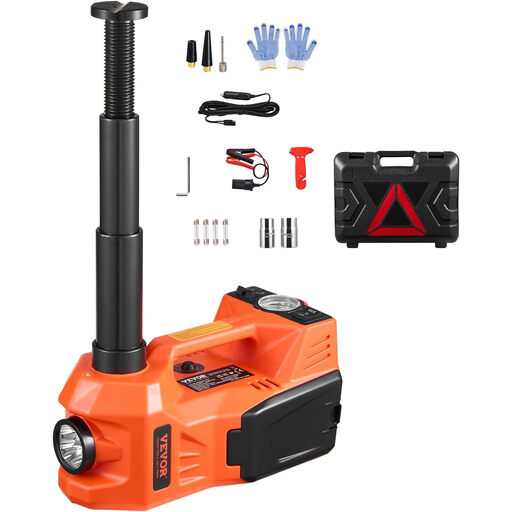
Why This Fits Their Persona: This kit is the all-in-one solution for drivers of heavy vehicles on long-distance journeys. The 5T lifting capacity, 12V operation, and integrated compressor offer maximum independence and safety during a breakdown.
The high 5-ton lifting capacity prevents overloading. As a complete tyre changing tool kit with a compressor and emergency hammer, it avoids hidden follow-up costs and missing accessories in a critical situation.
Multifunctional thanks to the integrated pump and LED light. Effortless push-button operation that completes the lifting process in about 2 minutes (according to the manufacturer).
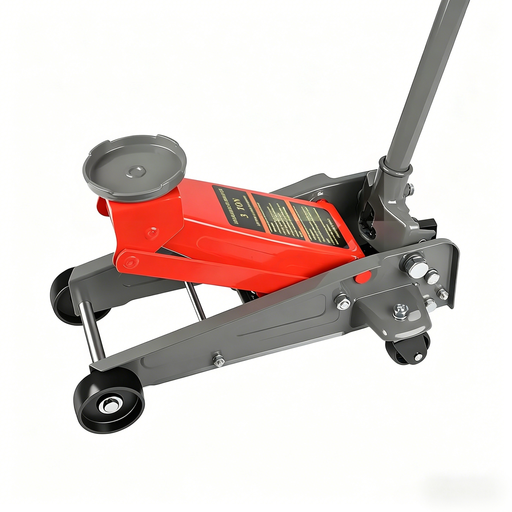
Why This Fits Their Persona: Ideal for the ambitious DIY mechanic who performs regular maintenance in their own garage. The robust hydraulic design and castors allow for easy positioning under the vehicle on a flat workshop floor.
This model bypasses the instability trap with its solid carbon steel construction and wide stance. It is designed for stationary use, where it offers maximum stability.
High stability and durability for repeated use. The 360° swivel castors provide excellent manoeuvrability in the workshop.
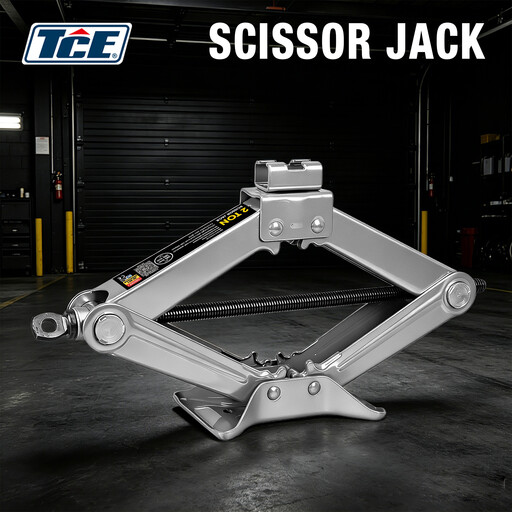
Why This Fits Their Persona: A simple, manual, and very space-saving solution for owners of saloons or city SUVs. Anyone who doesn't mind a bit of physical work and is looking for reliable, compact emergency equipment for the boot will find this a suitable tool.
This model focuses on the essentials. It avoids the complexity and potential failure points of electronics, offering a straightforward mechanical solution that impresses with its simplicity.
Extremely compact and foldable, it fits easily into the spare tyre well. Operation via a hand crank is uncomplicated and requires no power source.
We've compiled a complete, up-to-date list of products that fully meet these strict selection criteria and safety regulations.
When used correctly, an electric scissor jack is a safe alternative to a manual model. It is important to park the vehicle on a level, solid surface, apply the handbrake, and only place the jack at the lifting points specified by the vehicle manufacturer. Many electric models have a self-locking mechanism that prevents the jack from lowering if the power is interrupted.
The power consumption for a single lifting operation is relatively low and poses no problem for a healthy car battery. However, if the power supply is interrupted, the mechanical self-locking feature of the spindle ensures that the jack holds its position and the vehicle does not lower uncontrollably. The vehicle can then be lowered manually.
Most models come in a robust and compact plastic case. This case neatly and securely stores the jack and all accessories, such as cables, adapters, and often the impact wrench. The entire kit therefore takes up little more space than a small toolbox and can be easily stored in the boot or in the spare tyre well.