
Lieferung heute & morgen

Qualitätsgarantie

Willkommens-Angebote freischalten: KOSTENLOSE Lieferung | Bis zu 80 % RABATT | Kostenlose 30-Tage-JoyPlus-Testphase
App herunterladen
A 60 cm cooker hood fits many standard hobs, making it a popular choice for small, open-plan or refurbished kitchens. However, the right size alone does not guarantee good everyday usability. The key factors are installation type, air extraction, noise level, filter maintenance and the space available above the hob.
An advertised extraction rate of several hundred cubic metres per hour sounds convincing at first. In practice, however, actual performance also depends on the extraction duct, duct length, bends and backdraught flap. In recirculation mode, the air is not vented outside. Instead, a carbon filter absorbs odours, while grease filters capture grease particles.
Before buying, you should therefore establish whether you need a cooker hood with recirculation and extraction. A flexible model makes sense if the kitchen does not have an existing extraction duct or if the installation method has not yet been finalised.
A single maximum value says little about what the hood sounds like during everyday cooking. Check whether the noise level is stated for a specific power setting and whether the figure applies at maximum performance. A quiet cooker hood rated at 58 to 65 dB may be worth considering for an open-plan kitchen, but it should always be assessed in relation to its extraction performance.
Grease builds up not only on the filter, but also on the housing, glass surfaces and fan area. A removable, dishwasher-safe metal filter reduces the maintenance required. In recirculation mode, the activated carbon filters also need to be replaced regularly. Before buying, check the number of filters, spare-part reference and cleaning intervals.
A 60 cm wall-mounted cooker hood is installed visibly on the wall. Angled models often provide more freedom of movement above the hob thanks to their sloping front. However, an angled cooker hood requires sufficient wall space and a suitable chimney or duct solution.
A built-in cooker hood is integrated into a wall cabinet. It suits minimalist kitchen fronts and confined spaces, but must match the existing cabinet dimensions precisely. Do not just check the width of around 60 cm; also consider the depth, height, fixing points and distance from the hob. The installation height depends on the operating instructions and the type of hob.
Extraction carries cooking vapours outside through a duct. This requires the necessary structural conditions, a suitable wall vent and professional installation. With recirculation, the air remains in the room and is passed through grease and activated carbon filters. This option is often easier to install in rented properties, but it creates ongoing costs for carbon filters and does not replace regular ventilation.
Models offering both operating modes provide greater flexibility. Check whether the hose, connection materials and activated carbon filter are actually included or need to be purchased separately.
Several power levels make it easier to adapt the hood to different cooking situations. A lower setting is usually sufficient for gentle warming, while intensive frying requires a higher setting. A cooker hood with touch control can be operated via a smooth surface. Push buttons, on the other hand, can be simpler to use with frequent operation and less dependent on a sensitive sensor panel.
A cooker hood with LED lighting provides additional illumination over the cooking area. Check the brightness, colour temperature and whether the bulbs can be replaced. The energy efficiency class and annual energy consumption are shown on the energy label or in the product data. A model advertised as an energy-efficient cooker hood should be compared using its specific consumption value. For the following model, the class is stated as A+++ according to the product details; such information should be checked against the current energy label and product page.
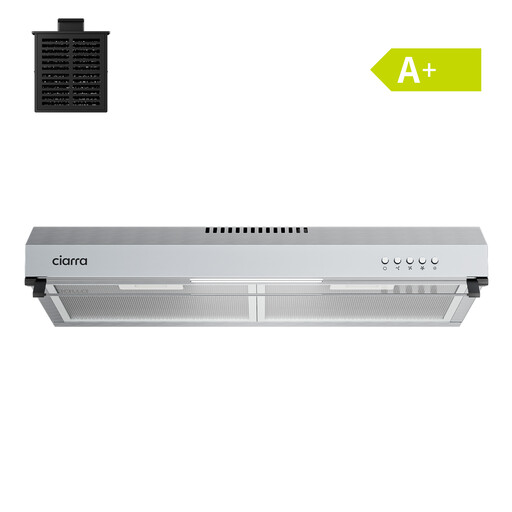
Why this product suits this profile: With its integrated design and 596 mm width, this model is ideal for kitchens where the hood should be discreetly concealed inside a wall cabinet.
The product details specify two washable aluminium filters as well as recirculation and extraction modes. This allows the installation method to be adapted to the kitchen.
Three power levels, maximum 184 m³/h, maximum 61 dB and a stated annual consumption of 11 kWh.
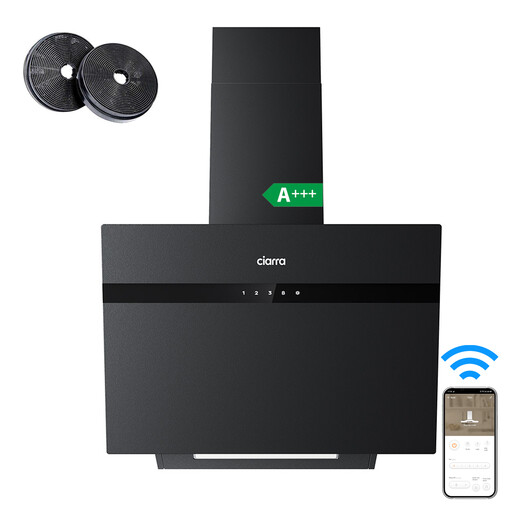
Why this product suits this profile: The angled glass front, dimmable LED lighting and app or Wi-Fi control are designed for modern open-plan kitchens where convenient operation is a priority.
The specifications state extraction and recirculation modes, two LED brightness levels and a washable aluminium filter. Installation nevertheless depends on the structural conditions in your kitchen.
Maximum extraction performance of 650 m³/h, maximum noise level of 58 dB and energy efficiency class A+++ according to the product details.
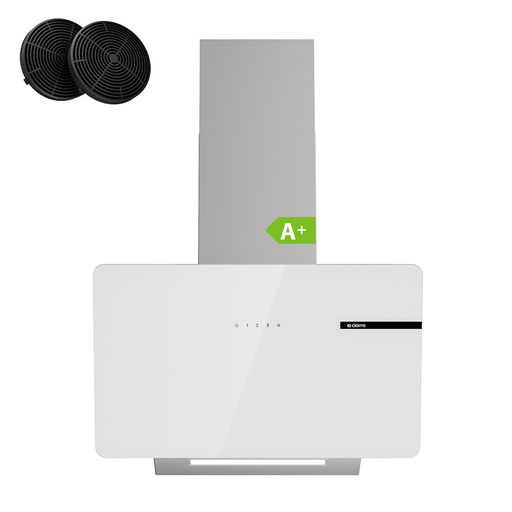
Why this product suits this profile: This 60 cm wall-mounted cooker hood with an angled front is designed for frequent cooking and kitchens where freedom of movement in front of the hob is important.
Touch control, three power levels and both operating modes are clearly listed in the product details. According to the specifications, the five-layer grease filter is dishwasher-safe.
Maximum extraction performance of 580 m³/h, integrated LED lighting, maximum noise level of 64 dB and energy efficiency class A+ according to the product details.
We have put together a complete, regularly updated list of products that fully meet these strict selection criteria and the safety regulations applicable in the EU.
If you often cook fresh meals, you may also be interested in a slow juicer. According to the product description, the EUHOMY Cold Press Juicer features a 135-mm feeding chute, a capacity of 1.8 litres and a 220-W motor. The stated juice yield and nutrient retention should be understood as manufacturer claims and not interpreted as medical benefits. View product details for the EUHOMY Slow Juicer.
For pour-over coffee, the TIMEMORE Glass Crystal Eye Coffee Dripper V01 and V02 are suitable for one or two cups. According to the product data, the variants are made from borosilicate glass and feature concave grooves. When choosing, the most important factors are the filter size, the correct paper filter and compatibility with your existing jug: View TIMEMORE V01 or View TIMEMORE V02. A separate coffee filter holder can be useful if you want to keep filter papers dry and close at hand next to the coffee grinder.
This depends on the size of the room, your cooking habits and the operating mode. A higher stated extraction rate may be useful for an open-plan kitchen or frequent frying. With extraction, the duct layout and wall vent affect actual performance. Compare the extraction rate, noise level and installation requirements together.
The required distance depends on the model, type of hob and installation instructions. Gas and electric hobs may have different minimum clearance requirements. The manufacturer’s specifications and local installation regulations are decisive. Before installation, you should also check the chimney height, underside of the cabinet and working area.
Electricity costs depend on power consumption, daily usage time and the energy price. Low annual consumption can help reduce ongoing electricity costs. With recirculation, there are also regular expenses for activated carbon filters. Extraction models, on the other hand, require a suitable external connection and may involve additional structural costs.