
Lieferung heute & morgen

Qualitätsgarantie

Willkommens-Angebote freischalten: KOSTENLOSE Lieferung | Bis zu 80 % RABATT | Kostenlose 30-Tage-JoyPlus-Testphase
App herunterladen
A 60 cm cooker hood fits many standard hobs and kitchen units. However, models vary considerably in terms of installation, extraction rate, noise level, filtration and controls. If you focus only on the colour or a high m³/h figure, you may later face additional installation work, expensive replacement filters or an unsuitable design.
The Joybuy Product Recommendation Officer selection provides an objective overview of the relevant product data and shows which 60 cm cooker hood suits which kitchen setup.
A 60 cm-wide hood is not automatically suitable for every 60 cm wall unit. Depth, height, cut-out dimensions and mounting method are also important. An integrated cooker hood is fitted inside a unit, while an under-cabinet cooker hood is mounted beneath an existing wall unit. A 60 cm wall-mounted hood, on the other hand, requires a load-bearing wall and sufficient space for the chimney.
Telescopic models also extend outwards: depending on how far they are extended, the Ciarra under-cabinet hoods measuring 59.9 cm and 59.6 cm wide require a variable appliance depth. Before buying, you should therefore compare the dimensions of the existing unit with the distance to the hob.
A high airflow figure is often prominently advertised. In practice, however, the extraction route, duct diameter, bends, backdraft damper and filter condition all affect actual performance. A cooker hood with recirculation and extraction offers greater installation flexibility, but it operates differently in each mode:
A washable metal grease filter helps to reduce ongoing replacement costs. Depending on the model, it can be cleaned by hand or in the dishwasher. An activated carbon filter is only required in recirculation mode and captures odours. It is a consumable component and must be replaced regularly, depending on usage and the manufacturer’s instructions.
Noise levels also deserve attention. Figures are usually given in dB and refer to specific power settings. A rating of 59 to 63 dB on the highest setting is comparable to a normal conversation, but may still be noticeable in an open-plan kitchen and living area. If you cook frequently, a model with several power settings is recommended so that the hood does not have to run permanently at a high level during everyday use.
Follow the installation instructions provided by the relevant manufacturer. For example, one Comfee model specifies a minimum distance of 65 cm above electric hobs and 75 cm above gas hobs. The information in the relevant instruction manual and the requirements of the hob manufacturer remain decisive.
Lower extraction rates may be sufficient for small kitchens or occasional cooking. For frequent frying, grilling or cooking in an open-plan kitchen and living area, a powerful cooker hood with several settings and, where applicable, a boost function is a sensible choice. Product specifications should always be considered alongside the noise level.
An energy-efficient cooker hood can help to limit ongoing electricity costs if used regularly. In addition to the energy efficiency class, compare the stated annual consumption in kWh/a. A cooker hood with LED lighting improves visibility over the cooking area, but does not replace general kitchen lighting.
Controls include mechanical buttons, sliders, touch controls, as well as Wi-Fi and app control. A cooker hood with touch or Wi-Fi control offers additional adjustment options. Mechanical push or rocker switches, on the other hand, are straightforward and work without an app, network connection or smartphone.
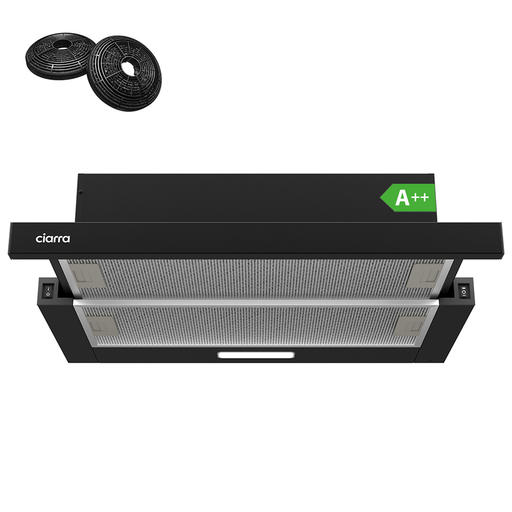
Why this product suits this profile: The space-saving telescopic design is ideal for small kitchens, rented properties and existing wall units.
The technical specifications list both recirculation and extraction modes, two power settings and washable aluminium filters. According to the product details, the activated carbon filter is included.
Up to 370 m³/h airflow, A++ energy efficiency class and integrated LED lighting.

Why this product suits this profile: This 60 cm wall-mounted hood combines touch controls, app connectivity and a boost function for cooking at different intensities.
The specifications list the airflow, maximum noise level of 59 dB, annual consumption of 12 kWh/a and filter types separately.
According to the product data, up to 650 m³/h, A+++ energy efficiency class and two washable aluminium grease filters.
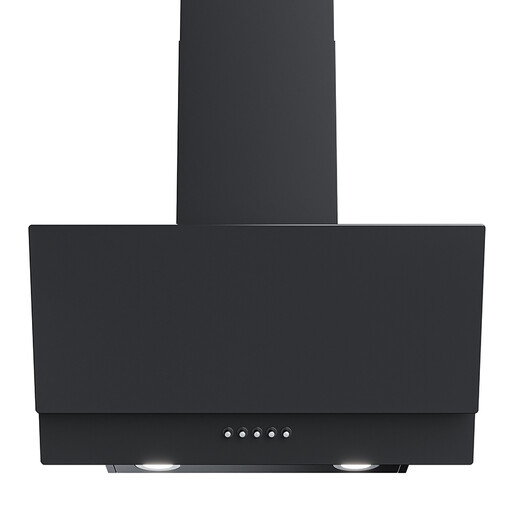
Why this product suits this profile: The black angled hood is ideal for households looking to combine visible wall mounting with greater freedom of movement in front of the hob.
Both extraction and recirculation modes are supported; according to the description, an activated carbon filter set, chimney components, backdraft damper and mounting materials are included.
60 cm width, 300 m³/h airflow, five-part aluminium grease filter and LED lighting.
We have put together a complete, regularly updated list of products that fully meet these strict selection criteria and the safety regulations applicable in the EU.
Before installation, check the mains voltage, mounting points and minimum distance from the hob. In extraction mode, the ducting route should be as short and straight as possible. In rented properties, recirculation is often the simpler solution, provided that regular replacement of the carbon filter is planned.
Clean the grease filter according to usage, approximately every two to four weeks if the hood is used frequently. The appliance must be disconnected from the mains before every cleaning or maintenance task. Open flames beneath the hood should never be left unattended, as grease deposits may pose a fire risk. For gas appliances and open-flued heating appliances, you must also ensure that the room is adequately ventilated.
A hood with recirculation mode is often a good choice for rented properties because it does not require a hole through the wall or a permanent extraction connection. Suitable activated carbon filters, adequate air circulation and installation that does not breach the tenancy agreement are important. Combined models can potentially be converted to extraction at a later stage.
How loud a hood seems depends on the kitchen, room acoustics and power setting. Appliances producing around 59 to 64 dB on the highest setting fall within a range that can be clearly audible in open-plan kitchens. For comparison, always use the dB rating for the same power setting rather than looking only at the lowest figure.
Electricity consumption can be estimated using the stated annual consumption in kWh/a. With recirculation, there are also regular costs for activated carbon filters. Washable metal grease filters reduce the need for replacement parts, but must be cleaned consistently. As well as the energy efficiency class, check the filter price, replacement interval and accessibility.