
Lieferung heute & morgen

Qualitätsgarantie

Willkommens-Angebote freischalten: KOSTENLOSE Lieferung | Bis zu 80 % RABATT | Kostenlose 30-Tage-JoyPlus-Testphase
App herunterladen
A 60 cm cooker hood fits many standard hobs, making it a popular choice for small to medium-sized kitchens. However, choosing a 60 cm model does not automatically mean you have found the right appliance. The key factors are the installation type, extraction route, filters, noise level and the airflow capacity you actually need.
As a Joybuy Product Recommendation Officer, I filter through the most important product details and explain what households, tenants and homeowners should look out for before buying.
Figures such as 650 m³/h often refer to the highest setting or a boost function. In everyday use, however, the hood is often operated at a lower setting. The length of the duct, bends, backdraught damper and external vent can also affect actual performance.
A moderate airflow capacity may be sufficient for a small kitchen. If you often fry food, cook with several pans or have an open-plan kitchen, you should look for a higher maximum airflow capacity and several power settings.
A recirculating cooker hood requires a grease filter and, if you want to reduce odours, an additional activated carbon filter. This carbon filter is normally a consumable component and must be replaced depending on usage and the manufacturer's instructions.
With extraction, cooking air is channelled outside through a suitable duct. This requires the right structural conditions. In rented properties, altering an exterior wall or extraction duct may require permission. Before buying, you should therefore establish whether external extraction is possible at all.
The description quiet cooker hood is no substitute for a specific measurement. Compare noise levels in dB, ideally across several power settings. A model rated at 58 dB on its highest setting should be assessed differently from one rated at 64 dB. The room acoustics and extraction duct can also affect the perceived noise level.
A 60 cm under-cabinet cooker hood is mounted underneath a wall cabinet or directly on the wall. It is suitable for kitchens with limited space and generally offers straightforward operation. Telescopic models can be partially slid away when not in use.
A 60 cm built-in cooker hood is largely concealed within the kitchen furniture. Beforehand, check not only the width but also the depth, height, cut-out dimensions and the space required for the extraction connection. A stated width of around 596 to 599 mm does not automatically mean that every model will fit every 60 cm cabinet.
A 60 cm wall-mounted hood is installed visibly on the wall. A 60 cm angled cooker hood has a sloping front and can provide more freedom of movement above the hob. If you are considering a black cooker hood, you should also bear in mind that glass surfaces show fingerprints and dust differently from stainless steel.
A recirculating and extracting cooker hood offers flexibility for different kitchen layouts. In extraction mode, a suitable hose or duct is required. In recirculation mode, the air passes through the grease filter and then through an activated carbon filter.
Washable aluminium grease filters are particularly practical. Several filter layers can make cleaning easier, but they do not replace regular maintenance. Depending on how often you cook, grease filters should be checked and cleaned approximately every two to four weeks. The manufacturer's instructions take precedence; not every filter is suitable for the dishwasher.
Airflow capacity is stated in m³/h. Models with 200 to 300 m³/h may be sufficient for light cooking in small kitchens. Appliances with 400 m³/h or more offer greater capacity. A 650 m³/h cooker hood is particularly worth considering if you fry food frequently or have an open-plan kitchen. However, it needs a suitable installation so that performance is not restricted by an inefficient extraction route.
The energy efficiency class and annual consumption in kWh/a are also important comparison values. An energy-efficient cooker hood with low annual consumption can be more economical if used regularly. LED lighting generally requires little power and improves visibility over the cooking area. However, brightness and colour temperature can vary from one model to another.
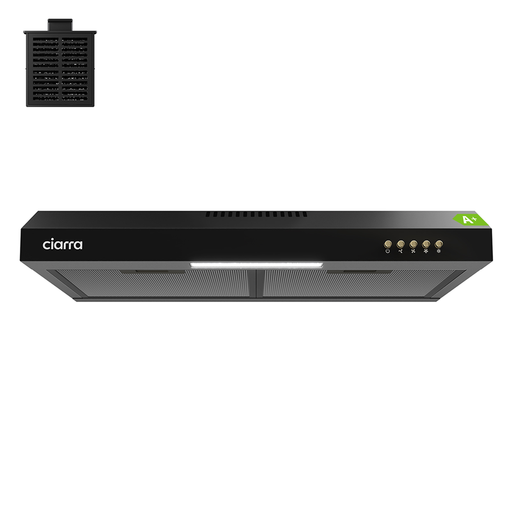
Why this product suits this profile: This compact 60 cm under-cabinet cooker hood is designed for kitchens with limited space and offers push-button controls alongside integrated lighting.
The product details specify noise levels of 51 to 61 dB and a washable aluminium filter cassette. Both extraction and recirculation modes are supported.
596 mm wide, energy efficiency class A+, three power settings and a maximum airflow capacity of 184 m³/h according to the product details.
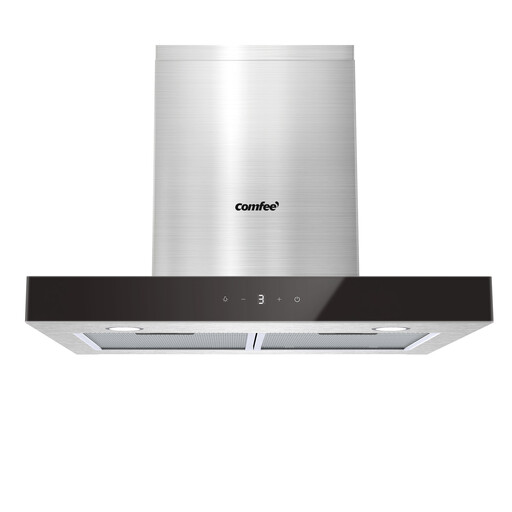
Why this product suits this profile: This model is aimed at households looking to combine high airflow capacity, several power settings and an easily accessible filter design.
The product description states both the maximum airflow capacity and the noise level. The washable five-layer aluminium filter is designed for regular cleaning.
Up to 650 m³/h, energy efficiency class A+++, LED lighting, plus touch and gesture controls according to the manufacturer's specifications.
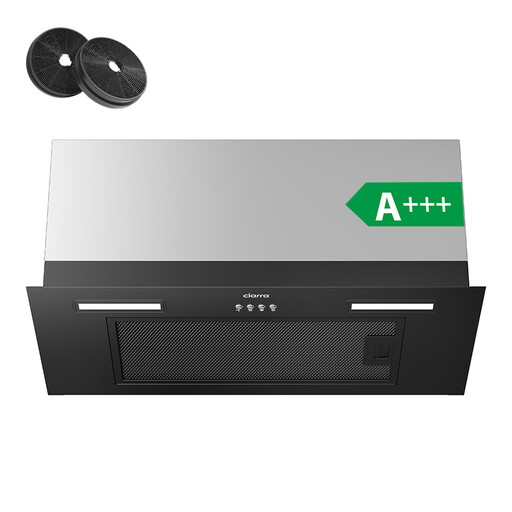
Why this product suits this profile: This 60 cm built-in cooker hood is designed to blend discreetly into wall cabinets and kitchen furniture.
The installation dimensions of 599 × 309 × 263 mm and the required extraction pipe solution should be checked against the kitchen cabinet before ordering.
Energy efficiency class A+++, up to 650 m³/h, washable aluminium grease filter, with support for both extraction and recirculation.
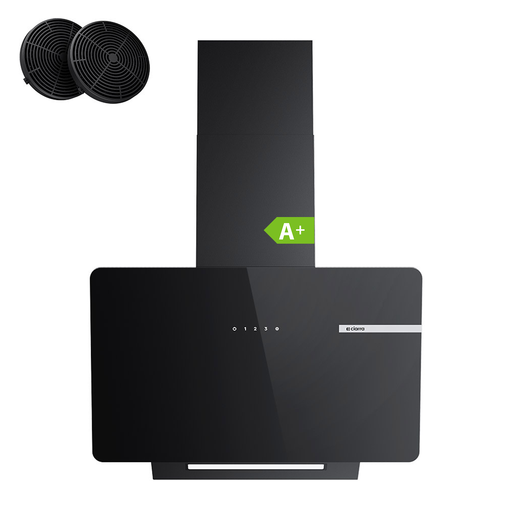
Why this product suits this profile: This black 60 cm wall-mounted hood combines a sloping glass front with recirculation and extraction options, making it adaptable to different kitchen layouts.
The product details specify a width of 595 mm, a maximum noise level of 64 dB and the activated carbon filters required for recirculation. This allows you to check space and maintenance requirements in advance.
A+, SensorTouch controls, LED lighting, washable aluminium filter and a maximum airflow capacity of 580 m³/h according to the product details.
We have put together a complete, regularly updated list of products that fully meet these strict selection criteria and the safety regulations applicable in the EU.
A 60 cm-wide hood is suitable for many standard kitchens. However, the actual external dimensions, the position of the filter surface and the installation height are all important. If you have a larger hob, the hood should not be narrower than the cooking zone.
Extraction sends vapours and odours outside and requires a suitable duct. Recirculation is more flexible for rented properties, but requires a grease filter and usually an activated carbon filter that needs to be replaced regularly. The available structural options should determine your decision.
Annual consumption is stated in kWh/a and depends on the model and how it is used. Compare the energy efficiency class and annual consumption together. LED lighting, motor power and how often you use the higher power settings also affect running costs.