
Lieferung heute & morgen

Qualitätsgarantie

Willkommens-Angebote freischalten: KOSTENLOSE Lieferung | Bis zu 80 % RABATT | Kostenlose 30-Tage-JoyPlus-Testphase
App herunterladen
A 60 cm induction hob often fits standard kitchens and offers between two and four cooking zones, depending on the model. Even so, choosing one is not simply a matter of colour or wattage. Focusing only on high power or a long list of extra features can easily mean overlooking important details such as cut-out dimensions, the electrical connection and the controls.
As a Joybuy Product Recommendation Officer, I filter the relevant information according to practical criteria. This helps you avoid common purchasing mistakes and match models more effectively to your everyday kitchen needs.
A hob approximately 590 to 592 mm wide is not automatically suitable for every existing cut-out. The key factor is the worktop cut-out dimensions. For several 60 cm models, these are approximately 560 × 490 mm, for example. Other appliances require different dimensions, such as 565 × 495 mm, or 265 × 495 mm for a 30 cm model.
Before ordering, you should measure:
A 7400 W induction hob may state a high total output across four zones. When several zones are used at the same time, however, the power management system distributes the available power depending on the connection and selected settings. This is technically normal rather than a fault, but it should be taken into account during planning.
You should also check whether the model requires a suitable connection. Some built-in hobs are supplied without a plug and must be connected by a qualified electrician. With appliances of this type, a standard socket is not automatically sufficient.
A boost function increases power for rapid heating, but it does not replace a cooking zone of the right size. A FlexZone or CombiZone, on the other hand, is useful if you often use elongated griddles, oval roasting dishes or large pans. When comparing models, you should therefore look beyond the word “Boost” in the product description and check how the cooking areas are actually arranged.
A built-in induction hob is permanently integrated into the worktop and is suitable for kitchen renovations, homeowners and rented properties with a suitable cut-out. A self-contained induction hob has its own controls and can be installed independently of an oven. Even so, the electrical requirements and installation rules still apply.
A portable induction plate is suitable for a temporary kitchen, a small flat or additional cooking capacity. The 2000 W ochama model, for example, is designed for use on a worktop. It does not require a permanent cut-out, but it does take up worktop space when in use and must be adequately ventilated during operation.
A 4-zone induction hob is a sensible choice if you regularly use several pans or pots at the same time. Pay attention to the zone diameters: combinations of 145, 160, 180 and 210 mm are common. Large pans require a suitably sized zone.
A 2-zone induction hob takes up less space and may be sufficient for individuals, couples or smaller kitchens. With 30 cm models, the worktop cut-out is considerably smaller. Depending on the version, the power output may be 3000 or 3500 W, for example.
An induction hob with touch controls should have clearly visible displays and an intuitive way to select each zone. Useful features include:
Once the glass-ceramic surface has cooled, it can be cleaned with a soft, damp cloth. A suitable glass scraper can be used for burnt-on residue. A damaged or cracked glass-ceramic induction hob must not be used.
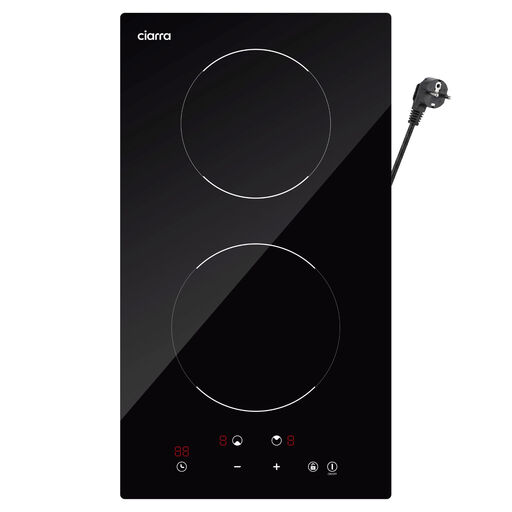
Why this product suits this profile: This compact 2-zone model is designed for smaller households or kitchens with limited worktop space. Nine power levels and a timer of up to 99 minutes cover everyday cooking needs.
The required cut-out dimensions of 270 × 490 mm are clearly stated. This allows you to check whether your worktop is suitable before buying.
2 cooking zones, touch controls, child lock, residual heat indicator and automatic safety shut-off.
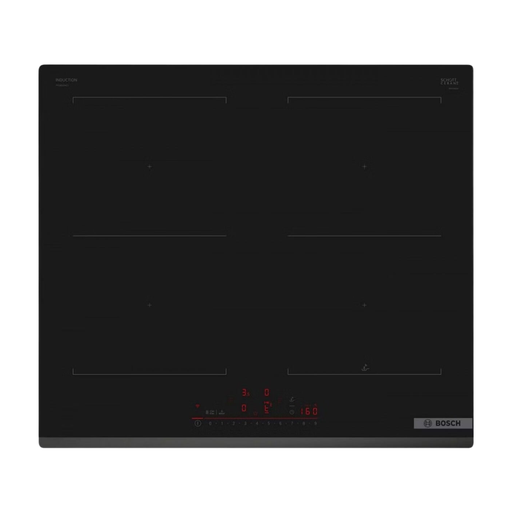
Why this product suits this profile: This 60 cm built-in hob combines four zones with a total output of 7400 W and a combinable FlexInduction area for elongated cookware.
As well as Boost, the zone dimensions, cut-out dimensions of 560 × 490 mm and power management are specified. This makes technical planning easier.
Four zones, FlexInduction, individual timer, child lock, pan detection and a two-stage residual heat indicator.
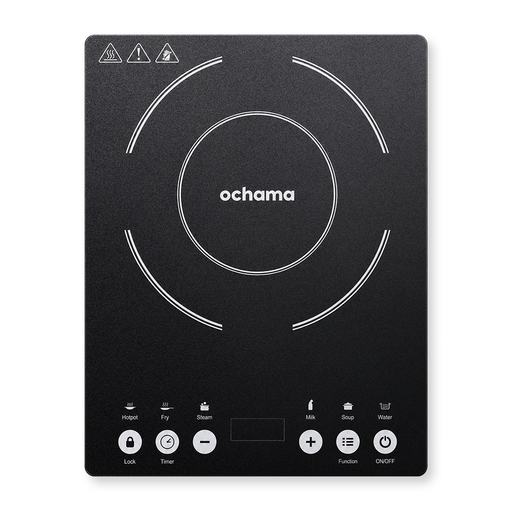
Why this product suits this profile: This portable single hob is suitable as an additional cooking station, for smaller households or temporary use without permanent installation.
Its compact design avoids the issue of an unsuitable built-in installation. Ten power levels and six functions are specified directly on the appliance.
2000 W, touch controls, glass panel, child lock and protection programme for dry heating.
Use only cookware with a magnetic base. A magnet test on the underside provides an initial indication. Aluminium or ceramic cookware without a magnetic base will generally not be detected by the cooking zone.
For permanent installation, the manufacturer's installation instructions should be followed. Particularly with appliances rated at 6000 to 7400 W, the connection must be carried out by a qualified electrician. The ventilation beneath the hob must not be blocked. Oil and fat should not be heated unattended while cooking.
For cleaning, allow the surface to cool, observe the residual heat indicator and do not use abrasive products. Metal objects, aluminium foil and empty pans should not be placed on an active cooking zone. People with pacemakers or other electronic implants should follow the manufacturer's safety instructions and seek medical advice before use.
We have put together a complete, regularly updated list of products that fully meet these strict selection criteria and the safety regulations applicable in the EU.
No. The external width is often around 590 to 592 mm, but the required cut-out may vary depending on the model. Measure the existing cut-out and compare it with the installation specifications for the particular appliance.
Its lifespan depends, among other things, on how often it is used, cleaning, ventilation and correct connection. A damaged glass-ceramic surface or repeated overheating can affect its operation. Specific warranty and guarantee conditions should be checked before purchase.
Induction transfers heat directly to suitable cookware via an electromagnetic field. This eliminates the conventional process of heating a heating element. However, actual electricity consumption depends on cooking time, power level, pan size, whether a lid is used and how many zones are operated at the same time. Wattage alone therefore does not provide a reliable indication of running costs.