
Lieferung heute & morgen

Qualitätsgarantie

Willkommens-Angebote freischalten: KOSTENLOSE Lieferung | Bis zu 80 % RABATT | Kostenlose 30-Tage-JoyPlus-Testphase
App herunterladen
A 60 cm induction hob often fits standard worktops and offers plenty of space for everyday family cooking. Even so, models differ significantly in terms of connection power, cut-out dimensions, cooking zones and safety features. If you only focus on the wattage or a glossy black surface, you risk overlooking important details.
A hob that is roughly 590 or 592 mm wide is not automatically suitable for every 60 cm cut-out. What matters is the worktop cut-out measurement. With many appliances, the required cut-out is approximately 560 × 490 mm. Other models may need, for example, 565 × 495 mm.
Before you buy, you should therefore:
A hob that is too large cannot simply be fitted. A cut-out that is too small must not be widened yourself if doing so would compromise stability or pipework.
A 4-zone induction hob might be rated at 6,000, 6,600, 7,200 or 7,400 W. Depending on the model, this total power is distributed between the zones during operation. If you run several pans on a high setting at the same time, an automatic power limitation may kick in.
So pay attention to:
For appliances without a plug, the connection must not be improvised. The electrical specifications of the hob and your home's installation must match.
An induction hob with touch controls is easy to clean and allows direct adjustment. However, the sensor surface can become unreliable if water, grease or pan handles are resting on it. Depending on the model, a timer can be set separately for each zone or only centrally.
Useful features include:
A feature is only relevant if it suits your cooking style. If you mostly cook with two small pans, you don't necessarily need a large flexible zone. For roasting pans, griddle plates or oval fish kettles, however, it can be very handy.
A 4-plate induction hob is ideal for households where several dishes are regularly prepared at the same time. Two- or three-zone models take up less space and can be more suitable for single-person households, small kitchens or a separate cooking station.
Induction only works with magnetic cookware. A simple magnet test on the base of the pan will show whether it is suitable. Typical materials are cast iron, iron and magnetic stainless steel. The base should be as flat as possible and match the size of the cooking zone.
A classic built-in induction hob is set into the worktop. As well as width and depth, also check the appliance height. The models being compared range from approximately 51 to 64 mm in height. There must be enough space beneath the hob for ventilation and, if necessary, a drawer with a safety clearance.
A freestanding induction hob or portable induction plate, on the other hand, sits on the work surface. It is suitable for rented accommodation, extra cooking capacity or temporary kitchen solutions, but does not automatically replace a permanently installed hob.
Touch control panels should have clearly readable power levels. Nine or ten levels allow finer adjustment than a few coarse settings. Also important are a clear residual heat indicator and an automatic switch-off function.
People with pacemakers or other electronic implants should consult the manufacturer's instructions before use and, if necessary, seek medical advice. The hob must not be operated if the glass surface is damaged. The surface should only be cleaned once the residual heat indicator has gone out.
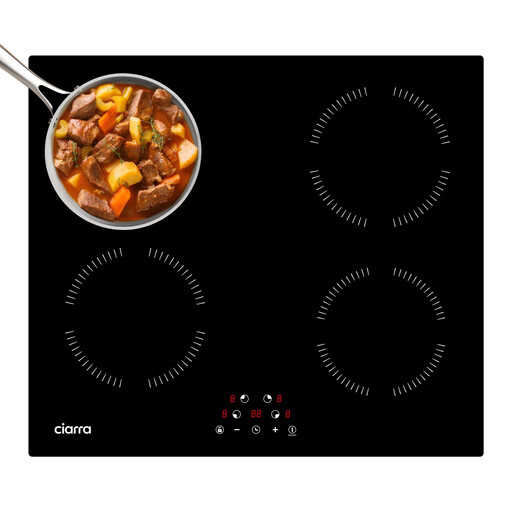
Why this product fits the profile: This 60 cm model offers four cooking zones, touch controls and a total power of 6,000 W for everyday cooking tasks.
The stated overall dimensions of 590 × 520 × 62 mm and a cut-out of 560 × 490 mm make it easy to match with a standard worktop.
Nine power levels, individual timer, pan detection, child lock and residual heat indicator.
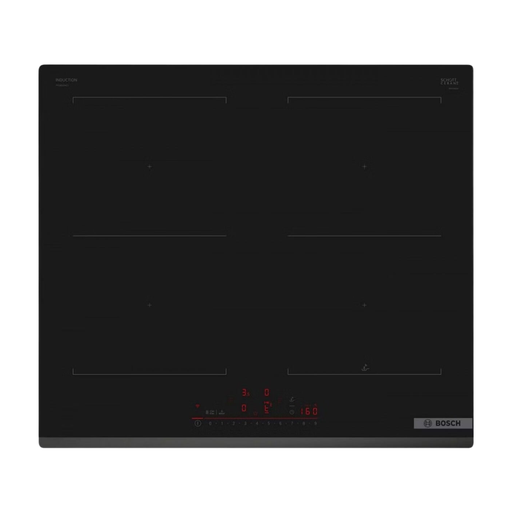
Why this product fits the profile: The CombiZone is designed for households that frequently use oblong or large cookware.
The product details state 592 × 522 × 51 mm, a cut-out of 560 × 490 mm and a connection power of 7,400 W.
Four zones, CombiZone, Boost function, zone-specific timer, automatic pan detection and two-stage residual heat indicator.

Why this product fits the profile: This portable single hob is ideal as an extra appliance, for small kitchens or flexible cooking situations.
As a portable model, it won't be confused with a fixed 60 cm built-in hob. The ventilation openings must remain clear during use.
2,000 W, ten power levels, six preset functions, touch controls, child lock and dry-boil protection.
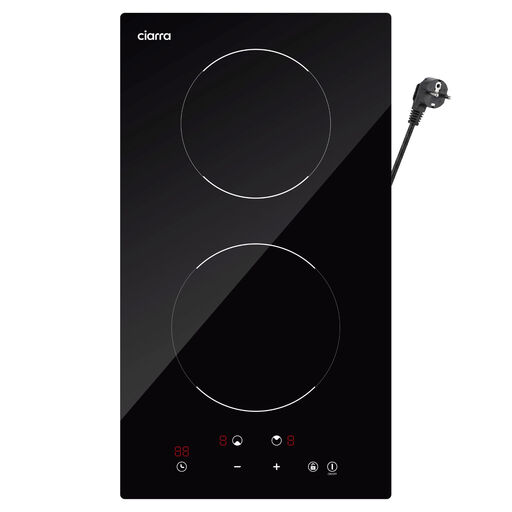
Why this product fits the profile: At 290 mm wide, this two-zone model is designed for narrow work areas or supplementary cooking stations.
The compact design prevents unnecessary worktop space being reserved for four zones. The cut-out is 270 × 490 mm.
3,000 W, nine power levels, individual timer up to 99 minutes, child lock, pan detection and overheat protection.
We have put together a complete, regularly updated list of products that fully meet these strict selection criteria and the safety regulations in force in the EU.
For many built-in appliances, the cut-out is approximately 560 × 490 mm. However, the exact measurements vary by model. Always refer to the installation instructions for the specific appliance you choose, not just the "60 cm" label.
The lifespan depends on factors such as the connection, ventilation, cleaning and daily use. A damaged glass surface, blocked ventilation or faulty electrical installation can compromise safe operation. Use suitable, flat cookware and only have repairs carried out by authorised professionals.
Induction transfers heat directly to the magnetic pan base. This eliminates the long heating-up time of a classic heating element, and energy is transferred more efficiently during cooking. However, actual consumption depends on cooking time, power level, pan size and how many zones are used simultaneously. So it's not just the advertised wattage that matters, but also sensible cooking habits.