
Lieferung heute & morgen

Qualitätsgarantie

Willkommens-Angebote freischalten: KOSTENLOSE Lieferung | Bis zu 80 % RABATT | Kostenlose 30-Tage-JoyPlus-Testphase
App herunterladen
A level-access shower looks modern and makes getting in and out easier. But for your bathroom drain to work reliably over time, there’s more to consider than the cover you can see. When choosing 600 mm stainless steel shower drains, it’s easy to overlook important details such as the floor gradient, water trap, access for cleaning and installation height.
These details can lead to extra work later, particularly during renovations. A shower drain that doesn’t suit the screed height can make installation more difficult. A hair strainer that’s too small can quickly become blocked. And a cover that’s difficult to remove can make routine maintenance needlessly complicated.
A stainless steel look suits many bathrooms, but it tells you little about how the drain is made. Important details include the stated material, the strength of the cover and whether you can open the drain for cleaning.
A tile-insert shower drain holds a suitable tile, helping it blend in with the floor. This only works if the cover suits the tile thickness and is fitted correctly. So an invisible shower drain isn’t automatically completely invisible: the grout lines, floor gradient and tile alignment will still be visible.
You should be able to reach a bathroom drain with a water trap for maintenance. A removable hair strainer is just as important. If these parts are missing or difficult to remove, hair and debris can affect drainage.
The material should be clearly stated for any stainless steel shower drain set. The model featured here is listed as being made from 304 stainless steel, a material commonly used in damp environments. However, the material alone won’t ensure a watertight installation: the connections to the bonded waterproofing and floor structure must be completed with care.
A 600 mm linear shower drain suits many compact to medium-sized shower areas. Even so, check the actual installation requirements before you buy. The product dimensions for this model are 64 × 11 × 7 cm. Adjustable installation feet also make it easier to level the drain.
The floor gradient is particularly important in a level-access shower. The floor must direct water reliably towards the drain. The drain itself can’t compensate for a floor gradient that hasn’t been planned correctly. For renovations, consider the screed height, waterproofing, tile thickness and drain pipe together.
According to the product details, this model has a fast-flowing drain, a water trap and a removable hair strainer. This combination is practical for everyday use, as you can remove hair regularly before it reaches further into the drain pipe.
The cover can be used on either side: one side is stainless steel, while the other can hold a suitable tile. This lets you choose between a visible metal finish and a design that blends more closely into the floor. The 360° rotating design may also give you more flexibility when positioning the drain.
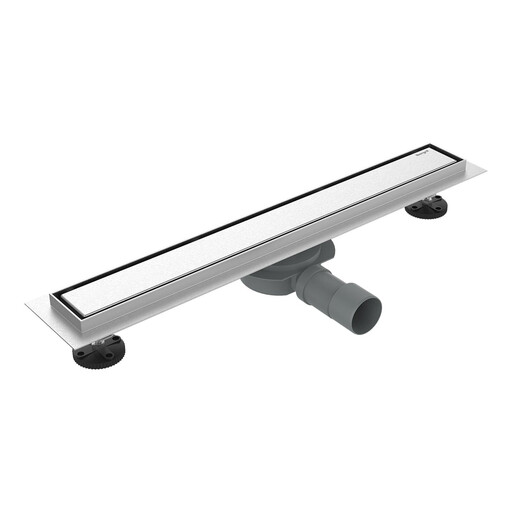
Why this product suits this profile: Its 600 mm length, hair strainer and water trap meet key requirements for a home shower area.
The product details list a removable hair filter and a water trap, covering two maintenance features that are often overlooked.
304 stainless steel, a 2-in-1 cover and adjustable installation feet, according to the product description.
Why this product suits this profile: Its reversible cover gives you the choice of a visible stainless steel side or a closer-fitting finish using your own tile.
Rather than committing to one fixed look, you can adapt the cover to suit your tile design. The removable cover also provides access for cleaning.
Double-sided cover, 360° rotating design and 304 stainless steel specification, according to the product details.
Why this product suits this profile: For households where the shower is used regularly, easy access and straightforward cleaning are important things to consider.
The removable hair strainer makes it easier to clear away debris regularly. The product description also mentions a removable cover and fast water drainage.
A generous drainage area, hair strainer, water trap and adjustable installation feet, according to the manufacturer.
Before installation, ask your installer or contractor to check the following:
We’ve put together a complete, regularly updated list of products that meet these strict selection criteria and fully comply with the safety regulations in force across the EU.
The required gradient depends on the floor structure, tile size and drainage system. A gentle slope towards the shower drain is often planned. Your contractor should determine the precise gradient based on the site conditions and the waterproofing system being used.
It depends on how often the shower is used and how much hair and debris collects. With daily use, it’s a good idea to check it regularly. If water isn’t draining as easily, remove and clean the hair strainer sooner.
A shower drain doesn’t need its own power supply, so the drain itself doesn’t usually incur ongoing costs. Instead, factor in installation, any replacement parts and suitable cleaning products. A design that’s easy to access can make day-to-day maintenance simpler.