
Lieferung heute & morgen

Qualitätsgarantie

Willkommens-Angebote freischalten: KOSTENLOSE Lieferung | Bis zu 80 % RABATT | Kostenlose 30-Tage-JoyPlus-Testphase
App herunterladen
Choosing the right cooker hood is crucial for a functional and pleasant kitchen environment. But the market is filled with marketing promises that often create more confusion than clarity. Many buyers invest in models that are either overpowered, too loud, or unexpectedly expensive to maintain. This guide will help you understand the essential criteria and make an informed decision based on facts, not advertising slogans.
Before you choose a model, you should be aware of the typical pitfalls that can lead to dissatisfaction and unnecessary costs.
To find the right hood, focus on these three objective criteria.
The required airflow rate depends directly on your room's volume. A simple formula to guide you is:
Room Volume in m? (Length × Width × Height) × 10 = Recommended Airflow Rate in m?/h
For a kitchen with a 15 m? floor area and a 2.5 m ceiling height (37.5 m? volume), an airflow rate of around 375 m?/h would be sufficient. Models with 500–650 m?/h offer a solid reserve for intensive cooking without being oversized.
The type of construction determines its integration into your kitchen and the ergonomics at the hob.
Here are some models tailored to specific user profiles and their requirements.

Why it's a great fit: Ideal for users who value smart home integration, modern design, and high energy efficiency. App control offers everyday convenience.
The A+++ energy efficiency class and a moderate noise level of 59 dB at a high output of 650 m?/h counteract the pitfalls of high running costs and noise pollution.
The combination of Wi-Fi control, a booster function for intensive cooking sessions, and a very low annual energy consumption of 12 kWh/a.
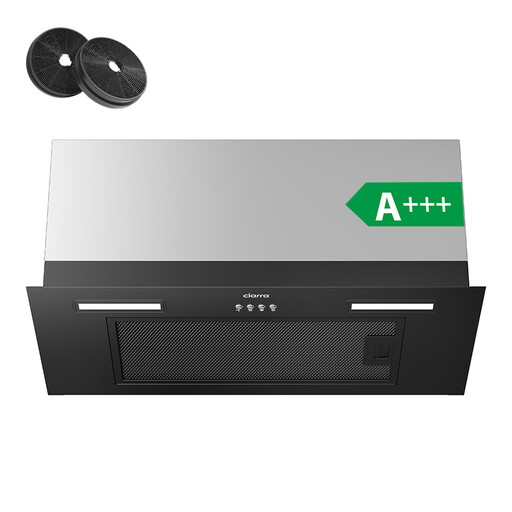
Why it's a great fit: Perfect for minimalist kitchens where the technology should remain invisible. Despite its compact design, it delivers high performance.
This model defies the compromise between design and performance. It offers a powerful 650 m?/h airflow rate, rarely found in built-in models, and combines it with an A+++ efficiency class.
Completely concealed installation while providing high extraction power and an extremely low annual energy consumption of just 9 kWh/a.
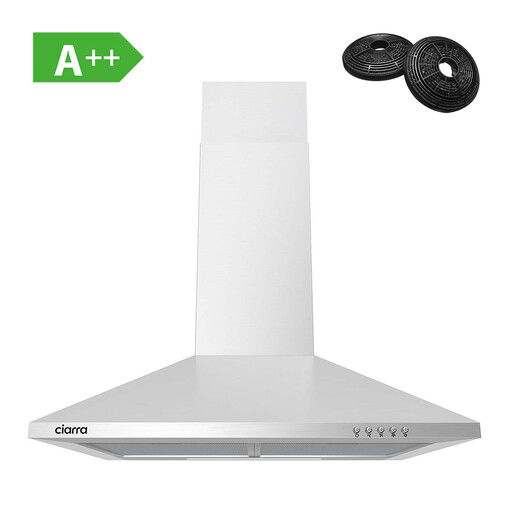
Why it's a great fit: A solid and reliable solution for anyone seeking a functional wall-mounted hood with good energy efficiency and simple operation.
This model avoids the trap of a loud, inefficient budget appliance. With an A++ energy efficiency class and a clear noise level of 63 dB (max.), it offers transparent and solid performance data.
A balanced price-to-performance ratio. The mechanical push-buttons are designed for durability, and the washable aluminium grease filters keep maintenance costs low.
We have compiled a complete, up-to-date list of products that fully meet these strict selection criteria and all relevant safety standards.
1. How often should the activated charcoal filter be replaced in a recirculating hood? The lifespan of an activated charcoal filter depends heavily on the frequency and intensity of use. As a general guideline, replacement is recommended every 3 to 6 months. Some models use regenerable filters that can be heated in the oven and reused multiple times, which reduces running costs.
2. What is the required distance between the hob and the cooker hood? The safety distance is crucial for both performance and fire prevention. For electric hobs, a distance of 65 cm is generally recommended. For gas hobs, the distance should be at least 75 cm due to the open flame. Always follow the specific instructions in the manufacturer's installation manual.