
Lieferung heute & morgen

Qualitätsgarantie

Willkommens-Angebote freischalten: KOSTENLOSE Lieferung | Bis zu 80 % RABATT | Kostenlose 30-Tage-JoyPlus-Testphase
App herunterladen
Choosing a new cooker hood can be a challenge. The standard 60 cm width offers a vast selection, and technical specifications can often be confusing. The goal is to effectively eliminate cooking vapours, grease deposits, and odours without the noise level disrupting your home comfort.
This article serves as your guide. We'll outline the most important criteria for selecting a 60 cm cooker hood and present a curated selection of models, each suited for different needs due to their specific features.
To make an informed decision, three main factors should be considered: the operating mode, the balance between performance and noise level, and energy efficiency.
The choice between an extraction and a recirculation system is the most fundamental decision and depends on the structural conditions of your kitchen.
Many modern appliances offer both installation options and include the necessary accessories for both variants right out of the box.
The performance of an extractor hood is measured in cubic metres per hour (m?/h). This value indicates how much air the appliance can circulate per hour. For an enclosed kitchen of about 15 m?, a rate of 300–400 m?/h is often sufficient. In open-plan kitchens, more powerful models with 600 m?/h or more are recommended.
At the same time, the noise level is crucial. A quiet cooker hood operates at levels below 60 decibels (dB) on a normal setting, which is roughly equivalent to the volume of a normal conversation. Pay attention to the dB rating at the highest performance level to ensure that operation is not perceived as disruptive, even during intensive cooking.
Design affects not only aesthetics but also functionality. For example, a 60 cm angled hood offers more headroom while cooking, whereas a classic 60 cm wall-mounted hood in a T-shape or pyramid form is a timeless design element. Models like a black cooker hood add modern accents, while stainless steel is easy to clean and durable.
The energy efficiency class provides information about power consumption. Appliances with an Energy Efficiency A+++ rating are particularly economical and help keep running costs low. The annual energy consumption is indicated in kilowatt-hours per year (kWh/a) on the energy label.
Here you will find a selection of models that focus on different aspects of design, performance, and functionality.

What sets this model apart: The forward-sloping design of this angled hood was specifically developed for greater freedom of movement while cooking. It is operated via a flush-mounted glass touch panel that is easy to clean. With an extraction rate of approx. 580 m?/h, it offers solid performance for most kitchens.
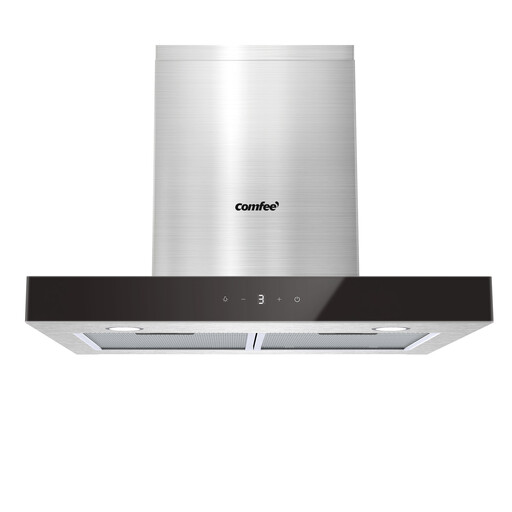
What sets this model apart: This T-shaped wall-mounted hood combines high performance with modern technology. With a suction power of up to 650 m?/h and an Energy Efficiency Class A+++ rating, it is both powerful and economical. A special feature is the gesture control, which allows for contactless operation.
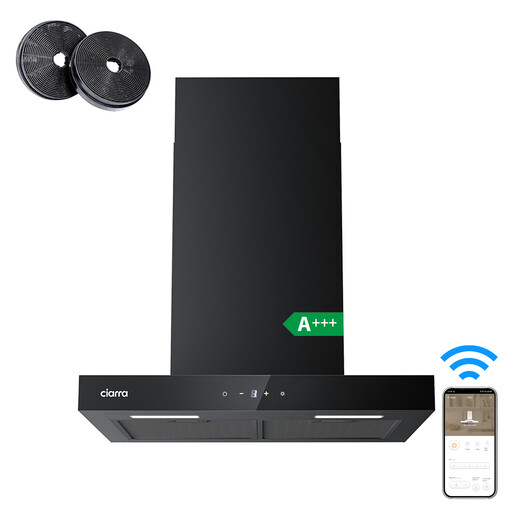
What sets this model apart: This black wall-mounted hood brings smart technology into the kitchen. It can be controlled via Wi-Fi and a smartphone app, making operation flexible. With a performance of up to 650 m?/h in booster mode and an Energy Efficiency Class A+++ rating, it is a future-proof choice. The black aluminium filters underscore its modern design.
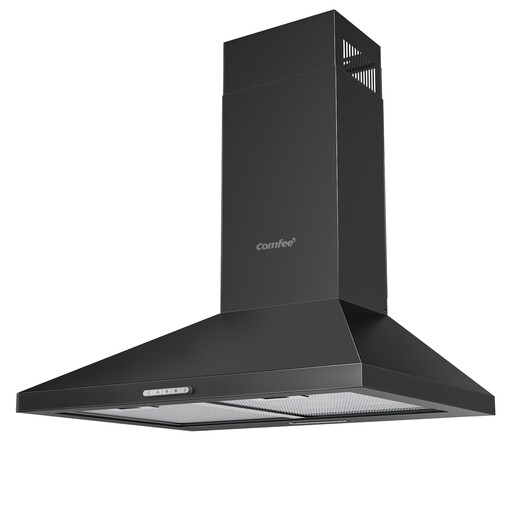
What sets this model apart: This model, with its classic pyramid design, offers reliable core functionality at an attractive price point. With an extraction rate of 400 m?/h, it is well-suited for standard kitchens. Operation is straightforward via push buttons that provide clear tactile feedback.
The models presented here already cover a wide range of needs. If the right appliance for your specific requirements isn't among them, there are many more options to discover. The selection of pure recirculation units is particularly large, especially for apartments without an external vent option.
If you need a flexible solution without an extraction duct, discover our wide selection of recirculating cooker hoods.
The lifespan of an activated charcoal filter depends heavily on the frequency of use and the type of cooking. As a general guideline, replacement every 3 to 6 months is recommended. Some models feature a saturation indicator that reminds you when it's time for a change. Always follow the manufacturer's instructions.
The extraction rate, specified in cubic metres per hour (m?/h), measures the volume of air a cooker hood can move per hour at its highest setting. A higher value means faster and more effective clearing of cooking vapours and odours from the kitchen air. The required performance depends on the size of your kitchen.
Yes, a 60 cm angled hood offers an ergonomic advantage: it provides more headroom over the hob, preventing you from bumping your head while cooking. On the other hand, a classic 60 cm wall-mounted hood can sometimes capture rising steam more directly across the entire cooking surface. The choice ultimately comes down to personal preference, your height, and your kitchen's design.