
Lieferung heute & morgen

Qualitätsgarantie

Willkommens-Angebote freischalten: KOSTENLOSE Lieferung | Bis zu 80 % RABATT | Kostenlose 30-Tage-JoyPlus-Testphase
App herunterladen
A 60 cm cooker hood fits many standard-sized hobs, making it a popular choice for rental properties, small kitchens and modern fitted kitchens. However, the width alone doesn't tell you much about how well it will actually perform. What really matters are the design, airflow, operating mode, noise level, filters and the available installation space.
If you only focus on a high m³/h rating or a sleek design, you can easily overlook important ongoing costs and installation details. The points below will help you separate marketing claims from genuinely useful product features.
Figures like 400, 580 or 650 m³/h usually refer to the highest power setting. In everyday use, though, you'll often run the hood on a lower setting. What's more, the ducting, pipe length, bends and non-return valve all affect the actual airflow.
For a small kitchen, a compact 60 cm under-cabinet hood delivering 200 to 250 m³/h may be perfectly adequate, whereas open-plan kitchens or frequent frying will benefit more from a more powerful 60 cm wall-mounted hood. Always consider the manufacturer's figures in relation to the operating levels and the type of installation.
A cooker hood with recirculation and extraction gives you flexible options. In extraction mode, cooking vapours are vented outside. For this, your kitchen needs a suitable wall or building connection. In recirculation mode, the air passes through a grease filter and usually a charcoal filter before being returned to the room.
The charcoal filter is a consumable item. Depending on how often you cook, it will need replacing regularly. A model that includes a charcoal filter can simplify the initial purchase, but it doesn't eliminate the ongoing costs later on.
A hood that's nominally 60 cm wide can vary in depth and height depending on the design. With a 60 cm under-cabinet cooker hood, you need to check the dimensions of the wall cabinet, the fixing points and the distance to the hob. For wall-mounted hoods, you also have to consider the chimney height, the wall type and the clearance required.
The installation height must follow the instructions in the user and installation manual. Different minimum distances may apply for gas and electric hobs.
Alongside the width, the depth, height and the distance between the hob and hood are crucial. A nominally suitable hood can be impractical if it clashes with cabinet fronts, windows or extraction outlets.
Airflow is given in m³/h. To compare models, look at each power setting individually. A high maximum figure is most relevant if you regularly cook with lots of steam, grease or strong smells.
Noise level is measured in dB. Because the noise level is usually quoted for the highest setting, figures like 51 dB on level 1 and 61 dB on level 3 are more informative than a single maximum value. So when looking for a "quiet cooker hood", judge it by the specific operating levels, not just the marketing claims.
A washable aluminium or metal grease filter will cost you less in the long run than a non-reusable one. Some filters are described as dishwasher-safe; always follow the manufacturer's care instructions.
A cooker hood with LED lighting can illuminate your worktop directly. Check whether the bulbs are integrated and whether their position provides even coverage over the hob. Stainless steel surfaces are easy to clean but can show fingerprints. With a stainless steel cooker hood, it's worth checking the cleaning instructions.
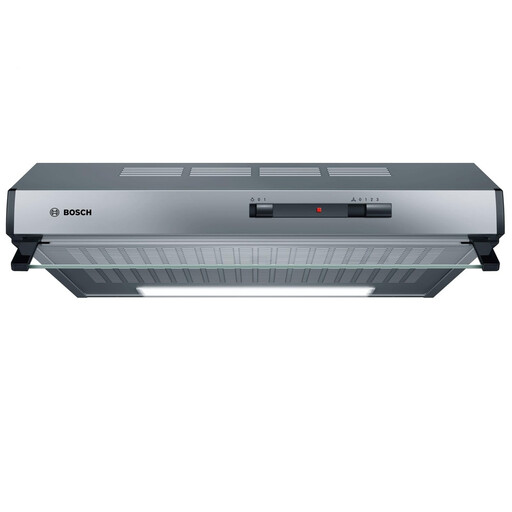
Why this product fits the profile: This compact under-cabinet hood offers three power levels, LED lighting and both extraction and recirculation modes. Its dimensions of 600 × 482 × 150 mm suit many classic installation scenarios.
The three levels and clearly stated maximum airflow of 250 m³/h make its intended use more transparent than a purely design-led choice. The recirculation kit needs to be purchased separately.
Washable grease filter according to the product information, LED light and stainless steel housing; maximum noise level 68 dB.
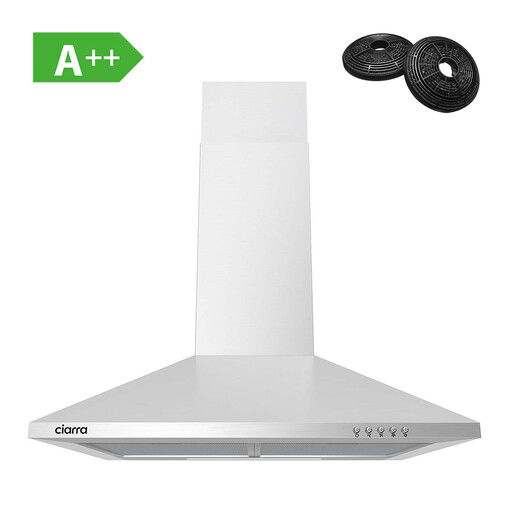
Why this product fits the profile: This stainless steel wall-mounted hood features three levels, LED lighting and both extraction and recirculation options. Its adjustable height from 572 to 950 mm accommodates different kitchen layouts.
The product data lists airflow and noise level separately for each of the three levels. This makes it easier to assess the everyday trade-off between performance and sound.
Maximum 367 m³/h, washable aluminium filters, energy efficiency class A++ and maximum noise level 63 dB.

Why this product fits the profile: This 60 cm wall-mounted hood is designed for households that cook frequently and want app or touch control. It offers three levels plus a booster function and supports both recirculation and extraction.
The product description states a maximum performance of 650 m³/h, a maximum noise level of 59 dB and an annual consumption of 12 kWh. These figures allow for a more targeted assessment.
Energy efficiency class A+++, washable aluminium filters, LED light and integrated Wi-Fi and app control.
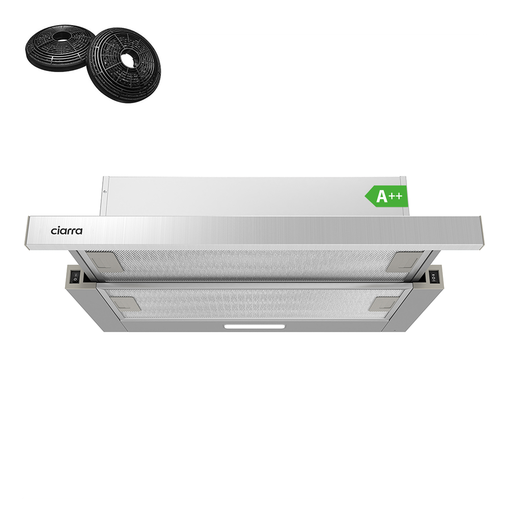
Why this product fits the profile: The pull-out design requires a depth of between 298 and 453 mm and can be partially pushed back when not in use. This is practical for limited worktop areas.
The switch between recirculation and extraction, as well as the included charcoal filters, are stated in the product description. Nevertheless, you should check the cabinet depth and connection before ordering.
Airflow up to 370 m³/h, energy efficiency class A++, LED light and two washable aluminium filters.
We've put together a complete, regularly updated list of products that fully meet these strict selection criteria and the safety regulations in force in the EU.
To keep your hood working properly, clean the grease filters regularly. With frequent use, cleaning every two to four weeks is a good idea; the level of soiling and the manufacturer's instructions are the deciding factors. In recirculation mode, charcoal filters must be replaced at the recommended intervals.
Always disconnect the power supply before cleaning. Installation and electrical connection should be carried out in accordance with the instructions and by a qualified person. In extraction mode, the connection to the outside must be airtight and correctly sized. If you use gas-powered appliances at the same time, make sure the room is adequately ventilated.
For rental properties, a 60 cm under-cabinet hood or telescopic hood with recirculation mode is often practical if there's no extraction outlet. Check the cabinet dimensions, the fixings and whether the required charcoal filter is included in the box.
It depends on your kitchen and the building's possibilities. Extraction vents moist and polluted air outside, but needs a suitable connection. Recirculation is more flexible to install, but requires a grease filter and regular replacement of the charcoal filter. For new builds or renovations, you should consider the operating mode during the kitchen planning stage.
The lifespan depends on usage, cleaning, installation and the availability of spare parts. Regularly cleaned grease filters reduce deposits on the appliance. So before you buy, it's worth checking whether the filters are removable and which consumable items you can buy later.