
Lieferung heute & morgen

Qualitätsgarantie

Willkommens-Angebote freischalten: KOSTENLOSE Lieferung | Bis zu 80 % RABATT | Kostenlose 30-Tage-JoyPlus-Testphase
App herunterladen
A 60 cm cooker hood fits many standard British kitchens and is often matched to the width of a hob. However, choosing one isn't just about colour or price. The installation situation, air circulation, noise level and cleaning effort are all key factors.
A figure like 580 or 650 m³/h sounds impressive at first. However, it describes the airflow under specific conditions and doesn't alone tell you how effectively the hood will work in your kitchen. In extraction mode, the actual performance is affected by duct length, duct diameter, bends and a non-return valve. In recirculation mode, odour absorption also depends on the activated carbon filter used.
A cooker hood with both recirculation and extraction offers flexibility, but in recirculation mode it needs a suitable activated carbon filter. Depending on the model and how often you cook, this filter must be checked and replaced regularly. The metal or aluminium grease filter also requires maintenance, as grease build-up can affect airflow and fire safety.
Before buying, you should check the actual dimensions. An under-cabinet cooker hood, for example, may be only 8 to 15 cm high, while a 60 cm wall-mounted hood with a chimney needs significantly more space above. You also need to consider the minimum distance to the hob, the depth of the hood and any existing wall cabinets. In rented properties, recirculation is often easier to install, whereas extraction requires structural changes and possibly your landlord's permission.
The variants 60 cm black cooker hood and 60 cm stainless steel cooker hood mainly differ in appearance and care. Black glass can show fingerprints more easily, while stainless steel, depending on the finish, should also be cleaned regularly with a suitable, non-abrasive cloth.
Always compare the stated airflow together with the noise level. Product data might show, for example, 184 m³/h at 61 dB or 650 m³/h at around 58 to 64 dB. These values come from the respective manufacturer specifications and cannot simply be compared directly.
With extraction, steam and odours are vented outside through a duct. This can be useful if you fry food often, but requires a suitable wall vent or an existing extraction connection. Recirculation filters the air and returns it to the room. This solution is usually simpler in rented properties, but requires a suitable activated carbon filter and regular maintenance.
Look for a removable grease filter. A dishwasher-safe grease filter makes cleaning easier, provided the manufacturer explicitly allows this. For other filters, warm water with a suitable washing-up liquid is preferable.
A cooker hood with LED lighting can also illuminate your worktop. Check whether the lighting is positioned directly over the hob and whether the colour temperature suits your kitchen. Details like energy efficiency class A++ or A+++ and an annual consumption in kWh/year should be checked on the product data sheet. The energy class alone is no substitute for comparing the actual annual consumption.
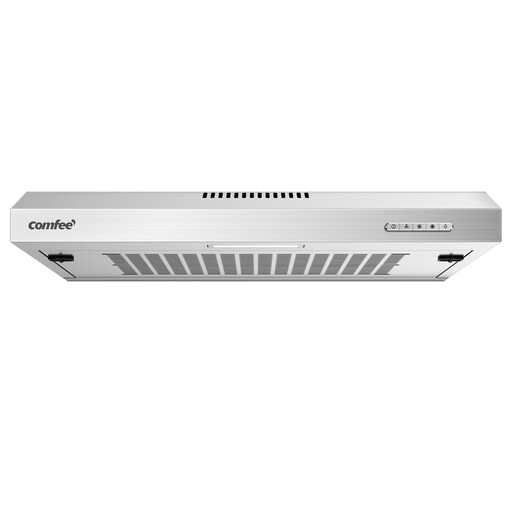
Why this product fits the profile: This compact stainless steel hood is designed for small kitchens and simple operation. Three power levels, LED lighting and two operating modes provide a basic set of features for everyday use.
The data mentions both extraction and recirculation, as well as the required separately available cotton filter for recirculation. This makes it easier to budget for ongoing filter costs before you buy.
60 cm width, stated airflow of 200 m³/h and LED lighting; stainless steel housing with removable aluminium filter.
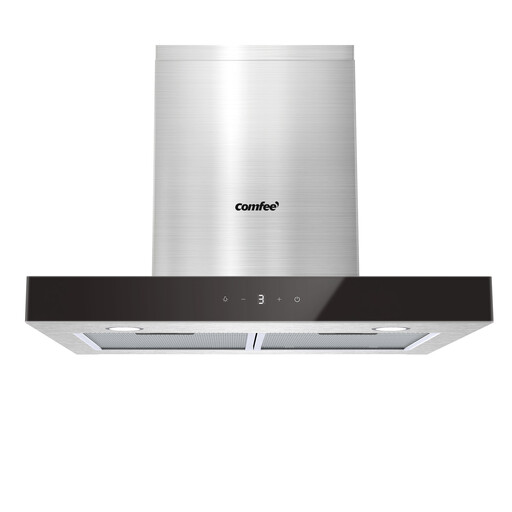
Why this product fits the profile: This wall-mounted hood is aimed at users who want to combine multiple operating options, a higher stated airflow and a reusable filter.
The product data clearly lists four speed levels, extraction and recirculation, and a five-layer, dishwasher-safe aluminium filter.
Stated airflow up to 650 m³/h, LED lighting, touch and gesture control, and stainless steel construction.
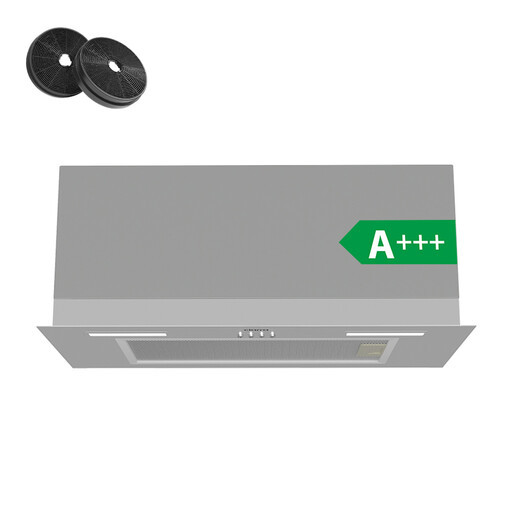
Why this product fits the profile: This built-in hood is designed for integrated kitchen fronts and combines a discreet design with three power levels and flexible air circulation.
The installation dimensions of 599 × 309 × 263 mm, the maximum airflow and the annual consumption of 9 kWh/year are clearly stated. This allows you to check the fit with your kitchen cabinet beforehand.
Stated airflow up to 640 m³/h on level 3, washable aluminium filter and use with extraction or activated carbon filter in recirculation mode.
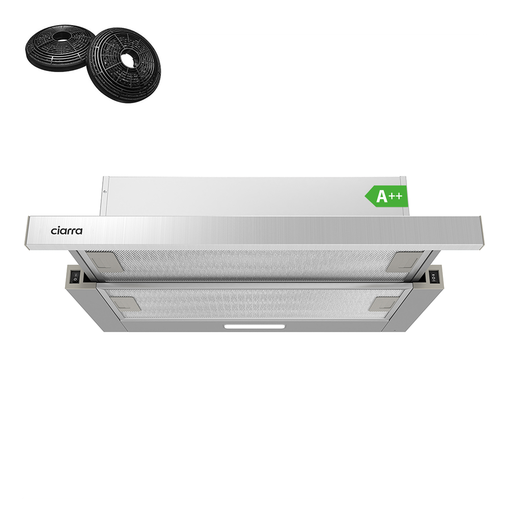
Why this product fits the profile: The pull-out design makes use of existing cabinet space and can be partially hidden when not in use. This is practical for small rented kitchens with limited worktop space.
The product description mentions both operating modes, the included carbon filters, two washable aluminium filters and a maximum noise level of 61 dB.
Telescopic pull-out, LED lighting, stated airflow up to 370 m³/h and annual consumption of 10 kWh/year.
We've put together a complete, regularly updated list of products that fully meet these strict selection criteria and the safety regulations in force in the EU.
That depends on the room size, your cooking habits and the operating mode. For occasional cooking in a small kitchen, models with around 200 m³/h may be sufficient. If you fry food often or have an open-plan kitchen, you might consider a hood with a higher stated airflow. With extraction, the ducting must be appropriately sized.
Recirculation is usually easier to install because no hole needs to be made in the wall. However, it involves ongoing costs for activated carbon filters. Extraction can vent steam and odours outside, but requires a suitable connection and must be agreed with your landlord and the building's structural conditions.
With regular use, cleaning every two to four weeks is a sensible guideline. The exact frequency depends on how much you cook and the fat content of your food. Always disconnect the power supply before cleaning. With recirculation, you should also check the condition of the activated carbon filter.