
Lieferung heute & morgen

Qualitätsgarantie

Willkommens-Angebote freischalten: KOSTENLOSE Lieferung | Bis zu 80 % RABATT | Kostenlose 30-Tage-JoyPlus-Testphase
App herunterladen
A 60 cm cooker hood fits many standard hobs and is therefore a popular choice for flats, couples and families. However, models differ significantly in terms of extraction rate, noise level, installation and ongoing maintenance. A high number on the packaging alone tells you little about whether the hood will work effectively in your own kitchen.
The points below will help you avoid common buying mistakes and choose a model that suits your cooking habits, room size and installation options.
Figures such as 580 m³/h or 650 m³/h usually refer to a specific operating condition. Once installed, factors like duct length, bends, non-return flap and the vent opening can affect the airflow. An unnecessarily long or narrow duct can reduce performance and increase noise.
Not every appliance with a high stated extraction rate is automatically suitable for a 60 cm hob. What matters is whether the hood matches your room size, cooking intensity and existing ductwork.
A cooker hood with recirculation and extraction offers flexibility. In recirculation mode, however, the air is not vented outside. A charcoal filter traps odours and must be checked and replaced regularly depending on usage. You should factor in this ongoing cost before you buy.
In extraction mode, charcoal filters are usually not needed, but you will require a suitable wall vent, ducting and permission from your landlord or management company.
A chimney hood with an angled design gives you more headroom in front of the hob. However, before ordering, you should check whether the depth, height and chimney adjustment fit your wall and wall units. A cooker hood with touch control is not automatically more practical either: smooth control panels are easy to clean, but they can be less responsive with damp or greasy fingers than mechanical buttons.
The width of the hood should at least match the width of your hob. A 60 cm hood is suitable for many 60 cm hobs. If you have a wider hob, a larger hood may be a better choice.
Alongside a classic 60 cm wall-mounted hood, you can also consider under-cabinet, built-in and angled chimney hoods. Check the following before you buy:
Installation and electrical connection should be carried out according to the instructions. If you are unsure, involve a qualified installer.
The extraction rate is given in m³/h. For intensive cooking, a more powerful model may be useful, while in a small, enclosed kitchen, the lower settings may be sufficient. A cooker hood with 650 m³/h offers a high stated extraction rate, but it needs suitable ducting or a well-maintained recirculation filter to perform properly.
Noise level is given in dB. Since the maximum value usually applies to the highest setting, it is worth looking at the noise levels on several operating speeds. Models with readings around 59 to 65 dB on the highest setting can be interesting for open-plan kitchens; however, the actual perceived noise depends on installation and room acoustics.
A multi-layer aluminium filter traps grease particles and can be removed and cleaned on many models. A dishwasher-safe grease filter reduces maintenance effort. Cleaning should be carried out regularly, as grease build-up should not be allowed to accumulate in the appliance for safety reasons.
A cooker hood with LED lighting illuminates the cooking area independently of the room lighting. When it comes to energy efficiency, both the energy class and the stated annual consumption are relevant. An energy-efficient cooker hood can limit electricity consumption compared to less efficient models when used frequently. These values should be understood as manufacturer specifications for the particular model.
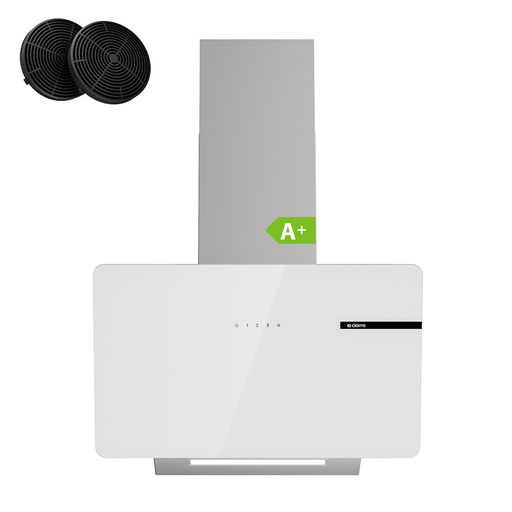
Why this product suits the profile: The 60 cm width fits many standard hobs. The angled glass design creates extra space in front of the hood and supports space-saving wall mounting.
The product details mention both recirculation and extraction modes. A charcoal filter and ducting are included according to the description; the specific installation must suit your kitchen.
Stated extraction rate of 580 m³/h, three power levels, touch control, LED lighting and a dishwasher-safe five-layer aluminium filter.
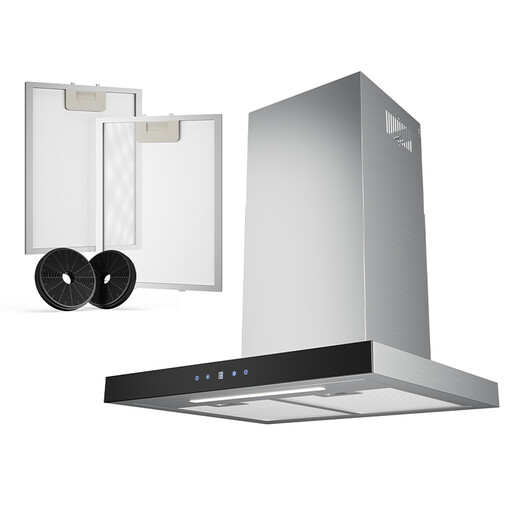
Why this product suits the profile: The combination of digital display, touch control and stainless steel housing appeals to households that prioritise ease of use and clearly specified features.
The description lists both recirculation and extraction modes and mentions an included charcoal filter. Before ordering, check the filter type, chimney height and wall clearances.
Stated extraction rate of 611 m³/h, energy efficiency class A++, five-layer aluminium filter, LED light and dishwasher-safe grease filter.
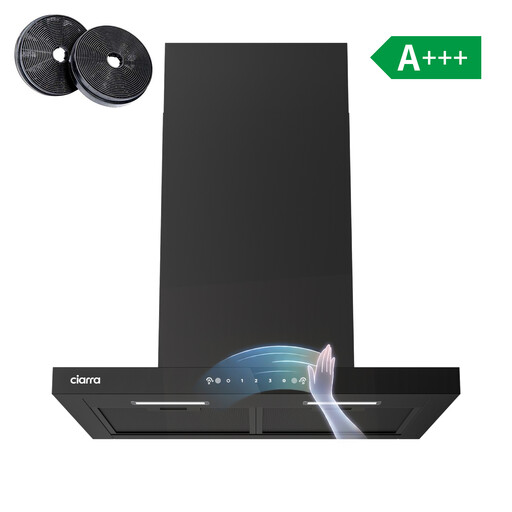
Why this product suits the profile: The slim, 40 mm thick panel and stated extraction rate of 650 m³/h appeal to households that want a discreet look combined with a higher extraction capacity.
The data lists both installation types, two washable aluminium filters and a maximum noise level of 59 dB. In recirculation mode, regular charcoal filter replacement remains necessary.
Stated energy efficiency class A+++, wave and touch control, LED lighting, 650 m³/h extraction rate and adjustable height from 527 to 1,005 mm.
We have compiled a complete, regularly updated list of products that fully meet these strict selection criteria and the safety regulations in force in the EU.
Switch the hood on before you start cooking and select the power level to suit the cooking situation. After cooking, a short run-on time can help to remove any remaining steam. Check and clean the grease filter approximately every two to four weeks, depending on usage. Follow the manufacturer's instructions regarding dishwasher suitability and suitable cleaning agents.
In recirculation mode, the charcoal filter is a consumable item. In extraction mode, the ductwork should remain clear and be professionally connected. Always disconnect the power supply before cleaning or maintenance work.
That depends on room size, cooking intensity and operating mode. For occasional cooking, a lower extraction rate may be sufficient. If you frequently fry or have an open-plan kitchen, you might consider models with around 580 to 650 m³/h. The ductwork must be suitable for the stated performance.
Extraction vents steam and odours outside, but requires a suitable connection. Recirculation is more flexible to install and practical for many rented flats. However, charcoal filters must be checked regularly and replaced when necessary.
The lifespan depends on the motor, installation, cleaning intervals and intensity of use. Regular filter maintenance, a clean surface and clear ductwork can help to maintain functionality over the long term. Warranty conditions, spare parts availability and the long-term costs of filters and electricity are also important factors.