
Lieferung heute & morgen

Qualitätsgarantie

Willkommens-Angebote freischalten: KOSTENLOSE Lieferung | Bis zu 80 % RABATT | Kostenlose 30-Tage-JoyPlus-Testphase
App herunterladen
A 60 cm induction hob will often fit standardised kitchen worktops and, depending on the model, offer two, three or four cooking zones. However, models can vary considerably in terms of installation dimensions, connected load, controls and safety features. If you focus only on wattage or a modern glass design, you could later be faced with an unsuitable worktop cut-out, cooking zones that are too small or a complicated electrical installation.
This buying guide from the Joybuy Product Recommendation Officer selection explains which specifications are relevant before you buy and which model may suit different usage situations.
A hob measuring around 59 to 60 cm in width does not automatically require the same-size worktop cut-out. Many built-in appliances, for example, have external dimensions of approximately 592 × 522 mm, while the cut-out measures around 560 × 490 mm. Other models require 565 × 495 mm.
Before buying, always compare these three specifications:
An existing cut-out must not be enlarged or reduced without checking first. In Germany, installation and electrical connection should generally be carried out by a qualified electrician.
A 4-zone induction hob with 7.200 or 7.400 watts can supply several pans at the same time. However, depending on the model, the available power is distributed via integrated power management. If several zones are operated at a high setting or on Boost, the output of individual areas may be limited.
You should therefore check:
A boost induction hob can speed up heating under certain conditions. However, the function is only useful when the pan base is magnetic and matches the zone. A magnet test on the base provides an initial indication of suitability. The base should also be flat and sufficiently large.
With a glass-ceramic induction hob, the surface remains hot after switching off because of residual heat from the pan. A residual-heat indicator is therefore more important than an especially glossy design.
Four individual zones are suitable for families and households where several dishes are prepared at the same time. A FlexInduction or CombiZone can connect two adjacent areas. This is practical for elongated griddle plates, fish pans or large roasting dishes.
A 2-zone induction hob takes up less space and may be sufficient for small kitchens, flats or as an additional cooking area. For mobile use, a portable induction hotplate with 2.000 to 3.500 watts is an alternative when a built-in appliance is not required.
An induction hob with touch controls should clearly display the power setting for each zone. Depending on the appliance, there may be nine, ten or more settings. A separate timer for each cooking zone can support automatic switch-off and prevent you from losing track of the set cooking time.
Other useful features include:
The child lock prevents accidental inputs, but it does not replace supervision of children in the kitchen.
Many 60 cm built-in appliances are supplied with a connection cable but without a Schuko plug, and require a fixed connection. The specifications for 220–240 volts, connected load and fuse rating must match the existing electrical installation.
Check the installation instructions before buying. Professional installation is particularly important for appliances with around 6.000 to 7.400 watts. Sufficient ventilation beneath the hob protects the electronics from excessive heat.

Why this product suits this profile: This built-in induction hob offers four zones, nine power settings and a total output of 7.200 W. It is aimed at households that use several pans at the same time and value a clear, straightforward feature set.
The technical specifications state the external dimensions, cut-out size, connection data and power settings. This allows you to check before ordering whether the hob is suitable for your kitchen.
Four zones, Boost function, timer of up to 99 minutes, pan detection, child lock and residual-heat indicator.
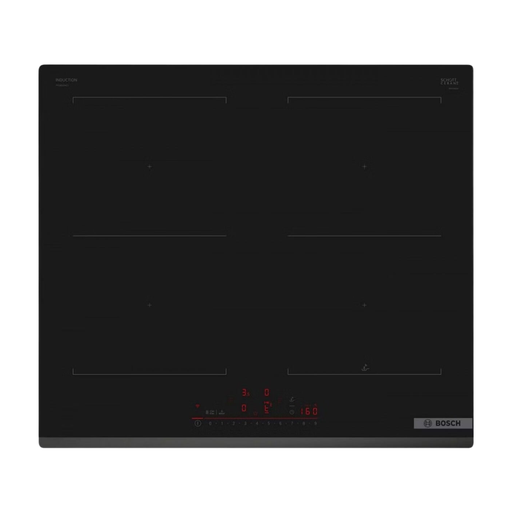
Why this product suits this profile: This 60 cm hob combines four zones with 7.400 W, TouchSelect controls and a CombiZone for larger pans or roasting dishes.
The connectable cooking area addresses the problem of large, elongated pans not sitting fully on conventional individual zones.
CombiZone, Boost on every zone, individual timers, automatic switch-off, child lock and a two-stage residual-heat indicator.
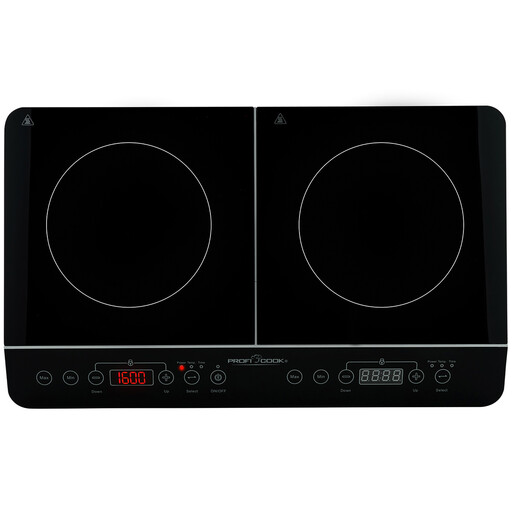
Why this product suits this profile: This portable double hotplate is suitable for small kitchens, additional cooking areas or situations where a permanently installed hob is not required.
The portable design prevents you from making the wrong choice for a built-in installation. Automatic pan detection and switch-off also reduce the risk of unintended continuous operation.
Two cooking surfaces, 16 power settings, temperature selection from 60 to 240 °C, 180-minute timer, overheating protection and non-slip feet.
Induction heats the base of a suitable pan directly. This means the glass ceramic does not need to be heated for as long as it does with traditional radiant hobs. However, actual electricity consumption depends on cooking time, power setting, pan size and connected load. It is therefore not possible to state a general saving that applies to every cooking style.
For cleaning, wait until the residual-heat indicator has gone out. Spilt liquids can usually be removed with a damp cloth. Burnt-on residue should be treated with a suitable glass-ceramic scraper and a cleaning product recommended by the manufacturer. Abrasive cleaners and hard sponges can damage the surface.
Do not use the hob if there are visible cracks. Metal objects should not be placed on active zones, and oil or fat should not be left unattended while heating. People with pacemakers or other electronic implants should follow the safety instructions provided by the relevant manufacturer and seek medical advice if necessary.
We have put together a complete, regularly updated list of products that fully meet these strict selection criteria and the safety regulations applicable in the EU.
Many 60 cm models require a cut-out of approximately 560 × 490 mm. Dimensions may vary depending on the manufacturer. You should therefore check the installation drawing for the specific model and compare it with your existing worktop.
Its service life depends on operating hours, care, ventilation and the quality of the electrical installation. It is not possible to give a standard lifespan that applies in every case. Gentle cleaning, unobstructed ventilation areas and avoiding damaged cookware can support reliable everyday use.
Induction transfers heat directly to the magnetic base of the pan. This can result in lower heat losses during heating than with conventional heating surfaces. Actual consumption is still determined by the power setting, cooking time, pan and household electricity tariff. The key factors are therefore not just wattage, but also the right zone size and using the hob according to your needs.