
Lieferung heute & morgen

Qualitätsgarantie

Willkommens-Angebote freischalten: KOSTENLOSE Lieferung | Bis zu 80 % RABATT | Kostenlose 30-Tage-JoyPlus-Testphase
App herunterladen
A 60 cm induction hob fits into many British kitchens and, with four cooking zones, provides plenty of space for everyday cooking. However, choosing the right model is not simply a question of brand, design or wattage. Terms such as “Boost”, “TouchControl” and “FlexZone” can be useful, but they tell you little if the installation dimensions, electrical connection and controls are not suitable for your kitchen.
Many 60 cm hobs are approximately 59 to 59.2 cm wide overall. However, the worktop cut-out is what matters for installation. Common dimensions are around 56 × 49 cm, although some models require a slightly larger or differently shaped cut-out.
You should therefore check the following before buying:
A hob that is too large cannot be fitted without modifying the worktop. If the cut-out is too small, stability and sealing may be compromised.
A 4-zone induction hob may, for example, be listed with a total power rating of 6,000, 7,200 or 7,400 watts. This does not necessarily mean that this power is continuously available to all cooking zones at the same time. A power management function distributes the available connection power when several zones are being used simultaneously.
The Boost function increases the power of one zone for a limited period. When cooking with several pans, the power of other zones may be reduced. If you often fry, boil and heat a large pan at the same time, you should therefore pay attention to the zone layout and load management.
An induction hob with a child lock, pan detection, residual heat indicator and automatic switch-off helps to reduce operating errors, but it does not replace supervision. Even with induction, the glass ceramic surface can be heated by a hot pan base.
The following features are particularly useful:
A classic 4-zone induction hob usually has two smaller and two larger cooking areas. Check whether their diameters suit your pans. An 18 cm pan will not automatically work optimally on every zone.
A FlexInduction or double zone combines two adjacent areas. This is practical for roasting dishes, oval fish pans or long griddle plates. It is important that the cookware actually covers the intended area. A flexible zone does not automatically guarantee even heating in every possible position.
An induction hob with TouchControl requires a clean, dry control panel. Grease, water or objects resting on the controls can affect the sensors. Clearly separated displays for each cooking zone and directly accessible power levels are useful features.
An induction hob with a timer should ideally offer a separate timer for each zone. This allows, for example, pasta water on one side and a sauce on the other to be switched off independently. Check whether the timer only sounds an alert or also switches the zone off automatically.
Models with 220–240 V are designed for the German power supply. However, the connected load may require its own circuit protection and a fixed connection. Some hobs are supplied without a plug and must be connected directly.
Installation and connection should be carried out by a qualified electrician. Before buying, check the connection data, fuse, phase distribution and the information in the installation instructions. Even an independent induction hob requires professional electrical installation; “independent” primarily means that it is operated and connected separately from an oven.
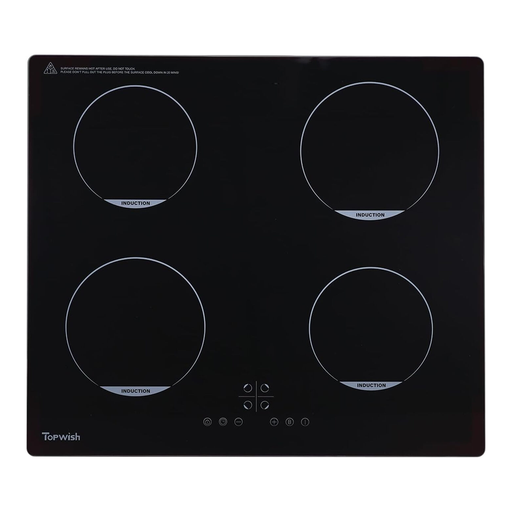
Why this product suits the profile: This model offers four cooking zones, touch controls and a stated total power output of 7,200 W for a classic 60 cm built-in installation.
The product details explicitly state the cut-out size, connection type, timer range of 1–99 minutes, child lock and residual heat indicator. Note that a fixed connection is required and no plug is supplied.
Four zones, nine power levels, Boost function and automatic switch-off according to the stated appliance specifications.

Why this product suits the profile: The four zones, 17 power levels, QuickStart and frameless design are aimed at households that prioritise ease of use and precise appliance configuration.
The stated overall dimensions of 592 × 522 × 51 mm and cut-out size of 560 × 490 mm make it easier to check compatibility with the worktop. The Boost power is specified for each zone.
17 power levels, four Boosters, timer with switch-off, child lock and restart function according to the product description.
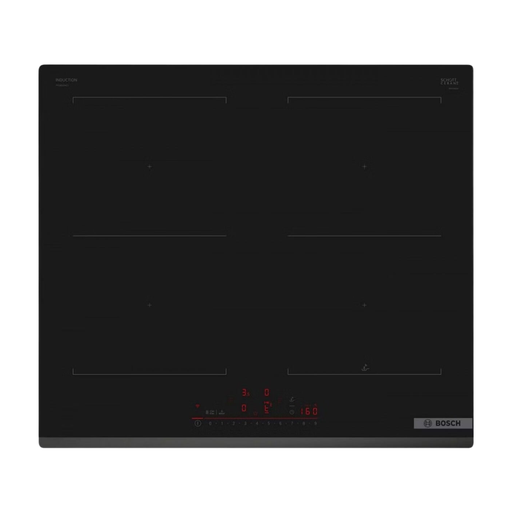
Why this product suits the profile: The CombiZone can be used with elongated cookware. This makes it a compelling choice for families, large pans and regular cooking with several vessels at once.
The flexible zone is not merely advertised; it is described as a combined area measuring 360 mm. Individual timers, automatic switch-off and power management are also specified.
Four zones, 7,400 W total power, Boost per zone, TouchSelect, pan detection and a two-stage residual heat indicator according to the product details.
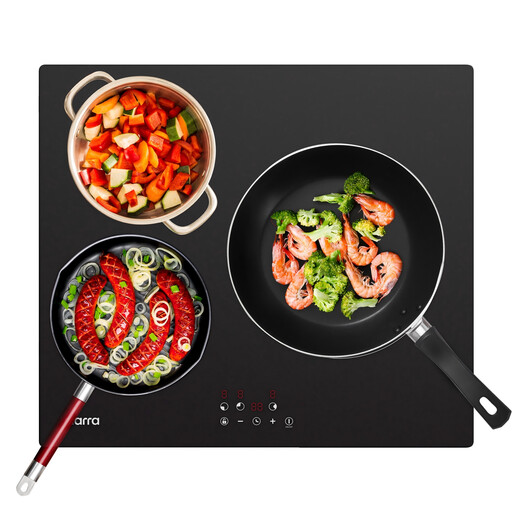
Why this product suits the profile: Three zones, including a large 280 mm area, can be a sensible choice if you often use large frying pans and do not necessarily need four separate zones.
The zone sizes and power ratings are listed individually. Before buying, the 560 × 490 mm cut-out should be checked against the existing worktop.
5,600 W total power, nine power levels, 99-minute timer, pan detection, overheating protection and child lock according to the supplier’s details.
We have put together a complete, regularly updated list of products that fully meet these strict selection criteria and the safety regulations applicable in the EU.
No. Although many appliances are designed for 60 cm kitchens, the required cut-out dimensions vary. Always check the installation diagram for the specific model and measure the worktop before placing your order.
Its service life depends, among other things, on how often it is used, installation, ventilation, cleaning and the electrical installation. Avoid impacts, heating empty pans and abrasive cleaning products. If the glass ceramic surface is damaged, the appliance should not be used further.
Induction transfers heat directly to suitable cookware. This can reduce heating times. However, actual consumption depends on cooking time, power level, pan size, whether a lid is used and whether several zones are operated at the same time. For a meaningful comparison, consider not only the wattage but also your own cooking habits.