
Lieferung heute & morgen

Qualitätsgarantie

Willkommens-Angebote freischalten: KOSTENLOSE Lieferung | Bis zu 80 % RABATT | Kostenlose 30-Tage-JoyPlus-Testphase
App herunterladen
A 65W GaN charger can replace separate power adapters for your smartphone, tablet and USB-C laptop. In practice, though, the stated wattage isn’t the only thing that matters. Port configuration, charging protocols, plug type and dimensions all determine whether a charger is right for everyday use.
The figure usually refers to the maximum total output or to a single USB-C port. When you connect several devices, the power is shared between them. For example, a 3-port charger might provide 45W through the first USB-C port and lower outputs through the other ports.
So check:
A USB-C Power Delivery charger often supports PD, but not every device uses the same profiles. Smartphones may also need PPS, QC4+, QC3.0, AFC or other protocols. If the right protocol isn’t supported, your device may charge at a lower output.
A PD PPS QC4+ charger is therefore worth considering if you need to charge devices from different brands and categories. Compatibility still depends on the device itself and the cable you use.
GaN technology can make smaller designs possible. On its own, however, it says nothing about the specific safety circuitry or build quality. Look for clear information on overvoltage, overcurrent, short-circuit and over-temperature protection, as well as easy-to-understand manufacturer and importer details.
Don’t treat a CE mark as proof of quality on its own. The input range, EU plug, instructions and intended use are also important buying considerations.
For a USB-C laptop, 65W is often a suitable power class. What matters is whether the laptop can charge via USB-C Power Delivery and which power profile the manufacturer requires. Ideally, a 65W USB-C power adapter should list output values up to 20V and sufficient current.
For smartphones and tablets, PPS can help adjust voltage and current automatically. That doesn’t mean every device will charge at its maximum speed. Compare the charger’s protocols with your device’s specifications.
A multi-port charger saves space, but may provide less power per port when you use several at once. Before buying, check that this suits the way you plan to use it.
When you’re travelling, the plug design matters as much as the dimensions. An EU plug works directly in Germany. For international travel, interchangeable plugs or a built-in travel adapter may be useful. A 65W travel charger with several plug standards can help you pack less, but depending on its design, it may be larger than a standard wall charger.
Use cables rated for the power you need. Higher USB-C PD outputs may require a suitable 5A cable. Don’t continue using a charger if its cable or casing is damaged.
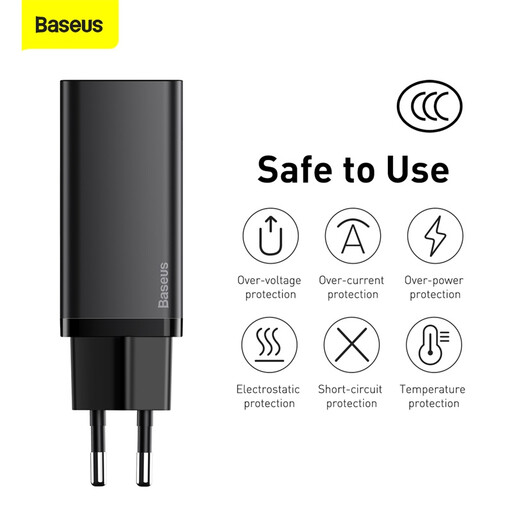
Why this product suits this user: With one USB-C port and one USB-A port, it’s a good match for a current main device and older accessories.
The specifications list 65W and support for PD3.0, QC4+ and other protocols. That means you don’t have to rely on a vague ‘fast charging’ claim alone.
EU version, 65W total output, 115g weight and support for multiple charging protocols.
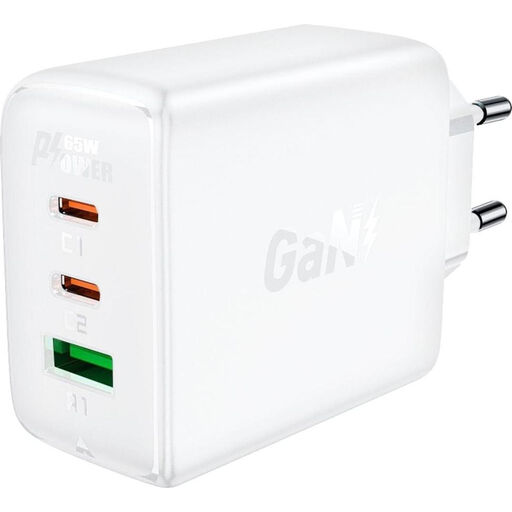
Why this product suits this user: Two USB-C ports and one USB-A port cover common combinations of laptop, smartphone and accessories.
The product details list PPS, PD, QC4+ and QC3.0, along with automatic power distribution. This makes it easier to check compatibility with different devices.
65W, 2 × USB-C, 1 × USB-A, EU plug, 100–240V input and a stated weight of 136g.
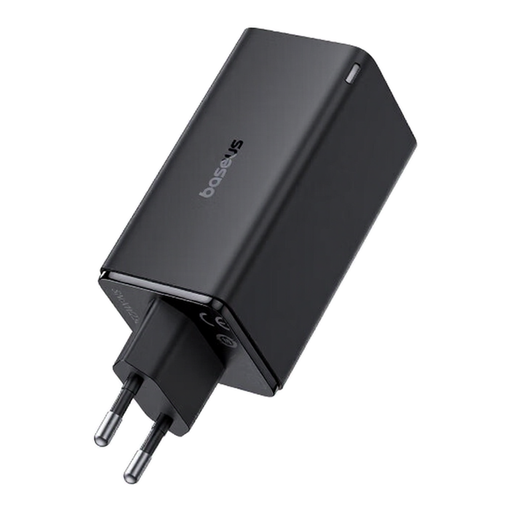
Why this product suits this user: With four ports, it’s designed for workspaces, shared homes and anyone with several USB devices.
Four ports reduce the need for multiple power adapters. Before buying, though, check how the 65W is shared when several devices are connected at once.
2 × USB-C and 2 × USB-A, 65W total output, dimensions of 4 × 3,4 × 6,37cm and a stated weight of 142g.
We’ve put together a complete, regularly updated list of products that meet these strict selection criteria and fully comply with the safety regulations in force in the EU.
It depends on the laptop’s USB-C PD requirements. If the device supports a suitable 65W profile, a matching power adapter may be enough. However, the power is shared when you connect several devices.
Two or three ports are usually enough for a laptop and smartphone. A 4-port charger is a good choice if you also regularly charge a tablet, headphones or other accessories. Always check how the total power is shared.
GaN refers to the semiconductor technology used and makes compact designs possible. Actual electricity consumption depends on the device’s charge level, the connected device, efficiency and standby behaviour. Unplug the charger after use if you won’t need it for a while.