
Lieferung heute & morgen

Qualitätsgarantie

Willkommens-Angebote freischalten: KOSTENLOSE Lieferung | Bis zu 80 % RABATT | Kostenlose 30-Tage-JoyPlus-Testphase
App herunterladen
As your Joybuy Product Recommendation Officer, I often see well-intentioned purchases end in frustration. A powerful, large-capacity stand mixer promises culinary freedom, yet the market is flooded with models whose specifications obscure more than they reveal. Before you make a decision, it's crucial to understand the typical pitfalls that often lead to disappointment.
Many buyers focus on high wattage ratings or flashy designs, overlooking critical engineering features. The result is often a loud, unstable machine that struggles with heavy dough or loses power after a short time.
The 3 Most Common Misconceptions When Buying a Stand Mixer:
To avoid buyer's remorse, you should focus on three core technical aspects. These determine the longevity, performance, and user-friendliness of your future stand mixer.
The most important component is the drive system. Look for models with a direct current motor (DC motor). These motors are known for delivering high and consistent torque even at low speeds. This is especially important for a stand mixer for bread making, as kneading tough dough requires a lot of power. Furthermore, a quiet stand mixer is often equipped with a DC motor and a robust metal planetary gear system, which reduces noise levels and wear and tear.
A 6-litre capacity is ideal for home bakers who regularly bake for the family or prepare larger batches. A 6-litre dough mixer can typically handle dough quantities made from up to 1.5 kg of flour without issue. Look for a mixing bowl made of stainless steel (SUS304). This material is food-grade, durable, rust-proof, and easy to clean.
A good mixer with a dough hook should come with at least three standard attachments:
A splash guard with a pouring chute is another practical detail that keeps the kitchen clean. Operation should be via a rotary dial with clearly defined speed settings, plus a pulse function for short bursts of power.
Based on the objective criteria above, we have identified models suitable for specific needs.
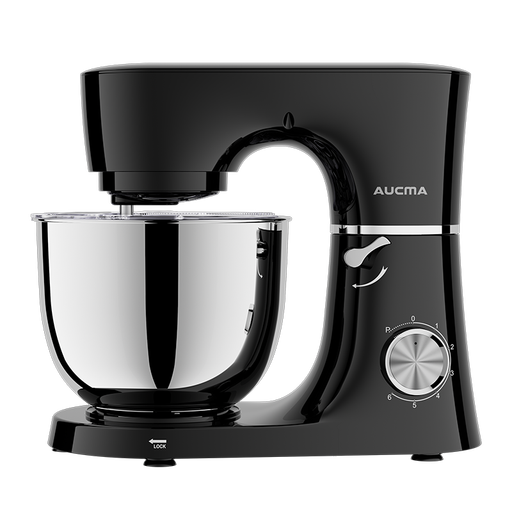
Why it's a match: The combination of a 6-litre stainless steel bowl and a high-torque DC motor makes it a reliable partner for demanding baking projects, from heavy sourdough loaves to multi-tiered cakes.
This model relies on an efficient 450W pure copper DC motor instead of a misleadingly high wattage rating. This ensures genuine kneading power and durability without running up the electricity bill.
Low operating noise (≤72dB according to the manufacturer) and a stable footing thanks to suction cup feet and vibration absorption. The tilt-head design facilitates easy access to the bowl.
Why it's a match: With its 6-litre volume, the machine offers enough capacity for family meals, from Friday night pizza dough to birthday cakes. It combines features often found only in more expensive segments, thus offering a balanced price-to-performance ratio.
It actively solves the problem of instability: Four strong suction cup feet on the base and an internal design for vibration absorption ensure the machine stays securely in place, even when fully loaded.
The large 6-litre capacity is ideal for family-sized portions. The included accessories (dough hook, beater, whisk) cover all basic baking and cooking needs.
We have compiled a complete, up-to-date list of products that fully meet these strict selection criteria and safety regulations.
1. How much dough can a 6L stand mixer handle? A 6-litre bowl is generally designed to process dough made from up to 1.5 kg of flour plus ingredients. This corresponds to about two large loaves of bread or a substantial amount of pizza dough. Always follow the manufacturer's specifications to avoid overloading the motor.
2. Is a quieter stand mixer less powerful? No, that's a common misconception. The noise level depends less on raw power and more on the quality of the motor and gearbox. A quiet stand mixer often uses a high-quality DC motor and a precision-engineered metal planetary gear system, resulting in quieter operation with simultaneously high torque. Loud noises are often a sign of inefficient power transfer and inferior components.
3. How do I properly clean the mixing bowl and attachments of my stand mixer? Most stainless steel mixing bowls and standard attachments (dough hook, flat beater, whisk) are dishwasher-safe. However, always check the user manual for your specific model. Hand washing with warm water and dish soap is also a safe and effective method. The machine's housing should only be wiped with a damp cloth and never submerged in water.