
Lieferung heute & morgen

Qualitätsgarantie

Willkommens-Angebote freischalten: KOSTENLOSE Lieferung | Bis zu 80 % RABATT | Kostenlose 30-Tage-JoyPlus-Testphase
App herunterladen
A 7-day pill organiser can make it easier to plan your medication, vitamins and food supplements for the week. But the number of compartments isn’t the only thing that matters. The closures, labelling, material, capacity and ease of cleaning all determine whether a pill box is genuinely practical for everyday use.
A pill organiser with 7 compartments is suitable for a simple daily dose. If you also want to store large capsules, fish oil or several food supplements, you’ll need more internal capacity. Claims such as “large capacity” should therefore be backed up with specific dimensions or quantities.
Descriptions such as “air-tight” or “anti humidity” may refer to how the lid is designed, but they don’t replace proper storage. Medication should be stored according to the instructions on the packaging. For sensitive products, the original packaging, patient information leaflet and, where appropriate, advice from a pharmacist should take priority.
Very tight clips may help prevent the organiser from opening accidentally, but can be inconvenient for older people or anyone with limited hand mobility. An arthritis-friendly pill organiser should open with controlled pressure while still closing securely. Rounded edges and clearly visible day markings also make it easier to use.
First, consider whether one dose a day is enough, or whether you need to separate doses taken at different times. A medication organiser with seven large daily compartments offers a different layout from a pill organiser with four doses per day.
Check the following:
If you take prescription medication, check whether transferring it to an organiser is compatible with its storage instructions. Some products must remain in their original packaging.
Polypropylene, or PP, is commonly used for pill organisers. If a product is described as a BPA-free pill organiser, this should be stated explicitly in the product description. Don’t assume it based only on its appearance or the type of plastic.
Permanent or deeply embossed day markings may be less prone to wearing away than printed labels. Even so, the lettering should be large enough and offer good contrast, especially on a pill organiser for older people.
For a travel pill organiser, compact dimensions, a secure closure and easy cleaning are important. Check whether the compartments can dry completely before you refill them. A damp interior isn’t suitable for medication or food supplements.
If you’re looking for a medication organiser to take with you, also consider:
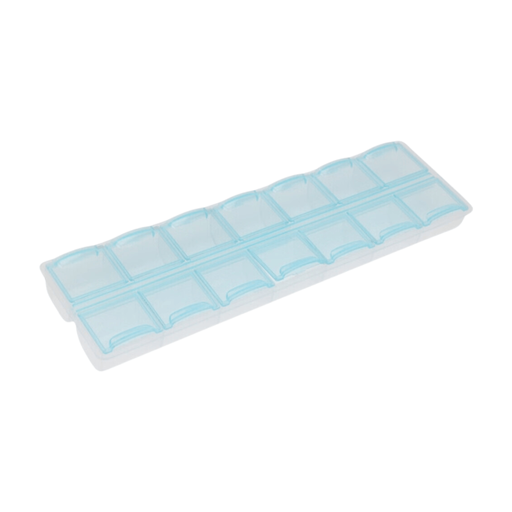
Why it suits this profile: This simple design is ideal if you’re looking for basic medication storage with individual compartments and don’t need a more complex daily layout.
Check the compartment layout before you buy to make sure the organiser suits the amount of medication you take. That way, you won’t buy it simply because it’s described as a weekly organiser.
Made from PP, with compartments for organised storage. The product page names Koopman International B.V. as the manufacturer.

Why it suits this profile: This organiser is designed for people who want to plan for larger capsules, vitamins, fish oil or several food supplements each day.
The product details give the dimensions of each compartment, specify BPA-free PP and describe a capacity designed for larger food supplements. This makes it easier to check whether it meets your needs.
BPA-free PP according to the product details, permanent embossed day markings and an opening lip. The organiser is listed as having 7 daily compartments in a compact design.
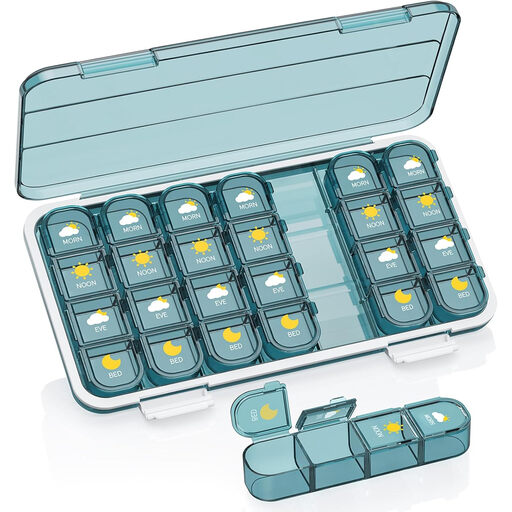
Why it suits this profile: This weekly pill organiser is suitable for people who divide their medication into four doses a day and want separate compartments for vitamins, fish oil or supplements.
The clear layout helps prevent you from trying to use a basic 7-compartment organiser for several doses a day. Separate compartments for each day and dose make everything easier to identify.
Four dose compartments per day, separate containers and a portable design. Manufacturer details and information about the EU-responsible person are listed on the product page.
A small medication organiser is a good choice if you only need to carry individual daily doses. The Portable Small Pill Organizer, 7 Compartments is listed as having seven compartments, an airtight lid and BPA-free material. It could therefore suit a simple weekly routine or work as a travel pill organiser. Whether it’s right for you will depend on the size of your tablets and their storage instructions.
The VVM Weekly Pill Organizer, with its sliding closure, is another option for people with limited finger mobility. According to the product description, it has deeply embossed day markings and seven sliding compartments. Even so, if you’re choosing an arthritis-friendly pill organiser, check how much force is needed to open it.
We’ve put together a complete, regularly updated list of products that meet these strict selection criteria and fully comply with the safety regulations in force in the EU.
First, set out the daily doses you need according to your medication plan. Then check each day of the week and each dose time individually. If you’re unsure, ask a pharmacist or your healthcare provider to check the layout with you. Medication with special storage requirements shouldn’t automatically be put in a pill organiser.
Its lifespan depends on the plastic, closure, how often it’s used and how it’s cleaned. Replace a pill box if compartments develop cracks, lids no longer close securely or the labels become difficult to read. Clean it according to the manufacturer’s instructions, and only refill it once all the compartments are completely dry.
The price depends on factors such as the number of compartments, the daily layout, material specifications and type of closure. A simple pill organiser with 7 compartments may be enough for one daily dose. If you take medication several times a day or use large capsules, a larger organiser with separate compartments may be more practical. So compare more than just the price: check the capacity, dimensions and ease of use too.