
Lieferung heute & morgen

Qualitätsgarantie

Willkommens-Angebote freischalten: KOSTENLOSE Lieferung | Bis zu 80 % RABATT | Kostenlose 30-Tage-JoyPlus-Testphase
App herunterladen
A 7-day pill organiser can make it easier to keep your medicines organised for the week. It’s a useful option for adults, older people, carers and travellers who want to sort tablets, capsules or food supplements by day of the week. But the number of compartments isn’t the only thing to consider. The closure, compartment size, labelling and ease of use all affect how practical a pill organiser is in everyday life.
A compact weekly pill organiser can save space when you’re out and about, but it may not have enough room for large capsules or several supplements. Fish oil capsules, vitamin capsules and larger tablets need considerably more space than small coated tablets. Check the stated compartment dimensions or look for examples from the manufacturer showing how much each compartment can hold.
A pill organiser with 7 compartments is suitable if you sort your medicines once a day. However, it can become confusing if you take them at several different times. A 21-compartment pill organiser, for example, divides the week into morning, midday and evening doses. A 28-compartment pill organiser provides four compartments per day and can make more complex routines easier to manage.
“Air-tight” or “sealed” doesn’t automatically mean that the organiser will remain completely leak-proof in all conditions. Check whether the product description mentions a snap closure, a seal or a sliding mechanism. It’s also important that a BPA-free pill organiser is explicitly labelled BPA-free. When storing medicines, always follow the instructions on the packaging for each product.
Base your choice on how often you actually take your medicines:
A pill organiser with removable daily compartments can make preparation easier. Check that the labels are clear and that the individual compartments close securely when you’re carrying them.
A large pill organiser isn’t automatically more practical for everyday use. Larger compartments hold more, but take up extra space in your handbag, rucksack or suitcase. If you need a pill organiser for travelling, compact overall dimensions are useful. For large capsules, check the internal height and the capacity stated by the seller.
Some VVM models are said to hold up to 12 fish oil capsules or 13 larger vitamins in each compartment. Treat these figures as a guide, as the shape and size of individual tablets can vary.
A snap closure can help prevent individual compartments from opening accidentally. If you have an air-tight pill organiser, check the seal regularly for damage. “Air-tight” is a product feature stated in the description, not a guarantee that it’s suitable for storing every medicine.
For everyday cleaning, the models mentioned can be wiped with a damp cloth or hand-washed using mild soap and warm water. Make sure the compartments are completely dry before filling them. Several product descriptions advise against putting the organiser in a dishwasher, microwave or freezer.
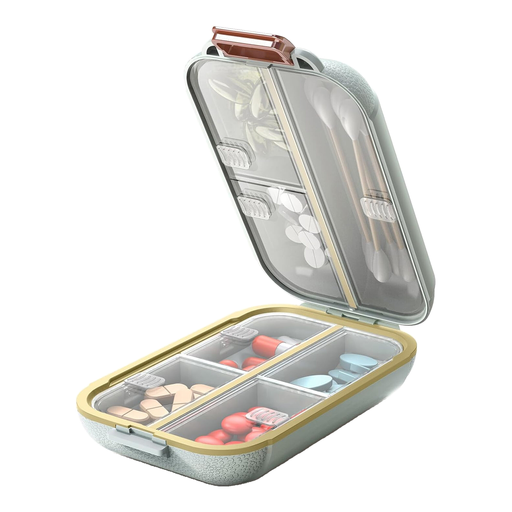
Why this product suits this profile: This compact organiser is designed for a simple weekly layout and for carrying with you day to day or when travelling. According to the product details, it has seven compartments, an air-tight lid and BPA-free materials.
The number of compartments is clearly stated. You can see before buying that this model isn’t designed for four daily dose times.
Seven compartments, a portable design, an air-tight lid according to the product description, and BPA-free materials.

Why this product suits this profile: According to the seller, both organisers are made from BPA-free plastic, with a stated material thickness of 1.6 millimetres and reinforced hinges. This may appeal to anyone who pays close attention to material specifications and build quality.
The product details specify the material, thickness, hinge construction and capacity examples. This makes it easier to assess key buying criteria in advance.
BPA-free plastic according to the seller, reinforced hinges, two organisers and seven spacious daily compartments.

Why this product suits this profile: This 28-compartment weekly pill organiser is designed for people with four daily dose times or several different medicines and supplements. Its stated dimensions of 9,1 × 5,1 × 1,2 inches also make it easier to plan for carrying in a bag or suitcase.
Four compartments per day mean you don’t have to combine different dose times in a single daily compartment.
28 compartments, snap closures, a portable design and, according to the product description, a sealed construction made from ABS, PP and TPE.
For anyone with limited finger mobility, for example due to arthritis, large tabs, sliding parts or easy-opening lids can make a difference. According to the product description, the VVM model with its drawer-style sliding mechanism is designed to be easier to open. Even so, try it before filling the compartments: a closure that’s too tight can be just as awkward as a lid that opens easily in your bag.
If needed, label additional dose times, and store medicines only as directed on the original packaging. A pill organiser is no substitute for the original packaging, the patient information leaflet or advice from a doctor or pharmacist. Keep it out of reach of children and pets.
We’ve put together a complete, regularly updated list of products that meet these strict selection criteria and fully comply with the safety regulations in force in the EU.
It depends on how often you take your medicines. Seven compartments are enough for one daily dose. If you take medicines three times a day, 21 compartments are a good choice; for four dose times, look for 28. The compartment size and labels should also suit your routine.
Many models can be wiped with a damp cloth or hand-washed using mild soap and warm water. Let the compartments dry completely before adding more tablets. Always follow the care instructions for the product.
There’s no set lifespan that applies to every organiser. Check the closures, hinges, labels and compartments regularly for signs of wear or cracks. Replace the organiser if you notice any damage, loose lids or unclear labelling. Always store medicines according to the instructions on the original packaging.