
Lieferung heute & morgen

Qualitätsgarantie

Willkommens-Angebote freischalten: KOSTENLOSE Lieferung | Bis zu 80 % RABATT | Kostenlose 30-Tage-JoyPlus-Testphase
App herunterladen
A 7-day pill organiser can keep your medicines, vitamins and supplements neatly organised. However, pill organisers vary considerably in their compartment layout, closures, ease of reading and capacity. A medication organiser that looks appealing isn’t automatically right for your own medication schedule.
As Joybuy Product Recommendation Officer, I focus on the most important product details and assess them against practical criteria. This can help you avoid common buying mistakes without relying on vague marketing claims.
A simple weekly pill organiser with seven compartments is useful if you only need one prepared dose per day. If you need to separate tablets for morning, lunchtime, evening or night, this layout may not be enough. In that case, 21 compartments for three daily doses or 28 compartments for four daily doses may be more practical.
Fish oil capsules, large vitamins and several tablets need more room than a single small pill. So it’s worth checking specific capacity figures rather than relying on descriptions such as ‘large pill organiser’. For example, some models are said to hold up to 12 fish oil capsules or 13 large vitamins in each daily compartment. These figures depend on the shape and size of the products in question.
A snap closure or seal can help keep compartments separate and secure the contents during transport. However, this doesn’t automatically mean that medicines are protected indefinitely from moisture, heat or light. A leakproof pill organiser should be closed and stored in a dry place, away from direct sunlight, in line with the manufacturer’s instructions. The original packaging and storage instructions for each medicine remain the most important guide.
Before buying, check the layout:
If you take a lot of tablets, a pill organiser with compartments and plenty of internal height may be more suitable than a very shallow model. The day and time markings should remain easy to read. Printed labels can wear away with friction; engraved or deeply embossed markings are a practical alternative to consider when comparing products.
For a BPA-free pill organiser, the product description should explicitly state the material. Common plastics include ABS, PP and TPE. ‘BPA-free’ describes a material property; it doesn’t indicate a medical benefit.
Also look for:
A medication organiser should only be used for the tablets, capsules, vitamins or supplements it’s designed to hold. Don’t put liquids or other unsuitable substances in the organiser.
Large labels, easy-to-identify compartments and lids that open without difficulty can be important for older people or anyone with limited hand strength. A closure that’s too tight can be inconvenient in everyday use. For a travel pill organiser, compact dimensions, a secure closure and a layout that makes it easy to check your tablets while you’re out and about are also important.
A pill splitter may be useful for tablets that are suitable for splitting. However, it’s no substitute for medical or pharmacy advice: not every tablet can be split, particularly capsules, liquid-filled capsules or medicines with special release properties.
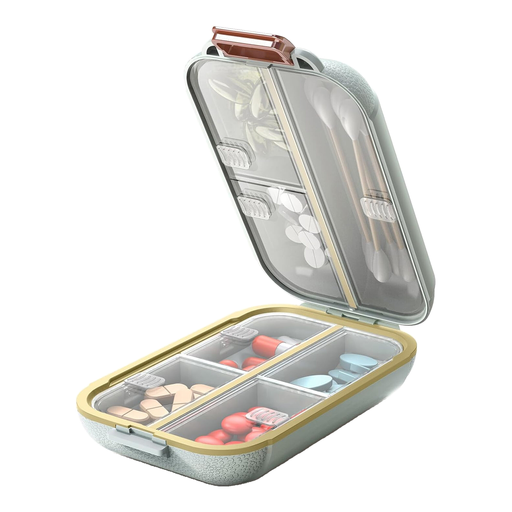
Why this product suits this profile: The seven compartments are suitable for a simple weekly routine, with one dose per day. Its compact design is made for a handbag, rucksack or luggage.
The product details specify seven separate compartments, an airtight lid and BPA-free material. This makes the key features to consider clear.
Seven compartments, a compact travel-friendly design and a snap-shut lid.
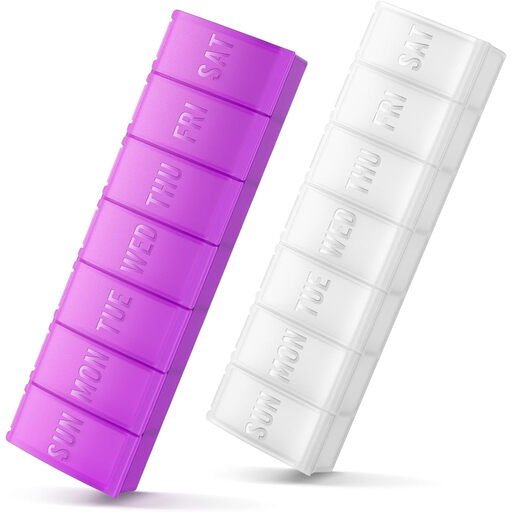
Why this product suits this profile: The larger compartments are designed for vitamins, supplements and larger capsules. The two-organiser set can be used for alternating weekly schedules or as a spare.
The product details specify BPA-free material, permanent day markings and easy-open lids. This makes the labelling and ease of use clear and easy to assess.
BPA-free material, seven large daily compartments, embossed markings and two organisers included.

Why this product suits this profile: Four compartments per day keep morning, lunchtime, evening and night doses separate. This makes it especially easy to stay organised with a complex medication schedule or lots of different tablets.
The 28 separately closable compartments reduce the risk of mixing doses for different times of day. The manufacturer also describes it as having a sealed, portable design.
28 compartments, four time slots per day, generous capacity and compact dimensions for taking on the go.

Why this product suits this profile: The sliding mechanism and deeply embossed day labels may make it easier to use every day. According to the product description, each of the seven compartments is designed to hold several larger supplements.
Instead of a small hinged lid, this model uses a sliding mechanism. According to the supplier, the day markings are deeply embossed rather than simply printed.
Sliding lid, seven compartments, embossed days of the week and room for larger supplements.
We’ve put together a complete, regularly updated list of products that meet these strict selection criteria and fully comply with the safety regulations in force in the EU.
Fill the compartments according to your current medication schedule, then check that everything is in the right place twice. If you take several doses a day, an organiser with 21 or 28 compartments can be easier to use than a standard weekly pill organiser. Don’t remove medicines from their original packaging without checking first, especially if the storage instructions or labelling advise against it.
Its lifespan depends on the material, hinges, closure and how often you use it. Check the compartments regularly for cracks, loose lids, damaged seals and markings that are difficult to read. Replace the medication organiser if you notice any visible damage.
An integrated pill splitter is intended for certain tablets that can be split. Capsules, liquid-filled capsules and some medicines must not be split. Before changing how you take a medicine, check the patient information leaflet or ask a pharmacist or your doctor’s practice.