
Lieferung heute & morgen

Qualitätsgarantie

Willkommens-Angebote freischalten: KOSTENLOSE Lieferung | Bis zu 80 % RABATT | Kostenlose 30-Tage-JoyPlus-Testphase
App herunterladen
A 7-day pill organiser can keep your medicines, vitamins, food supplements or fish oil neatly organised for a week. But the number of compartments isn’t the only thing that matters. An unsuitable 7-day pill box could open while you’re out, lack space for large capsules or be difficult to use if you have limited finger mobility.
This buying guide explains which features to look for in a pill organiser, which marketing claims to treat with caution and which type might suit different everyday needs.
Claims such as ‘large capacity’ don’t always tell you enough. What matters is how many tablets, and what size, will actually fit in each compartment. Fish oil capsules and large vitamin supplements need considerably more room than small tablets. For a realistic idea of capacity, look for specific figures and compartment dimensions.
A clasp should stay securely shut when you’re out and about, but still open without too much effort. Hard push buttons, small tabs or tight sliding lids can be awkward, particularly for older people or anyone with arthritis or limited finger mobility. Product images only give you a limited impression, so details of the clasp and opening mechanism are more useful.
A box with seven compartments is suitable for simple day-to-day planning. If you take medicines in the morning, at lunchtime, in the evening or at night, you’ll need a 21-compartment pill organiser or a 28-compartment pill organiser. A 7-day pill box without separate compartments for different times of day can become confusing if you take several doses.
First, check how the weekly pill organiser is laid out:
A large pill organiser isn’t automatically the right choice. If you only take a few medicines, it may take up unnecessary space. A larger interior, however, can be useful for several large capsules or food supplements.
For a BPA-free pill organiser, the product description should explicitly state that it is BPA-free. The VVM models listed here are described as being made from BPA-free plastic. Other products may be made from materials such as PP, ABS or TPE. These details help you understand what a product is made from, but they don’t replace checking the storage instructions for your specific medicine.
The day labels should remain easy to read. Deeply embossed or engraved labels may be less prone to wearing away than simple stickers. Cleaning is also worth considering: many organisers can be cleaned with a damp cloth or by hand using mild soapy water. Make sure all the compartments are completely dry before refilling them.
For a pill organiser for when you’re out and about, secure-fitting lids and a sturdy outer frame are useful. An airtight closure can help prevent the contents from mixing and protect them from moisture. However, it doesn’t mean that every medicine can be stored outside its original packaging for as long as you like.
Always follow the instructions in the patient information leaflet or ask your pharmacist for advice. Medicines should also be kept out of the reach of children and pets, and away from direct sunlight and excessive heat.
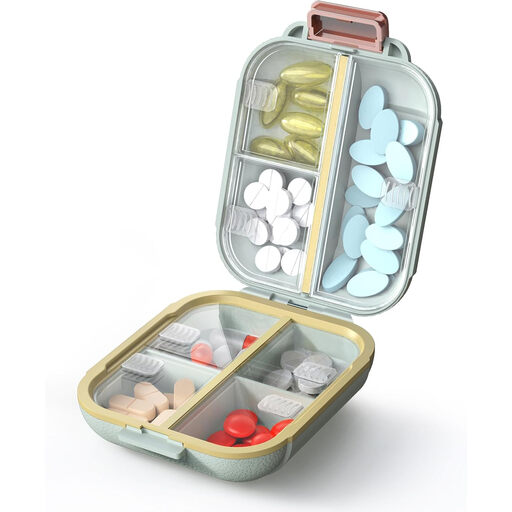
Why this product suits this profile: Its compact design and seven compartments make it suitable for keeping a simple daily medication routine organised at home, in the office or while travelling.
The stated BPA-free material and airtight lid address questions about materials and closures that are often unclear with cheaper organisers.
7 separate compartments, a compact design and, according to the product description, BPA-free material with an airtight lid.
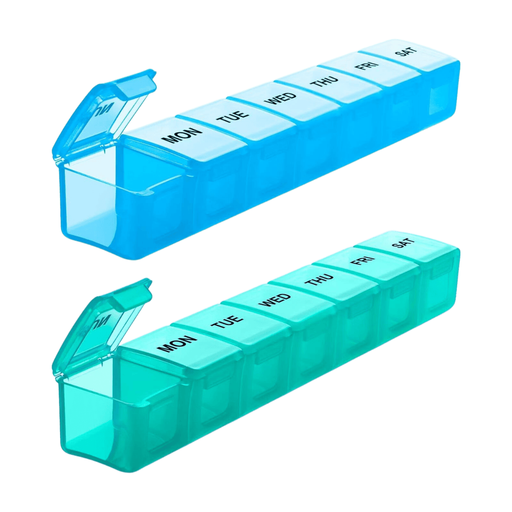
Why this product suits this profile: The two weekly organisers give you a handy spare or let you keep different supplements and medicines separate.
The product description specifies BPA-free plastic, 1.6 mm material thickness, reinforced hinges and wear-resistant day labels.
Large compartments that, according to the product description, hold up to 12 fish oil capsules or 13 large vitamins each; supplied in a 2-pack.

Why this product suits this profile: Four separate time-of-day compartments per day are designed for people who take several doses a day or have a comprehensive supplement routine.
The 28-compartment layout keeps doses for different times of day separate instead of putting them all in one compartment.
28 compartments marked for four times of day, plus a closable design for travel, work or your bedside table.
Fill your pill organiser in a regular, well-lit place if possible. Before you start, check:
Not every medicine is suitable for storing together in a pill organiser. If you’re unsure, ask a pharmacist or your GP surgery. A pill organiser helps you stay organised, but it doesn’t replace your medication plan or a doctor’s dosage instructions.
We’ve put together a complete, regularly updated list of products that meet these strict selection criteria and fully comply with the safety regulations in force in the EU.
If you take your medicines once a day, seven daily compartments are often enough. For three doses a day, a 21-compartment organiser makes it easier to keep track. If you take four doses a day, consider a 28-compartment pill organiser.
It depends on the medicine and the manufacturer’s instructions. Medicines that are sensitive to light, moisture or temperature may need to stay in their original packaging. Check the patient information leaflet and ask your pharmacist if you’re unsure.
Many models can be cleaned with a damp cloth or by hand using mild soapy water. Avoid harsh cleaning products and only refill the organiser once all the compartments are completely dry. If your product has special seals, follow the care instructions as well.