
Lieferung heute & morgen

Qualitätsgarantie

Willkommens-Angebote freischalten: KOSTENLOSE Lieferung | Bis zu 80 % RABATT | Kostenlose 30-Tage-JoyPlus-Testphase
App herunterladen
A 7-zone pocket sprung mattress is designed to provide differentiated support for your body, minimise motion transfer, and retain its shape for many years. In practice, however, it’s not just the number of zones or a marketing label that determines suitability. What matters more are the spring core, the density of the foam layers, firmness, dimensions, and care properties.
If you’re looking for an ergonomic mattress, a breathable mattress, or a mattress for two people, you should thoroughly check the product specifications. Particularly with H3 models, there are differences in construction and actual feel.
Seven comfort zones sound like they automatically provide the right body support. In reality, they only describe the division of the mattress core. What’s crucial is how the zones are constructed and whether they suit your height, weight, and preferred sleeping position.
A 7-zone mattress can be suitable for side, back, or stomach sleepers, but it won’t necessarily be equally comfortable for everyone. Side sleepers usually need more sink-in space around the shoulders, while the hips and lower back should be supported firmly enough.
The firmness rating H3 is a common reference point in Germany, but it’s not a fully standardised, legally defined measurement across all manufacturers. An H3 pocket sprung mattress can therefore feel different depending on the spring core, padding, and body weight.
Before buying, you should compare the information on recommended weight capacity, mattress height, and core construction. A particularly high firmness level doesn’t automatically make it a back-friendly mattress.
A height of 25 or 28 cm can provide more room for the spring core and comfort layers. However, on its own, it says nothing about durability. Also pay attention to the material layers, spring gauge, cover workmanship, and care instructions.
Delivery in a vacuum is not a sign of quality either. After unpacking, a mattress usually needs 24 to 72 hours, depending on the model, to reach its intended shape.
With an H3 pocket sprung mattress, each individual spring is encased in a fabric pocket. This allows them to respond point-by-point and generally transfer less movement than interconnected spring cores. This can be relevant for couples if one person moves around a lot during sleep.
According to the product specifications, the GTIMEX models use 2.1 mm thick carbon steel springs with six coils. The description also mentions a durability test of 30,000 compressions. This information should be understood as a manufacturer’s claim and is not equivalent to a general lifespan guarantee.
A mattress with memory foam can adapt more slowly to body pressure thanks to its viscoelastic properties. The feel depends on the thickness of the foam, room temperature, and your personal sleeping position. If you tend to toss and turn at night or prefer a very responsive feel, you should pay particular attention to this point.
Multiple comfort layers can help distribute pressure. Nevertheless, check whether the product description includes specific details about materials and construction. Terms like “orthopaedic mattress” or “ergonomic” are no substitute for technical data and are not a medical efficacy claim.
Spring cores generally promote air circulation inside the mattress. For your sleep environment, the padding layers and cover are also important. A removable and washable cover makes regular care easier.
A mattress protector shields the surface from sweat, skin particles, and minor spills. It should be breathable and fit the mattress size. If you have allergies, it’s worth checking the care instructions, washing temperature, and material details. Claims about reducing dust mites or bacteria should only be taken as specific manufacturer statements.
Common dimensions include:
Measure the inside of your bed frame before purchasing. You should also check the maximum body weight per sleeping area. For a model with a stated maximum load of 120 or 150 kg, this limit must not be exceeded.
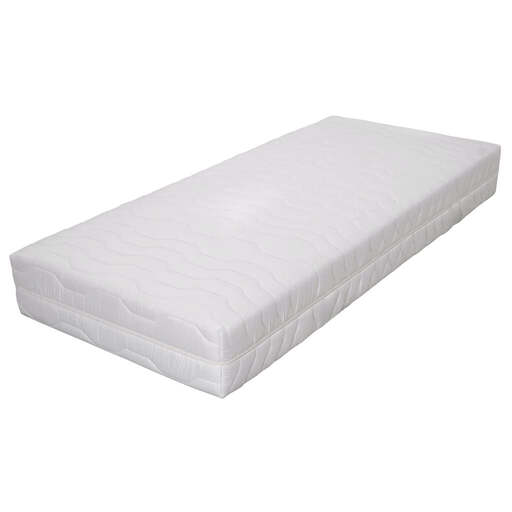
Why this product suits the profile: The 100 x 200 cm size is ideal for individuals who need more width than a standard single mattress and prefer a medium firmness level.
The product details specify exact dimensions, H2 firmness, 240 springs per square metre, and a removable cover with a zip.
20 cm height, washable polyester cover, and vacuum-packed delivery.
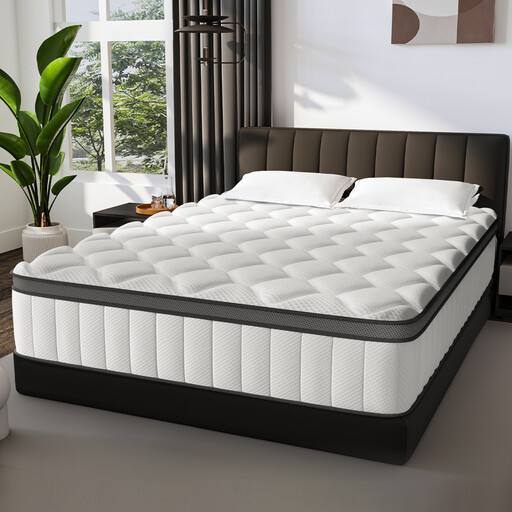
Why this product suits the profile: This model combines H3 firmness, 25 cm height, seven zones, and nine material layers for those seeking a more stable sleeping surface.
The description lists spring diameter, layer construction, and a maximum weight capacity of up to 150 kg, rather than relying solely on the number of zones.
140 x 200 cm, H3 version, viscoelastic foam, and a fitted sheet included according to the product details.
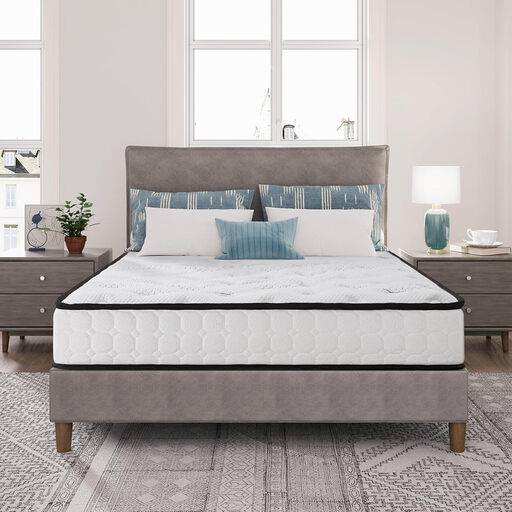
Why this product suits the profile: The compact size is ideal for single beds, guest rooms, or smaller spaces. Memory foam and a microfibre cover complement the pocket spring core.
The product details explicitly list dimensions, H3 firmness, memory foam, a washable cover, and low motion transfer.
90 x 190 x 22 cm, 7-zone construction, and OEKO-TEX certification according to the product description.
We’ve put together a complete, regularly updated list of products that fully meet these strict selection criteria and the safety regulations in force in the EU.
After opening, the mattress should be unrolled on a flat surface. Follow the manufacturer’s instructions for the expansion time. During this phase, the mattress should not be heavily loaded or folded.
To ensure even wear, the following steps can help:
For persistent back pain, a mattress is not a substitute for medical advice. The term “orthopaedic” used for the products mentioned describes the product positioning or construction, not a guaranteed health benefit.
H3 can be suitable for people who prefer a firmer sleeping surface. Side sleepers should also ensure that the shoulder zone gives way sufficiently. Back sleepers often need a balanced combination of support and pressure distribution. Body weight, the slatted base, and personal preference all influence the result.
A general lifespan cannot be deduced from the number of zones. Factors such as usage, room climate, care, material quality, and regular rotation all play a role. Manufacturer claims, such as a test with 30,000 compressions, refer to a specific testing method and are not a binding guarantee of actual lifespan in a household.
No. The expansion time specified by the manufacturer should be observed. Depending on the model, this is typically 24, 48, or 72 hours. Only after this time should the height, shape, and firmness be fully assessed. Also check the returns and hygiene policy before ordering, as opened mattresses may not be returnable under certain conditions.