
Lieferung heute & morgen

Qualitätsgarantie

Willkommens-Angebote freischalten: KOSTENLOSE Lieferung | Bis zu 80 % RABATT | Kostenlose 30-Tage-JoyPlus-Testphase
App herunterladen
An immersive TV backlight can fundamentally transform a home cinema experience by making the wall behind the television glow with the colours on the screen. This effect is especially intense on large screens of 75 inches or more, creating a more atmospheric and expansive-feeling picture. However, the market is flooded with products whose marketing promises often don't align with reality. Before you make a purchasing decision, it's crucial to understand the common pitfalls that can lead to disappointment and unnecessary expense.
Many buyers focus on the number of colours or brightness levels, but overlook critical technical flaws that can ruin the experience. Here are three widespread problems to watch out for:
To avoid the problems mentioned above, you should focus on a few key technical parameters. These are the primary determinants of the quality and longevity of your TV backlight.
The method the lighting system uses to detect screen colours is the most important factor for a synchronous experience. While simple systems display only a single, static colour, advanced solutions offer dynamic adjustment. The most effective way to achieve an effect similar to retrofitting Ambilight is with TV lighting with a camera. A specially designed camera, often with a wide-angle or fisheye lens, is placed on the top or bottom edge of the TV. It continuously captures the colours at the screen's edges and relays this information to the LED controller. The quality of the algorithm that processes this image data determines the accuracy and speed of the colour reproduction.
Not all LED strips are created equal. For dynamic and colour-accurate backlighting, RGBICW technology is an important standard. The acronym stands for:
This technology creates a much more nuanced and harmonious home cinema ambiance, as both colourful and monochrome scenes are illuminated correctly.
Ensure that the system you choose is explicitly rated for your screen size, for example, as an LED backlight for 85-inch TVs. The length of the LED strips and the camera's calibration are tailored to specific dimensions. A set that is too short will leave corners unlit, while a set that is too long will require a messy installation. Also, look for dual connectivity options (Wi-Fi and Bluetooth) and compatibility with common voice assistants to ensure flexible and future-proof control.
Based on the criteria above, we have identified a few products that are well-suited for different user groups and their specific needs.
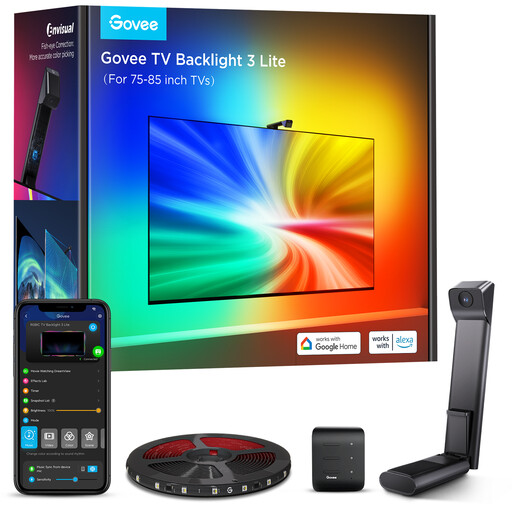
Why This Fits Their Persona: This model is specifically designed for owners of very large TVs who demand precise and immersive colour sync for movies and gaming. The combination of a camera and RGBICW technology aims for a high-end experience.
The integrated fisheye camera and its accompanying algorithm directly address the problem of inaccurate colour sync. The design, featuring a gravity-based mount for the camera, simplifies installation on ultra-thin TVs.
Precise colour detection via the camera; RGBICW technology for segmented colours and pure white; full smart home integration (Wi-Fi, app, voice control).
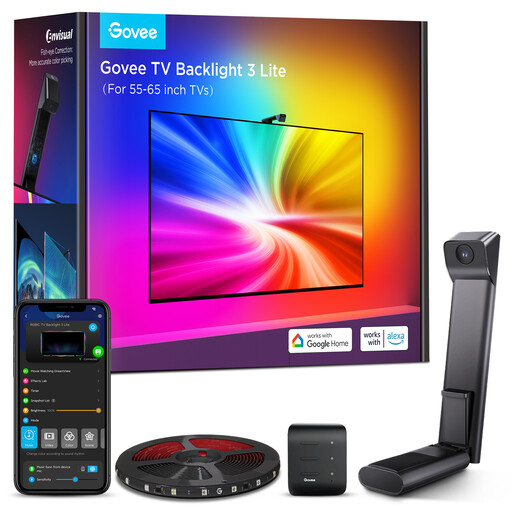
Why This Fits Their Persona: Ideal for users with TVs in the popular 55 to 65-inch size class who don't want to miss out on the advanced camera technology and smart features of the larger version.
This model offers the same technology as the 75-inch version but is optimised in length and calibration for smaller dimensions. This prevents installation issues and ensures equally precise colour reproduction.
Delivers the same advanced camera sync and RGBICW technology, perfectly tailored for the most common large TV sizes.
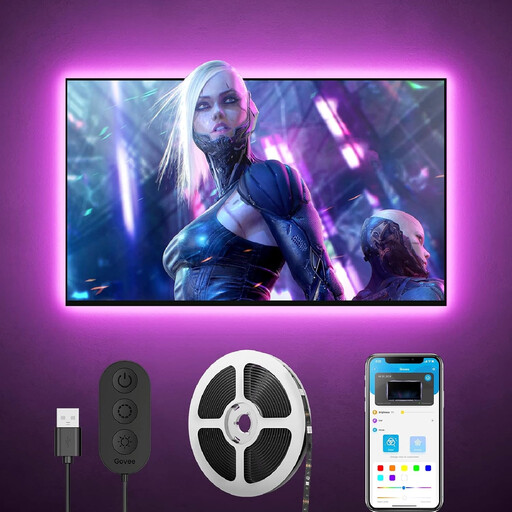
Why This Fits Their Persona: A great option for users with mid-sized TVs (46-60 inches) who want atmospheric lighting with app control and music sync but can do without the camera function.
This system doesn't promise screen-synchronised lighting, thereby sidestepping the potential for latency issues. It focuses on reliable app control and preset scenes, avoiding the pitfall of clunky operation.
Cost-effective entry point; control via the Govee Home app; music sync mode using a built-in microphone.
We have compiled a complete, up-to-date list of products that fully meet these strict selection criteria and safety regulations.
Installation is generally straightforward. First, clean the back of the TV to ensure good adhesion. Then, attach the self-adhesive LED strips along the edges. The camera is mounted centrally on the top or bottom edge of the screen; some models like the Govee H6099 use a weighted mount that rests stably on top of the TV. After connecting the cables to the control box and power supply, calibration is done via the corresponding smartphone app.
Indirect lighting behind the television can help reduce the perceived contrast between the bright screen and the dark surroundings. This effect, also known as "bias lighting," can be perceived as more comfortable by many users and may reduce the feeling of eye fatigue during long TV sessions. However, this is not a medical application but an improvement in viewing comfort.
Power consumption is generally very low. Modern LED systems are energy-efficient. For example, the manufacturer states a consumption of 5 watts for the Govee TV Backlight 3 Lite model. According to the energy label, this corresponds to class G with a consumption of 2 kWh per 1000 hours of operation. The running costs are therefore minimal, even with daily use.