
Lieferung heute & morgen

Qualitätsgarantie

Willkommens-Angebote freischalten: KOSTENLOSE Lieferung | Bis zu 80 % RABATT | Kostenlose 30-Tage-JoyPlus-Testphase
App herunterladen
A set of 2 80x80 cm pillows is practical for a double bed, guest room or as a replacement for your existing bedding. However, sleeping pillows in this size can vary considerably in terms of filling quantity, cover, washability and support. A large outer cover alone says little about the comfort you will experience when lying down.
Before buying, you should therefore look beyond a soft appearance or low price. Clear product information and care requirements that suit your everyday routine are what really matter.
A soft pillow filling can feel comfortable, but different materials sink to varying degrees. People who sleep on their side often need more volume between their head and the mattress than those who mainly sleep on their back. A very flat filling may be impractical for side sleepers, while a heavily filled pillow may feel too high for some back sleepers.
So pay attention to the filling quantity in grams, rather than relying solely on terms such as “comfortable” or “extra soft”.
For washable pillows, the specific instructions are crucial. Some models can be cleaned in a washing machine at 60 °C, while others may only be hand-washed at 40 °C. Drying is also important. Feathers and down, for example, need sufficient time to dry completely, whereas polyester fillings are often easier to care for.
Check the following before buying:
Terms such as OEKO-TEX, RDS and “hypoallergenic” relate to different aspects. OEKO-TEX may refer to tested limits for harmful substances in certain product components. RDS concerns the origin of down and feathers according to the relevant criteria of the standard. “Hypoallergenic” is not a general promise that every allergic reaction will be ruled out.
Read carefully what each statement specifically refers to and check whether it is clearly supported by the manufacturer or the product documentation.
An 80x80 cm pillow fits many classic German bedding sizes. However, its square shape places more material beneath the upper body than an oblong sleeping pillow. This can be useful for people who also like to position their pillow to the side. For targeted neck support, some people prefer smaller or longer shapes.
Also measure your existing pillowcase. A pillow with slightly different dimensions may become more compressed inside it or distribute unevenly.
When choosing a set of 2 feather pillows, pay attention to the composition. A higher proportion of feathers feels different from a mixture containing down. Feathers can provide more structure, while synthetic fillings such as polyester or microfibre are often designed to retain their shape and be easy to care for.
Filling quantity provides an objective point of comparison:
These figures do not determine comfort on their own. Fibre structure, quilting and the cover also affect how high and mouldable an 80x80 sleeping pillow is.
Cotton pillows can feel comfortable and breathable. However, a cover made from 100% cotton is not automatically easier to care for than a microfibre or polyester cover. Microfibre pillows are often smooth, lightweight and washable in certain versions. Waterproof covers often have lower washing temperatures so that the coating remains intact.
If easy cleaning is important to you, check the care instructions before placing your order. For families or frequent use, washable pillows that can be machine-washed at 60 °C may be more practical in everyday life than models requiring hand washing.
The following products differ in terms of filling, cover, washing temperature and intended use. The information is based on the respective product descriptions. For certificates and material labels, please refer to the latest manufacturer information on the product page.
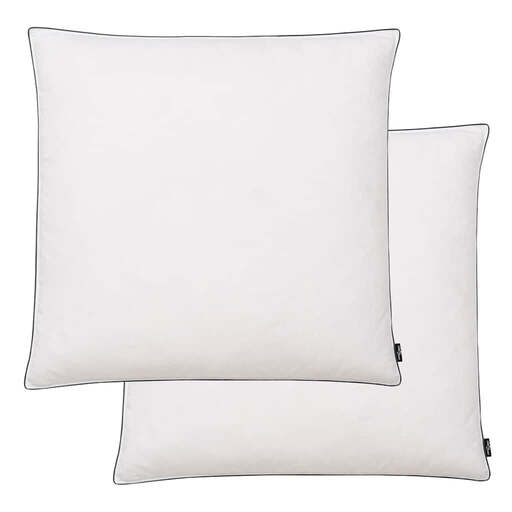
Why this product suits the profile: The set contains two white 80 x 80 cm pillows filled with duck feathers and duck down. It is suitable for shoppers looking for traditional bedding with manageable care requirements.
The product description specifies the filling materials, the total weight of approximately 1,100 g and the maximum hand-wash temperature of 40 °C. This makes it possible to assess the filling and care requirements before buying.
Two pillows, a white cover made from 100% polyester microfibre and vacuum packaging for transport.
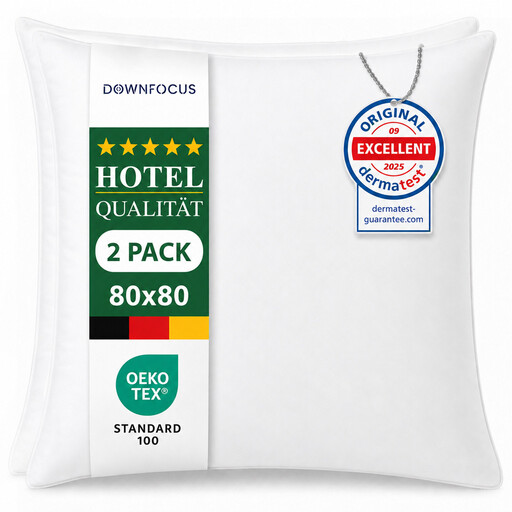
Why this product suits the profile: According to the product information, the set of 2 combines a feather filling of 800 g per pillow with a cover made from 100% cotton. OEKO-TEX and RDS labels are also specified.
The specified filling quantity and material composition provide concrete points of comparison instead of relying solely on advertising focused on a soft feel. Certificate details should be checked before buying.
Cotton cover, feather filling and information about OEKO-TEX and RDS according to the product description.
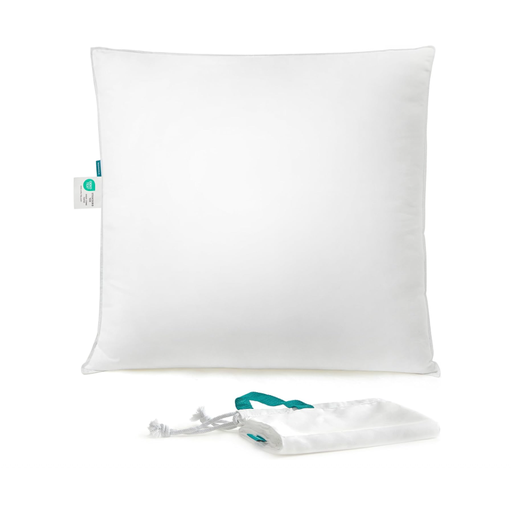
Why this product suits the profile: The 1,500 g polyester filling and softly brushed polyester cover are designed for frequent users who prefer greater filling volume and straightforward cleaning.
The product description specifies the filling quantity, washability at 60 °C and recommended air-drying method. This means important everyday features can be checked in advance.
Machine washable up to 60 °C, 1,500 g polyester filling and a storage bag included.
Regardless of the material, a pillow should be plumped up regularly and aired thoroughly. This helps the filling distribute more evenly. For vacuum-packed pillows, it is advisable to leave the pillow to rest after unpacking and gently reshape it.
Also bear the following in mind:
We have put together a complete, regularly updated list of products that fully meet these strict selection criteria and the safety regulations applicable in the EU.
This depends on the filling quantity, type of filling and your personal sleeping position. Pillows for side and back sleepers should not be selected based on size alone. Side sleepers often look for sufficient height and shape retention, while back sleepers may prefer a less heavily filled design.
There is no fixed general timeframe. Usage, soiling and the manufacturer’s care instructions are the key factors. A model that can be machine-washed at 60 °C requires different handling from a feather pillow that may only be hand-washed at 40 °C. An additional cover can reduce direct soiling.
The ongoing effort depends mainly on washability, drying and durability. Microfibre pillows that can be machine-washed may be less demanding if cleaned frequently. Feather pillows, on the other hand, require careful drying and regular plumping. So do not compare the purchase price alone; also consider the care programme, washing temperature and expected frequency of use.