
Lieferung heute & morgen

Qualitätsgarantie
App herunterladen
Kategorien
Selecting a new washing machine involves analysing technical specifications and their relevance to your household's unique needs. A capacity of 8 kg has become the standard for households of two to four people, offering an excellent balance between load size and operating costs. Key parameters like energy consumption, motor technology, and functional features are crucial in making the right decision.
Your choice of appliance should be based on an objective evaluation of its performance characteristics. The following technical aspects are vital for both functionality and long-term operating costs.
An 8 kg washing machine is designed for the laundry volume of an average household. For single or two-person households, a 6 kg washing machine can be a more efficient alternative, as it consumes less energy and water with smaller loads. The most common design is the front-loading washing machine, which is easy to load and can be integrated into a kitchen unit or installed as an under-counter appliance. A special category is the washer-dryer, which combines washing and drying functions in a single unit, making it ideal for homes with limited space.
Energy Efficiency Class A, according to the EU scale (A to G) valid since 2021, identifies the most economical appliances on the market. Low energy and water consumption reduces running costs over the appliance's entire lifespan. The spin performance, measured in revolutions per minute (rpm), determines the residual moisture in the laundry. A speed of 1400 rpm is an established standard that effectively removes water, significantly shortening the subsequent drying time, whether in a dryer or on a line.
Modern washing machines are often equipped with an inverter motor. Unlike conventional brushed motors, these operate on a brushless, magnetic system. This results in less wear and tear, greater durability, and, most importantly, reduced noise during operation. Having a quiet washing machine is a key factor, especially in open-plan living spaces or for running cycles overnight. Noise emissions are specified separately in decibels (dB) for the wash and spin cycles.
A washing machine with a steam function offers practical advantages. Steam can help with stain removal before the wash cycle or be used after the spin to reduce creasing, which minimises ironing. Other useful features include special hygiene or anti-allergy programmes that reliably eliminate germs and allergens at low temperatures, as well as quick wash cycles for lightly soiled items.
The following models have been selected based on their technical specifications and range of features.
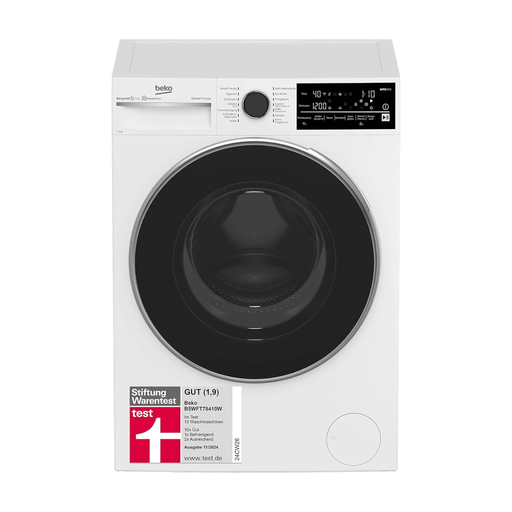
Why we recommend this product: The Beko washing machine B5WFT78410W combines an 8 kg capacity with an A-class energy efficiency rating and a 1400 rpm spin speed. The appliance received a "GOOD (1.9)" rating from Stiftung Warentest, the German consumer testing organisation, indicating solid overall performance. Its ProSmart Inverter Motor ensures quiet operation (72 dB during the spin cycle), while the SteamCure function enhances both cleaning power and fabric care.
Pros:
Who it's for: This model is ideal for households looking for a fully-featured, energy-efficient 8 kg washing machine. It's an excellent solution for users who prioritise hygiene, low noise levels, and a crease-reducing steam function.
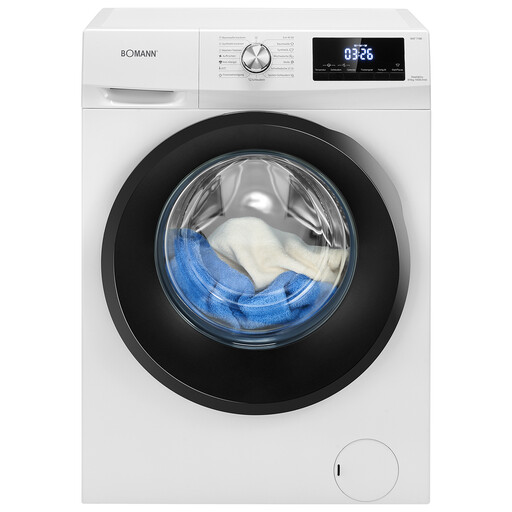
Why we recommend this product: The Bomann WAT 7186 is a washer-dryer that can wash up to 8 kg of laundry and dry up to 5 kg in a continuous cycle. This 2-in-1 solution is both space-saving and practical. Equipped with an inverter motor and a maximum spin speed of 1400 rpm, the appliance offers modern technology in a compact design.
Pros:
Who it's for: Ideal for small apartments or households without the space for two separate appliances. Users who value the convenience of a seamless wash-and-dry process will benefit from this model.
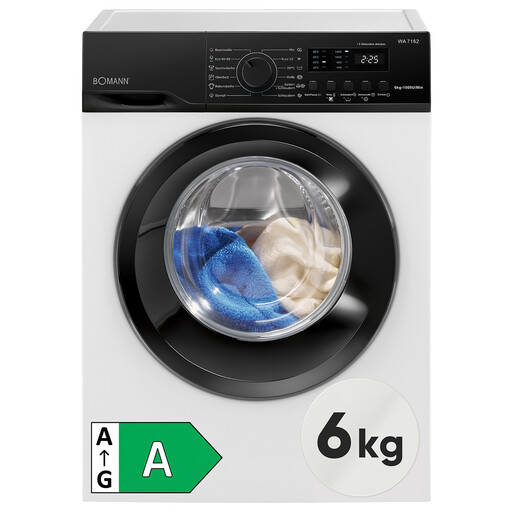
Why we recommend this product: The Bomann WA 7162 is a 6 kg washing machine with an A-class energy efficiency rating and a very low energy consumption of 37 kWh per 100 cycles. Despite its compact dimensions, it features an inverter motor. It represents an economical choice for smaller households that don't require the full capacity of an 8 kg model.
Pros:
Who it's for: This model is the right choice for singles, couples, or small families with a lower volume of laundry, who prioritise energy efficiency and compact dimensions.
The models presented here cover common user requirements. However, the market offers a wide variety of other specifications and features. For a comprehensive overview, especially regarding different models with a washing machine warranty, further research may be beneficial.
What is the advantage of an inverter motor in a washing machine? An inverter motor operates without carbon brushes, generating rotation via a variable magnetic field. This reduces mechanical friction, leading to several benefits: lower noise levels (for a quiet washing machine), less wear and tear for a longer lifespan, and improved energy efficiency, as the motor's power can be precisely adjusted to the load.
How much electricity does a Class A washing machine consume? Electricity consumption is stated on the EU energy label in kilowatt-hours (kWh) per 100 wash cycles, based on the Eco 40-60 programme. An 8 kg Class A energy efficient washing machine typically consumes between 45 and 55 kWh per 100 cycles. The exact value varies by model and is specified on its energy label.
Is a washing machine with a steam function worthwhile? A washing machine with a steam function can be a great investment if you want to save time on ironing. The steam smooths fabric fibres and reduces creasing. The function can also be used to hygienically refresh lightly worn clothes without running a full wash cycle, saving water and energy. Its usefulness ultimately depends on your personal habits and needs.