
Lieferung heute & morgen

Qualitätsgarantie

Willkommens-Angebote freischalten: KOSTENLOSE Lieferung | Bis zu 80 % RABATT | Kostenlose 30-Tage-JoyPlus-Testphase
App herunterladen
A 90 cm angled cooker hood can provide good coverage over a wide hob, while its forward-sloping design gives you more headroom. But for homeowners and keen cooks, the glass front and colour aren’t the only things that matter. Look for clear performance figures, the right installation type and a maintenance routine that’s practical for everyday use in the kitchen.
Figures such as 620 m³/h or more usually refer to a particular operating condition, often the highest setting. Lower settings are quieter and use less energy, but remove steam and odours more slowly. So check whether the hood has several speed settings, an intensive mode and clear noise-level information.
A 90 cm hood is worth considering for a wide hob, but you’ll need enough wall space and a suitable installation height. Mounting it too low can affect ease of use and safety, while positioning it too high can make it less effective at capturing cooking fumes. Always follow the manufacturer’s installation instructions and the requirements for your hob.
A recirculating and ducted cooker hood offers more flexibility. In recirculation mode, the grease filter captures grease particles, while an additional charcoal filter helps reduce odours. However, moisture stays in the room. With extraction, air is vented outside, so you’ll need a suitable duct, an external outlet and the right building conditions. This means extraction isn’t always straightforward in rented homes.
Airflow is an important comparison point for medium to large kitchens. The figure in m³/h shows how much air the hood can move per hour. A model with 620 m³/h, such as the Comfee CH90J64ET4A2B2-EU, offers several speed settings and can be turned up for more intensive cooking. Its actual performance also depends on the duct length, bends, backdraft damper and installation.
A quiet cooker hood should be pleasant to use on more than just its lowest setting. Compare the stated maximum sound pressure level, and bear in mind that ducting, distance from the wall and kitchen acoustics can all affect the noise. The Comfee hood is rated at 59 dB, while Ciarra’s 60 cm touch-control model reaches around 64 dB, according to the product information.
A Dunstabzugshaube A++ is sold with the corresponding energy efficiency rating. Even so, check the annual energy consumption in kWh/a, as the rating alone doesn’t tell you how much each use will cost. A cooker hood with an aluminium grease filter should be cleaned regularly. According to product details, some multi-layer filters are dishwasher-safe; always follow the relevant care instructions.
A touch-control cooker hood can be operated via a flush surface, without protruding rotary dials. Look for clearly marked settings, lighting that’s easy to reach and a control panel that’s simple to clean.
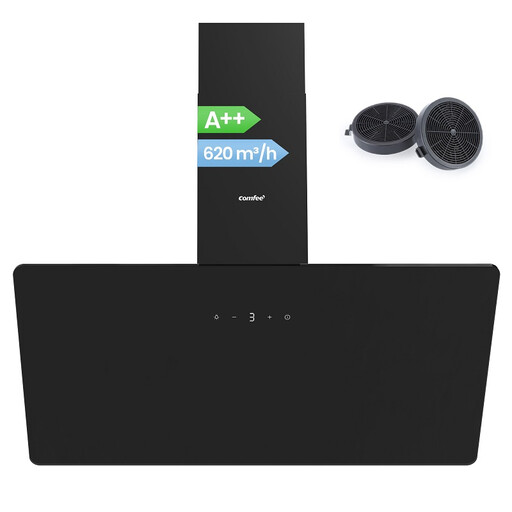
Why this product suits this profile: This 90 cm model is aimed at people with a wider hob who want a black angled cooker hood with several speed settings and flexible installation options.
The product details specify the width, 620 m³/h airflow, 59 dB noise level, four speeds, and recirculation and extraction modes. This makes it easier to compare key buying criteria in advance.
Features include an A++ energy efficiency rating, touch controls and a five-layer aluminium grease filter.
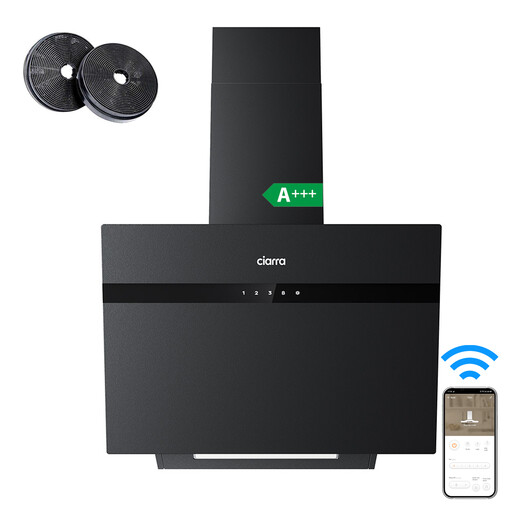
Why this product suits this profile: This model may appeal if you prefer app and Wi-Fi controls, a matt black glass front and flexible installation in a 60 cm appliance.
The product description explicitly lists recirculation and extraction modes, as well as a maximum noise level of 58 dB. Check that the 60 cm width suits your hob before buying.
Features include 650 m³/h airflow, an A+++ energy efficiency rating, SensorTouch controls and app control.
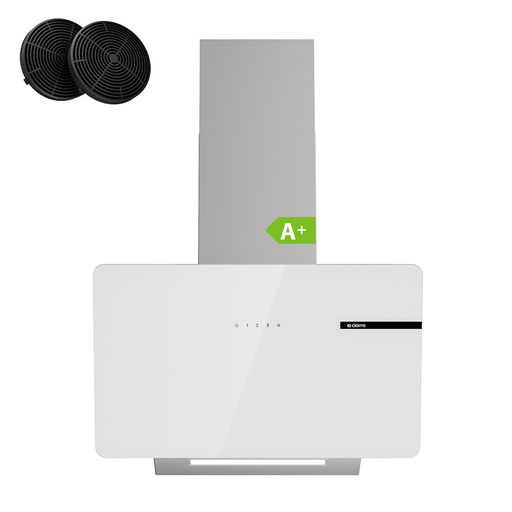
Why this product suits this profile: For smaller kitchens with a standard hob, this model offers a sloping front, touch controls and two selectable operating modes.
The product details distinguish between recirculation and extraction, and specify a washable five-layer aluminium filter. At around 64–65 dB, its stated noise level is higher than that of quieter alternatives.
Features include around 580 m³/h airflow, three speed settings, LED lighting and an A+ energy efficiency rating.
We’ve put together a complete, regularly updated list of products that meet these strict selection criteria and fully comply with the safety regulations in force in the EU.
The correct height depends on the manufacturer’s instructions, the type of hob and the installation method. Keep to the minimum clearances specified in the installation guide. Before fitting the hood, you should also check the wall, socket, extraction route and position of the hob.
Recirculation avoids the building work needed for an extraction duct, but charcoal filters need replacing regularly, depending on how often you use the hood. Extraction can carry moisture and cooking fumes outside, but requires a suitable installation. Running costs therefore depend on electricity use, filter changes and how intensively you cook.
That depends on your cooking habits. If you often fry or deep-fry food, it’s worth cleaning the filter more frequently. A dirty filter can reduce airflow and increase the need for maintenance. Before cleaning, disconnect the appliance from the mains and follow the care instructions.