
Lieferung heute & morgen

Qualitätsgarantie

Willkommens-Angebote freischalten: KOSTENLOSE Lieferung | Bis zu 80 % RABATT | Kostenlose 30-Tage-JoyPlus-Testphase
App herunterladen
A 90x200 cm slatted bed base needs to fit your bed frame, but there are other important factors to consider too, including weight capacity, the gap between the slats, overall height and how the base is secured. If you focus only on terms such as ‘7 zones’ or ‘ergonomic’, you may overlook important technical details.
Small differences in design can make a difference in everyday use, particularly with a single bed, a teenager’s bed or a bed used every night. These three common buying mistakes are especially easy to make:
A wooden slatted bed base usually consists of a frame and flexible slats, or individual slats joined together with straps. The following details are useful when assessing how well it will stand up to everyday use:
The stated maximum weight capacity is an objective way to compare products. Check whether it applies per person or to the whole sleeping area. The BeCo Superfix NV and BeCo Quick 28 are both rated for up to 130 kg per person.
Do not exceed the specified weight capacity. You should also make sure the bed frame, centre support and support rails can handle the total weight. For a 90x200 cm single bed, it’s also important that the slatted bed base sits centrally and level.
A 7-zone slatted bed base divides the sleeping area into sections with different levels of support. In practical terms, this may mean that the slats in certain areas are more flexible. According to the manufacturer’s product description, the BeCo Superfix NV has a 7-zone design with softly sprung zones.
An adjustable firmness level is often achieved using double slats and sliders in the central section. The vidaXL model is listed as having four adjustable double slats in the middle zone. This lets you tailor the springiness, but it does not replace a suitable mattress and is not the same as electric adjustment.
By contrast, a non-adjustable slatted bed base provides consistent support across the sleeping area. This design can be a good choice if you don’t need to adjust the head or foot section.
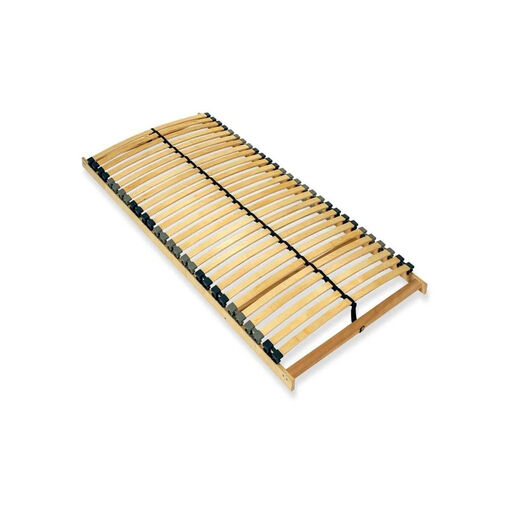
Why this product suits these needs: The beech frame, 28 birch sprung slats and overall height of around 8 cm make this a well-defined construction for a 90x200 cm bed used every night.
The weight capacity is clearly stated as up to 130 kg per person. It’s also a framed slatted bed base, not a roll-up version that needs to be secured separately.
28 slats, a 7-zone design, a central strap and suitability for all mattress types, according to the product information.
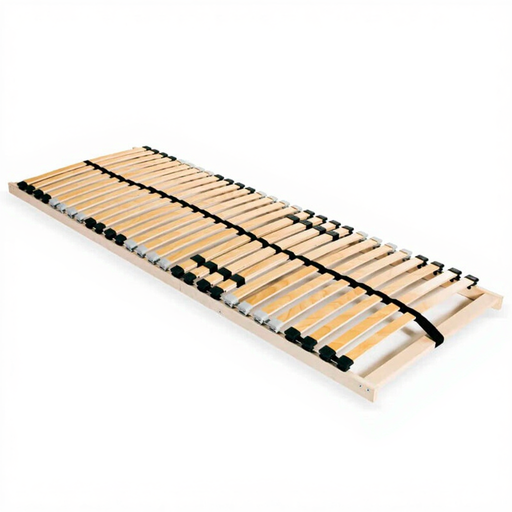
Why this product suits these needs: If you’re looking specifically for a slatted bed base with 28 slats and an adjustable centre zone, this model combines a sturdy beech frame with birch slats.
The adjustment feature is clearly described: it uses four double slats. The slats are also held in the frame by SBS caps.
7 zones, 28 birch slats and adjustable double slats in the central section.
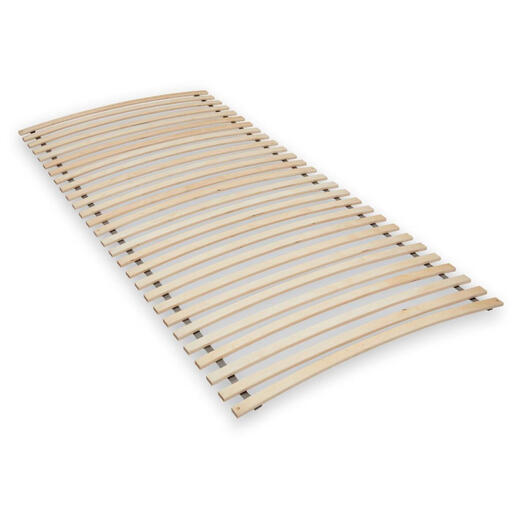
Why this product suits these needs: The pre-assembled roll-up slatted bed base is easy to transport and takes up little space. It’s suitable for bed frames with continuous side rails.
It’s explicitly described as a roll-up slatted bed base without a frame. The pre-drilled ends indicate that it needs to be screwed to the side rails.
28 birch plywood slats, 4 cm overall height, supplied pre-assembled and rolls up for space-saving storage.
We’ve put together a complete, regularly updated list of products that meet these strict selection criteria and fully comply with the safety regulations in force in the EU.
Before placing the mattress on the bed, set the slatted bed base on a flat, stable surface and check all the connections. Assemble a framed slatted bed base according to the instructions. Unroll a roll-up slatted bed base fully, make sure it lies flat and secure it to the continuous side rails with screws.
Also check:
A slatted bed base normally doesn’t use energy while in use. Its lifespan depends on the material, how often it’s used, the weight it supports and how well it’s cared for. Regular visual checks and tightening any loose connections can help keep it safe to use. If you notice cracks or deformed components, stop using the slatted bed base.
Not necessarily. The measurement usually refers to the nominal size of the sleeping area. What matters is the bed frame’s actual internal dimensions, the position of the support rails and whether there’s a centre support. Before buying, compare these measurements with the product details.
It depends on the information provided by the manufacturer. The models featured here are described as suitable for all mattress types. Even so, you should check the mattress height, the gap between the slats and ventilation requirements. A 7-zone design doesn’t automatically mean that every mattress will get the right support.
There’s no reliable way to give a single lifespan that applies to every slatted bed base. It depends on factors such as weight capacity, daily use, room conditions, material quality and the bed frame. Check the wooden frame, sprung slats and fixings regularly. If any part is damaged, replace it or replace the entire slatted bed base.