
Lieferung heute & morgen

Qualitätsgarantie

Willkommens-Angebote freischalten: KOSTENLOSE Lieferung | Bis zu 80 % RABATT | Kostenlose 30-Tage-JoyPlus-Testphase
App herunterladen
A 9L dual-zone air fryer is designed for households that want to prepare side dishes and main courses at the same time. Two separate cooking chambers allow you to use different temperatures and cooking times without flavours mixing. This is practical for families, couples and busy home cooks – provided the technical specifications genuinely suit your everyday cooking needs.
However, not every air fryer with two baskets offers the same range of features. Before buying, it is worth checking the capacity, controls, cleaning requirements and safety clearances carefully.
A 9-litre air fryer often has two baskets of around 4.5 litres each. This is not the same as having a single 9-litre cooking chamber. Large or elongated ingredients may fit less easily into two narrower baskets. For chips, vegetables, chicken wings or smaller pieces of meat, however, the split design is usually practical.
The key factor is therefore not just the total capacity, but also the size and shape of each individual basket. If you often prepare whole pieces of food, baking tins or larger casseroles, check the internal dimensions and included accessories.
When frying with less fat, hot air circulates around the food. Depending on the ingredient, oil may not be essential, but it can affect browning when cooking potatoes or breaded foods. Overfilled baskets restrict air circulation and can lead to uneven results.
Look for features such as a shake or turn reminder, a preheating function and clear temperature controls. Automatic programmes are helpful, but they do not replace adjustments based on the quantity, thickness and starting temperature of the food.
When an appliance is advertised as a dishwasher-safe air fryer, this usually refers to the baskets, inserts or grill plates – not the main unit. The housing must not be immersed in water. Before buying, make sure you know which components are genuinely dishwasher-safe and whether the non-stick coating may only be cleaned with mild detergents.
A 2-chamber air fryer is particularly useful when you want to cook different foods at the same time. Check whether the temperature and cooking time can be set separately for both zones. Only then can you, for example, cook vegetables at a different temperature from potato products.
An air fryer with Sync Finish balances different cooking times so that both baskets are ready at roughly the same time. This is convenient for shared meals, provided the individual settings can be adjusted flexibly enough. Match Cook, on the other hand, applies the same settings to both zones and is mainly suitable for identical portions.
The wattage alone does not describe an appliance’s overall performance. It does, however, indicate its electrical power rating. Models with two baskets often require more power than compact single-basket appliances. The Plodon Dual-Zone Air Fryer, for example, is specified at 2600 to 3100 watts, while the Bear QZG-F24F1 is rated at 2400 watts.
You should also consider the temperature range and timer. A range of around 80 to 200°C covers typical uses such as reheating, baking, cooking and air frying. For special recipes, manual settings are more important than having the longest possible list of automatic programmes.
A touchscreen makes it easier to select programmes and settings, but may be less convenient than dials when your fingers are greasy or wet. Look for clear displays, an intuitive menu system and audible signals.
For safe operation, the appliance needs a stable, heat-resistant surface. The ventilation openings must not be covered. Several models recommend leaving at least 10 cm of clearance at the sides and rear. The outer surfaces and escaping steam can become hot during operation.

Why this product suits the profile: This model combines two separate 4.5-litre chambers with ten preset programmes and digital touch controls. It is ideal for households that want to prepare a range of everyday dishes with minimal effort.
The separate chambers prevent different foods from mixing. The capacity is clearly split between two baskets, making it easier to understand than an unclear total-capacity claim.
9-litre total capacity, ten programmes, separate zones and removable non-stick-coated baskets.
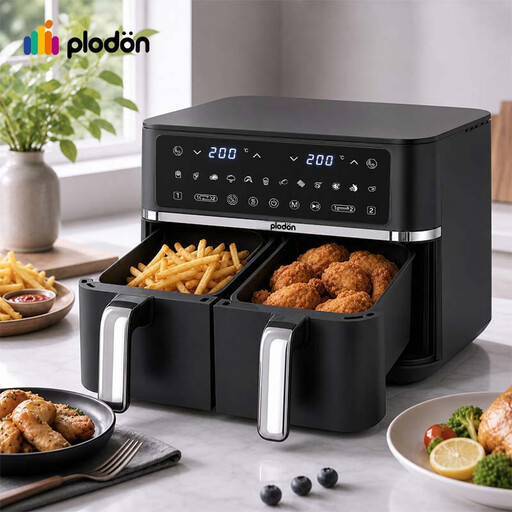
Why this product suits the profile: Two independently controllable 4.5-litre baskets, 12 programmes, plus Match Cook and Sync Finish, provide plenty of precise settings for family meals and different portion sizes.
The product specifications clearly state the basket configuration, independent temperature control and synchronisation functions. A shake reminder also indicates when food should be turned during cooking.
2600–3100 watts, 12 preset programmes, preheating, keep-warm function and parts described as dishwasher-safe.
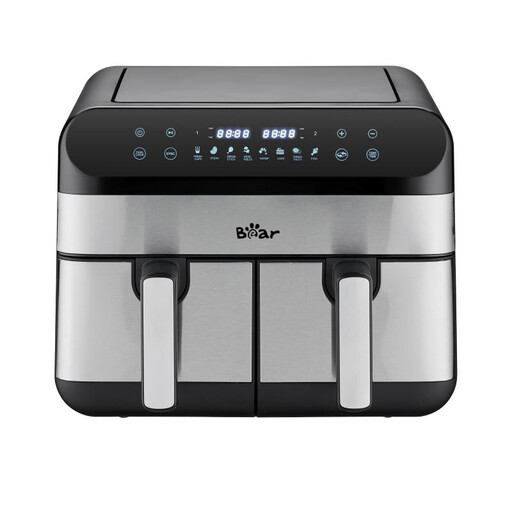
Why this product suits the profile: This appliance is designed for regular use with two separately adjustable baskets. Digital touchscreen controls and eight programmes cover popular foods such as chips, chicken, steak and vegetables.
The instructions specifically highlight keeping the ventilation openings clear, leaving at least 10 cm of clearance and not putting oil in the baskets. This helps prevent common operating mistakes with appliances of this type.
9.0-litre capacity, 2400 watts, independent temperature control and removable parts described as dishwasher-safe.
We have put together a complete, regularly updated list of products that fully meet these strict selection criteria and the safety regulations applicable in the EU.
That depends on the portion size and recipe. Two baskets of around 4.5 litres each are suitable for several side dishes, snacks or smaller main courses. Very large ingredients may be less flexible to position because of the divided design. For families, an air fryer is particularly practical when two different foods need to be prepared at the same time.
Match Cook applies the same time and temperature settings to both baskets. Sync Finish, by contrast, coordinates different settings so that both zones are ready at approximately the same time. Match Cook is suited to identical portions, while Sync Finish offers greater flexibility when preparing a main course and a side dish.
Electricity consumption depends on the power rating, running time, preheating and how fully the appliance is loaded. An appliance rated at 2600 watts theoretically uses 2.6 kilowatt-hours per hour of operation at full power; in practice, the heating element does not necessarily run continuously at full power. For a realistic estimate, multiply the consumption by your personal electricity tariff and take the actual cooking time into account.