
Lieferung heute & morgen

Qualitätsgarantie

Willkommens-Angebote freischalten: KOSTENLOSE Lieferung | Bis zu 80 % RABATT | Kostenlose 30-Tage-JoyPlus-Testphase
App herunterladen
Unsorted letters, loose paperwork and overflowing piles of paper take up space and make it harder to find what you need quickly. An A4 document desk organiser can help – provided its design and capacity suit your day-to-day needs. There are clear differences between a simple letter tray, a vertical multi-tier tray and a small office organiser.
The statement ‘suitable for A4’ does not automatically mean that wide ring binders, clear pockets or folders will fit comfortably. A4 paper measures 21 × 29,7 cm. For a practical paper tray, you should also check the internal width, insertion height and depth. With a narrow document holder, the paper may fit while labelled folders catch on the sides.
A large number of tiers may initially seem like a space-saving solution. However, if the compartments are only partly used, a tall file tray can take up unnecessary vertical space. Three tiers are often enough for daily post and documents in progress. If you need to separate several projects, study materials or departments, four or five compartments may be more suitable.
Thin constructions can bend under the weight of files or move when the trays are pulled out. Look for reinforced supports, non-slip feet and a level surface. With metal models, you should also avoid moisture to prevent the surface from rusting. Rubber feet protect your desk, but they cannot compensate for insufficient stability when the organiser is overloaded.
First, compare the footprint with the space available beside your monitor, keyboard and lamp. An organiser measuring around 35 cm long and 29 cm wide requires more depth than a slim letter tray. Its height determines whether the model will fit beneath a shelf or wall cabinet.
This classification can help you choose:
Metal mesh provides a clear view of the contents and can be cleaned with a dry cloth. A powder-coated finish can protect the surface against normal signs of use and oxidation, but it is not a reason to expose the organiser to moisture permanently. Wooden models often blend more discreetly into living spaces. With these, you should check the stated surface treatment and maximum load capacity.
Also important are rounded edges, neatly finished joints and non-slip feet. With products that are screwed together, all screws must be tightened securely. A desk tray with pull-out compartments should move smoothly without causing the entire construction to tip.
Open trays make it easy to see what is inside at a glance. Pull-out compartments provide easier access to documents stored further back. Check whether handles are included and whether the tray remains easy to slide when fully loaded. If you only need somewhere to place documents, pull-out compartments may not be necessary, allowing you to save space and money with a simpler letter tray.
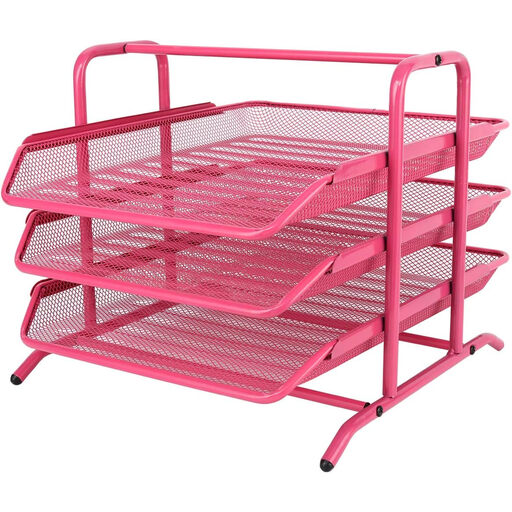
Why this product suits this profile: Three pull-out compartments cover the basic organisation of A4 documents, letters and office supplies. Measuring 35,5 × 29,5 × 26 cm, it remains relatively compact in height.
The number of tiers is clearly stated. The open mesh design makes it easier to check the contents at a glance, rather than letting paperwork disappear into closed compartments.
Three pull-out trays, metal construction, powder coating and four non-slip rubber feet.
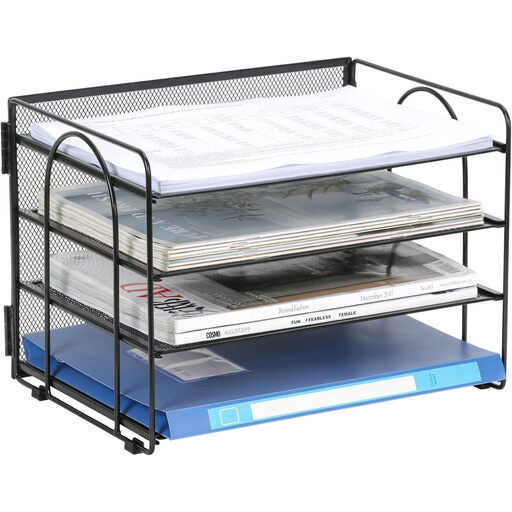
Why this product suits this profile: The four tiers make use of vertical space and provide clear separation for files, post, folders and magazines. Its stated weight of 1,46 kg helps to create a stable construction.
L-shaped reinforcements at the back are designed to distribute the load. The construction slots together without tools.
Four A4 tiers, metal mesh, anti-slip feet and a height of 23,5 cm.
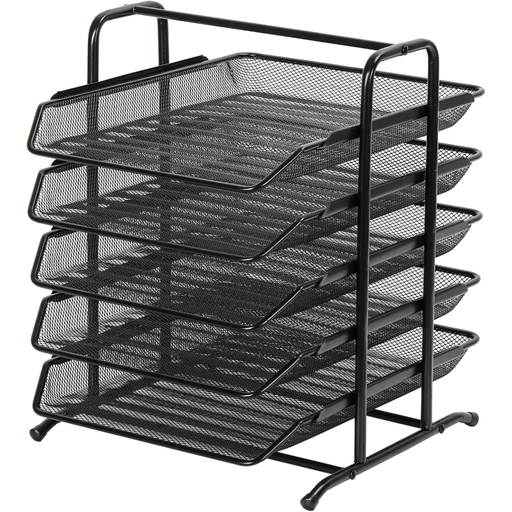
Why this product suits this profile: Five pull-out trays are suitable for users managing several tasks at once, whether in the office, while working from home or when dealing with extensive study materials.
The number of compartments is designed to allow separate filing by project or processing status. The rubber feet are intended to reduce slipping and scratches on the work surface.
Five pull-out trays, A4 compatibility, open mesh surfaces and external dimensions of 35,5 × 29,5 × 37,5 cm.
We have put together a complete, regularly updated list of products that fully meet these strict selection criteria and the safety regulations applicable in the EU.
Clear labelling prevents incoming and outgoing post from getting mixed up. Useful categories include ‘New’, ‘In progress’, ‘Awaiting response’ and ‘Completed’. Place documents you use frequently in the top or middle tray. Paperwork you rarely need should be stored in a closed archive, so that your desk tray does not remain permanently overloaded.
With an organiser featuring pull-out trays, you should avoid overfilling the compartments. Place the model on a level surface and check all connections after assembly. Metal surfaces can generally be cleaned with a soft, dry cloth. Aggressive cleaning products and excessive moisture may damage the surface.
That depends on the internal width and the design. Individual A4 sheets will usually fit without any problems. Ring binders, filled folders and clear pockets require additional space. Before buying, check the internal dimensions rather than just the product’s external measurements.
One to three compartments are enough for occasional post. In a home office or when managing several projects, four tiers provide a clearer overview. Five compartments are particularly worthwhile if you regularly separate documents by responsibility, priority or processing status.
Avoid overloading it continuously and place the organiser securely on a stable surface. Metal models should be kept dry. If the pull-out trays become difficult to move, careful adjustment in accordance with the manufacturer’s instructions may be necessary. Regularly emptying and wiping the organiser prevents dust from putting strain on the runners or surface.