
Lieferung heute & morgen

Qualitätsgarantie

Willkommens-Angebote freischalten: KOSTENLOSE Lieferung | Bis zu 80 % RABATT | Kostenlose 30-Tage-JoyPlus-Testphase
App herunterladen
An A4 document organiser should keep paperwork neatly sorted, easily accessible and take up as little desk space as possible. In practice, unclear dimensions, unsuitable mounting or overestimating the load capacity often lead to disappointing purchases. This applies just as much to an A4 paper tray in a home office as to a filing solution in a commercial office.
The Joybuy Product Recommendation Officer filters the most important product details and explains what to look out for before you buy.
The term ‘A4-compatible’ does not automatically mean that wide folders, ring binders or plastic pockets will fit comfortably. An A4 sheet measures 21.0 × 29.7 cm. For an office document organiser, you should also check the internal width and the height of each compartment.
With a wall-mounted document organiser, depth can also be crucial. A shallow compartment is suitable for loose paperwork and letters, while folders or bound files require more room.
A multi-tier organiser provides several levels, but it is not automatically suitable for every workspace. If you are choosing a letter tray with many compartments, decide in advance which categories you need, for example:
Without clear categorisation, the compartments can quickly become full, even if the organiser looks tidy from the outside.
A wall-mounted organiser saves desk space, but it must be suitable for the wall surface. The screws supplied are not equally suitable for every type of wall. Plasterboard, solid brick and concrete may require different wall plugs and anchors.
Before mounting, you should therefore check:
For loose A4 documents, an internal width just above 21 cm is sufficient. Folders, magazines and plastic pockets benefit from a little extra room. A file organiser requires more space than a simple paper tray.
With vertical models, you should also consider the compartment height. Several low levels are suitable for letters and individual documents. Taller compartments are more practical if you want to sort files or larger sets of paperwork.
Metal models, such as a metal letter tray, are often available with a powder-coated finish. This surface can make cleaning easier and provides a protective layer against everyday wear. Even so, moisture should not be left on the surface for prolonged periods.
Look for smoothly finished edges, sturdy connections and non-slip feet. On a desk organiser, rubber feet protect the work surface and reduce movement when removing documents.
Measure the available space before you buy. A vertical desk organiser makes use of height, but needs sufficient clearance from a monitor, shelving or the wall. With a mobile filing cabinet, consider its width, depth and the clearance required for drawers and castors.
Load ratings are only meaningful when they specify whether they apply to an individual compartment or the entire construction. If no specific figures are provided, avoid storing heavy files permanently and do not overfill the organiser.
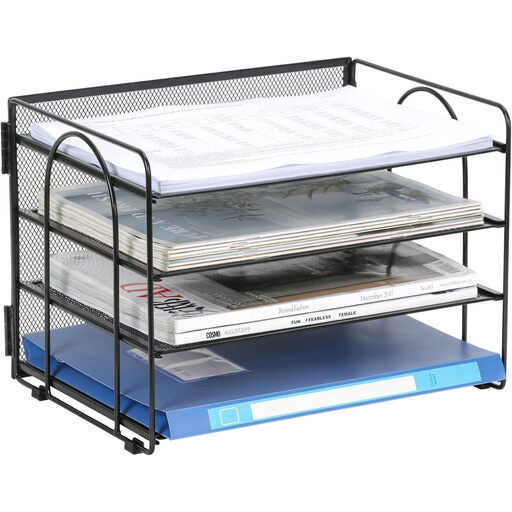
Why this product suits this profile: The four tiers provide a straightforward structure for letters, A4 paper and frequently used documents on your desk.
The product details specify dimensions of 33.5 × 23.5 × 23.5 cm and four non-slip rubber feet. This makes it easier to plan the required footprint in advance.
Powder-coated metal construction, tool-free assembly and a vertical design for your desk.
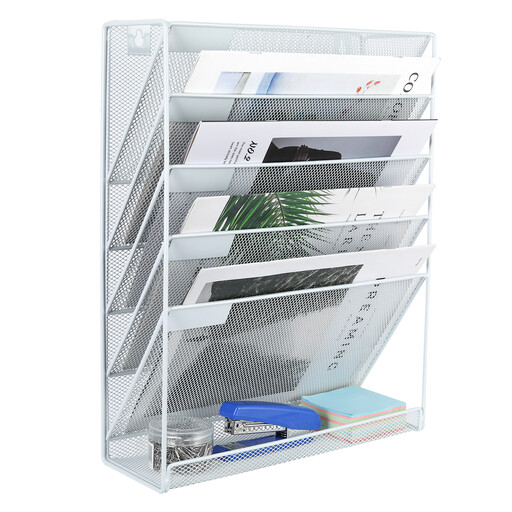
Why this product suits this profile: Six compartments and integrated labelling areas help you organise paperwork clearly in a home office or workplace.
The dimensions of 32.5 × 10.5 × 40.5 cm, internal width of 31.5 cm and compartment height of 5.5 cm are clearly specified. This makes it easier to compare the organiser with your documents.
Designed for wall-mounted or freestanding use, with powder-coated metal and six label areas.
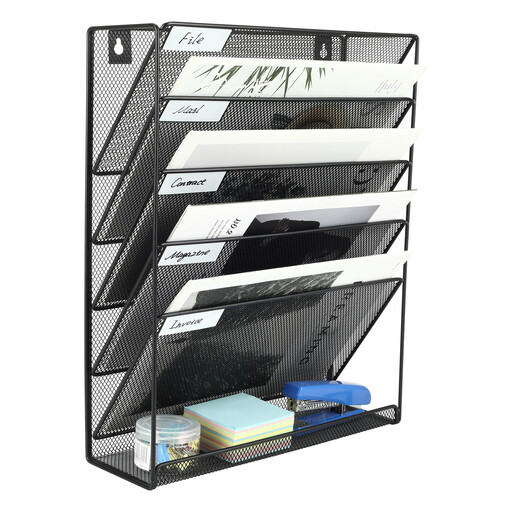
Why this product suits this profile: The vertical design is ideal for workspaces where you want to keep the desk clear while storing several document categories side by side.
The product specifically recommends using suitable wall anchors for the particular wall surface. This helps address a common planning mistake when choosing a wall-mounted organiser.
Six tiers, a 31.5 cm internal width and wall or door mounting for post, files and magazines.
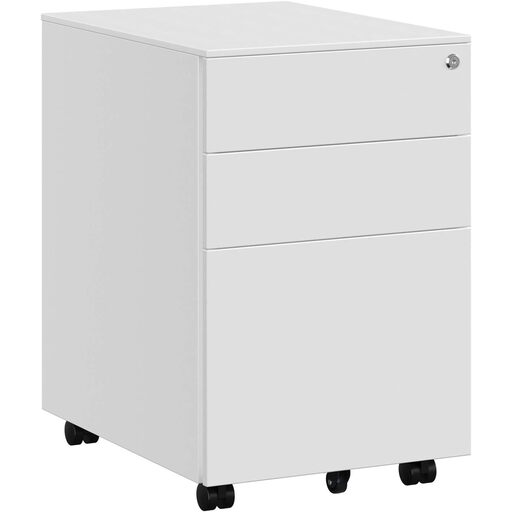
Why this product suits this profile: A mobile filing cabinet with lockable drawers is suitable for users who do not want to leave A4 documents openly stored on their desk.
The steel construction, five castors and stated load ratings of up to 15 kg per upper drawer and 20 kg for the bottom drawer provide clear guidance.
Three lockable drawers, full-extension runners and compatibility with A4, Legal and Letter documents.
We have put together a complete, regularly updated list of products that fully meet these strict selection criteria and the safety regulations applicable in the EU.
An A4 document organiser stays tidier when you avoid filling it to the brim. Regularly remove older paperwork and use labels that remain clear even when projects change.
A soft, dry cloth is usually all you need for metal organisers. For heavier soiling, you can use a slightly damp cloth. The surface should then be left dry. Check the screws and wall plugs on wall-mounted models at regular intervals. With mobile filing cabinets, the castors should move freely and the drawers should not be loaded beyond the stated capacity.
A vertical A4 paper tray with several tiers makes use of the available height rather than the entire desk surface. For a small number of categories, a four-compartment model is sufficient. Before buying, measure the external width and the space needed to access it.
That depends on the material, construction, fixings and load. A wall-mounted organiser can free up desk space, but it requires a suitable wall surface and correctly installed wall plugs. A desk organiser is easier to reposition, but it does require space.
Open letter trays are not suitable for confidential documents. Lockable drawers or a suitable filing cabinet are a better choice for this type of paperwork. You should also consider access rights in the office and dispose of documents properly once the retention period has expired.