
Lieferung heute & morgen

Qualitätsgarantie

Willkommens-Angebote freischalten: KOSTENLOSE Lieferung | Bis zu 80 % RABATT | Kostenlose 30-Tage-JoyPlus-Testphase
App herunterladen
An A4 wall file for documents can free up desk space and keep letters, files or magazines neatly accessible. However, not every organiser suits every location. Shoppers often decide based on the number of compartments or product images alone, overlooking installation, internal dimensions and weight capacity.
This buying guide from the Joybuy Product Recommendation Officer sets out the most important selection criteria and shows which design works best for different usage scenarios.
A multi-tiered organiser with lots of levels can look space-saving at first glance. However, with very shallow compartments, you may only be able to fit individual letters or thin documents. For ring binders, bulky project files or A4 suspension files, a classic wall file is usually not deep enough.
So, check the following:
A single sheet of A4 paper measures 210 × 297 mm. An A4 letter tray should offer a little extra room on the open side so that documents can be removed easily. With ring binders, clear plastic sleeves or brochures, the actual space required can be significantly larger.
Particularly with a wall-mounted document holder that has narrow compartments, you should compare the stated internal dimensions with your documents. A compartment with an internal width of around 31.5 cm can be suitable for loose A4 sheets and magazines, but it is not automatically designed for wide binders.
Screws supplied with the product do not necessarily replace the correct wall plugs. Plasterboard, concrete, brick and wood all require different fixing solutions. A fully loaded wall-mounted file holder for documents creates greater tensile and leverage forces than a single organiser with just a few letters.
Before buying and installing, you should therefore:
A metal wall file is often made from steel or a similar metal construction. According to product specifications, the models presented here feature a powder coating. This can make cleaning easier and protect the surface from oxidation during everyday use. However, it is not a reason to expose the organiser to high levels of moisture permanently.
Also look out for:
A mesh organiser design allows you to see the contents and looks comparatively lightweight. For frequent access, an open structure can be more practical than a closed box.
For a single landscape-format organiser, dimensions of 35 × 9 × 21.5 cm are given, for example. Such a design is suitable for incoming post, magazines or a current project. For multiple categories, models with three, five, six, eight or ten tiers are available.
A wall-mounted magazine holder solution with several compartments is useful if you want to sort documents by status, for instance:
Label fields can help you maintain that order over the long term. Without a clear sorting system, even a large wall organiser can quickly become a collection of unsorted papers.
Wall mounting saves floor space, but requires a suitable wall and secure fixings. An A4 desktop organiser, on the other hand, is easier to move and is ideal for rented flats, student workstations or changing projects.
This breakdown can help you decide:
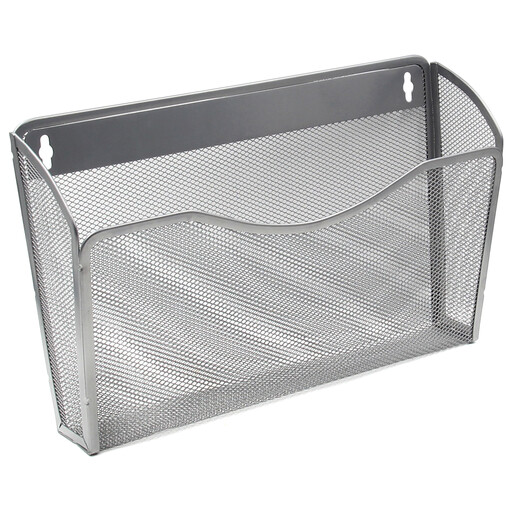
Why this product suits the profile: The single landscape-format compartment is ideal for incoming letters, magazines or current documents, and takes up little space at 35 × 9 × 21.5 cm.
The clearly limited capacity prevents you from buying lots of compartments when you only need one defined storage spot.
Metal construction, powder coating and supplied mounting screws; can be installed individually or in groups.
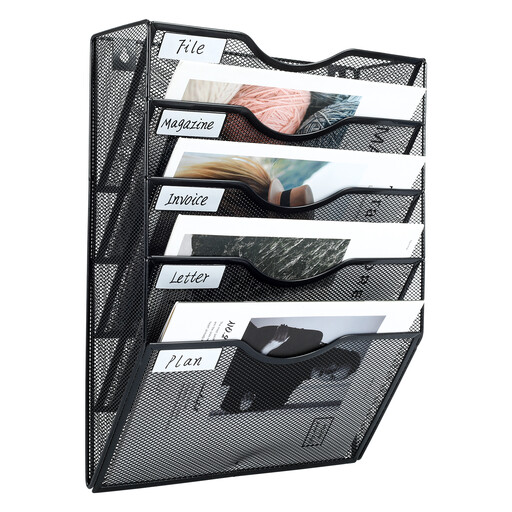
Why this product suits the profile: Five tiers with label fields support a fixed sorting system in the office, home office or entrance area.
The stated internal width of 31.5 cm and the label fields make its suitability for typical A4 documents clearer.
Five compartments, metal frame, powder coating, plus screws and adhesive labels included.
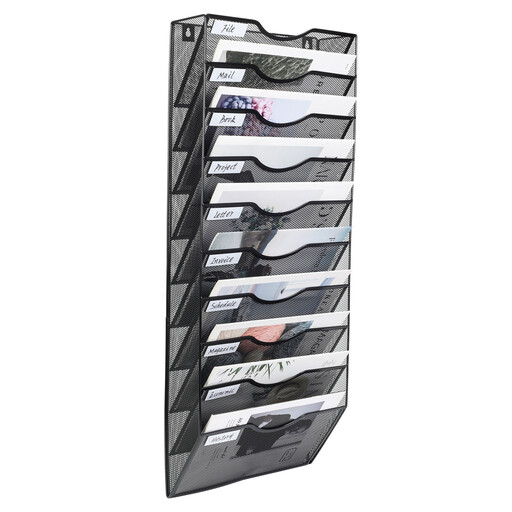
Why this product suits the profile: Ten vertical compartments are ideal for many separate tasks, for example in businesses, schools or heavily used home offices.
The ten clearly separated tiers reduce the mixing of different document groups; wall mounting uses vertical space rather than extra floor area.
81.5 cm height, ten compartments with a stated internal width of 31.5 cm and label fields.
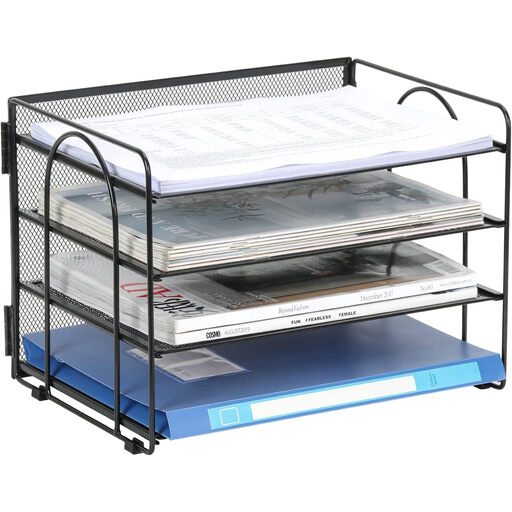
Why this product suits the profile: The freestanding design with four tiers is suitable for desks where drilling is not possible or frequent repositioning is needed.
Four non-slip rubber feet reduce sliding on the desk; the design requires no wall plugs.
Four A4 tiers, 33.5 × 23.5 × 23.5 cm, L-shaped reinforcements and tool-free assembly.
We have put together a complete, regularly updated list of products that fully meet these strict selection criteria and the safety regulations in force in the EU.
Mount the A4 wall file for documents on a load-bearing surface and use suitable wall anchors if necessary. Distribute heavy documents evenly across the compartments. The stated weight capacity of each product must not be exceeded.
For cleaning, a soft, dry cloth is usually sufficient. For heavier soiling, a slightly damp cloth can be used. Abrasive cleaners, prolonged moisture and harsh cleaning agents can damage the powder coating. Check screws and wall plugs regularly, especially if the organiser is used daily.
For incoming post, a single landscape-format organiser is often sufficient. If letters need to be sorted by processing status or recipient, a model with three to five compartments is more practical.
This is generally possible, but depends on the weight, fixing points and wall construction. Use cavity wall anchors suitable for plasterboard and only load the organiser after the fixings have been securely checked.
A general lifespan cannot be given. It depends on the material, installation, load, moisture and frequency of use. A correctly fixed metal organiser with evenly distributed documents and dry care can be designed for the intended office use.