
Lieferung heute & morgen

Qualitätsgarantie

Willkommens-Angebote freischalten: KOSTENLOSE Lieferung | Bis zu 80 % RABATT | Kostenlose 30-Tage-JoyPlus-Testphase
App herunterladen
An A5 lined notebook fits into most bags and offers plenty of space for notes, journaling, to-do lists or sketches. Yet models differ significantly in paper weight, binding and features. A decorative cover alone doesn't tell you whether a notebook will hold up in a school rucksack, an office or as a practical A5 diary.
With notebooks, "96 sheets" usually means 96 leaves, or 192 writable pages. An offer stating "96 pages" would be noticeably thinner. So before you buy, always check whether the specification refers to sheets or pages.
A paper weight of 100 g/m² can provide a solid base for many writing instruments. However, it's no guarantee that every ink will stay completely free of show-through. Fountain pens, gel pens and markers all behave differently. For everyday notes, 80 to 90 g/m² is often sufficient; if you use heavier inks, you can look specifically for 100 g/m² or more.
An A5 hardcover notebook protects the pages better inside a bag and provides a stable writing surface. A softcover is usually more flexible and lighter. A spiral binding can lie flat, but takes up more space at the side and may warp under rough handling. The right choice therefore depends on how you'll use it, not just on how it looks.
The A5 format measures approximately 14.8 × 21 cm. It's large enough for meeting notes and study plans, yet still handy for a rucksack or briefcase. With a notebook for school and office, you should also consider the page count and weight. A bulkier model can hold more content, but also takes up more space.
The figure g/m² describes the paper's grammage. An 90 g/m² paper is often lighter, while 100 g/m² paper can feel firmer to the touch. For a classic lined notebook, the line spacing should suit your handwriting. Narrow lines work well for compact notes, while wider lines can feel more comfortable for free writing.
Also check:
A notebook with an elastic closure stays shut during transport. A notebook with a bookmark gives you quick access to your current page. A pen loop stops you from having to hunt for a writing tool separately. These features are practical, but they don't automatically improve paper quality. So treat them as a bonus, not the main criterion.
The models below differ in volume, cover and binding. The details are based on their respective product descriptions.
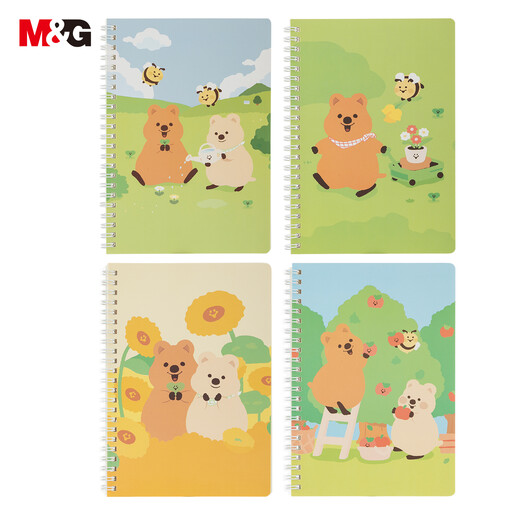
Why does this model fit? Four separate notebooks make it easy to keep subjects, projects or personal notes organised. The spiral binding is designed for frequent page turning and flat writing.
The product description states the pack contents, the A5 size and 60 sheets per notebook. This lets you assess the actual delivery before purchase.
Four notebooks, lined pages and spiral binding; suitable for school, office and separate topic areas.
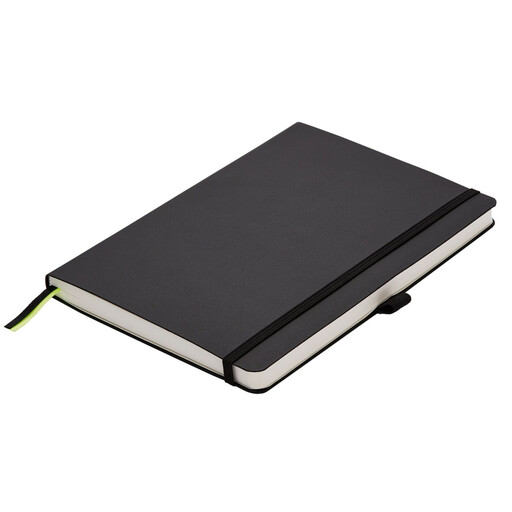
Why does this model fit? With 192 pages, 90 g/m² ivory paper, two ribbon bookmarks, a pen loop and an elastic closure, it's ideal for extensive note-taking at university or work.
The product data lists page count, paper weight and features separately. This means a fully equipped notebook isn't judged solely by its cover.
192 pages, two ribbon bookmarks, back pocket, elastic closure and pen loop; softcover for flexible transport.
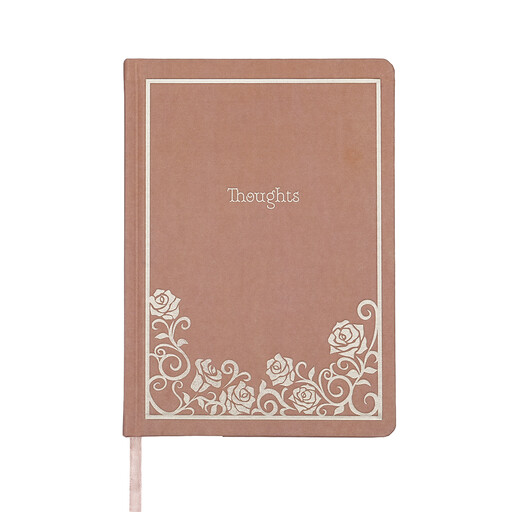
Why does this model fit? The fabric hardcover with a floral design is aimed at anyone looking for an A5 journal for daily writing or a gift for a stationery lover.
The description notes 96 sheets (192 pages), 100 g/m² paper, plus a bookmark and elastic closure. The decorative design therefore doesn't replace the technical specifications.
A5 hardcover, 100 g/m² paper, 192 pages and floral fabric design with finishing techniques as per the product description.
In the full range you'll find various formats, bindings and features for school, university, office and everyday life.
The lifespan of a high-quality notebook depends heavily on how it's transported and stored. A hardcover should not be exposed to prolonged moisture or direct sunlight. Spilled liquids can damage the paper, glue and cover. For coated covers, a slightly damp, soft cloth is sufficient for cleaning; harsh cleaning agents are not recommended.
With spiral-bound models, avoid bending the cover back too far. Elastic bands and ribbon bookmarks should be kept away from children under three years old, as small parts can pose a choking hazard. The respective safety instructions for each product remain the definitive guide.
For ballpoint pens and pencils, 80 to 90 g/m² is often sufficient. If you use gel pens or fountain pens, you may prefer a model with 100 g/m². However, you should still consider the specific suitability of the paper for your writing instrument.
A hardcover offers more stability and protects the pages during daily transport. A softcover is more flexible and often lighter. For frequent use on the go, a hardcover can make sense; for light bags or changing storage spots, a softcover is more practical.
"96 sheets" in the product descriptions mentioned means 96 leaves, which equates to around 192 pages if both sides are used. Before buying, always check whether the seller explicitly means sheets or pages.